49 works in this view — arrow keys or swipe to move between them.
Dance in Art
Nocturne
Fedorovitch, Sophie
- Collection:
- Costume design
- Source:
- Victoria and Albert Museum
- Rights:
- Rights vary by item — check the source record before reusing this image. Source record ↗
- Recorded as:
- V&A — check rights per item
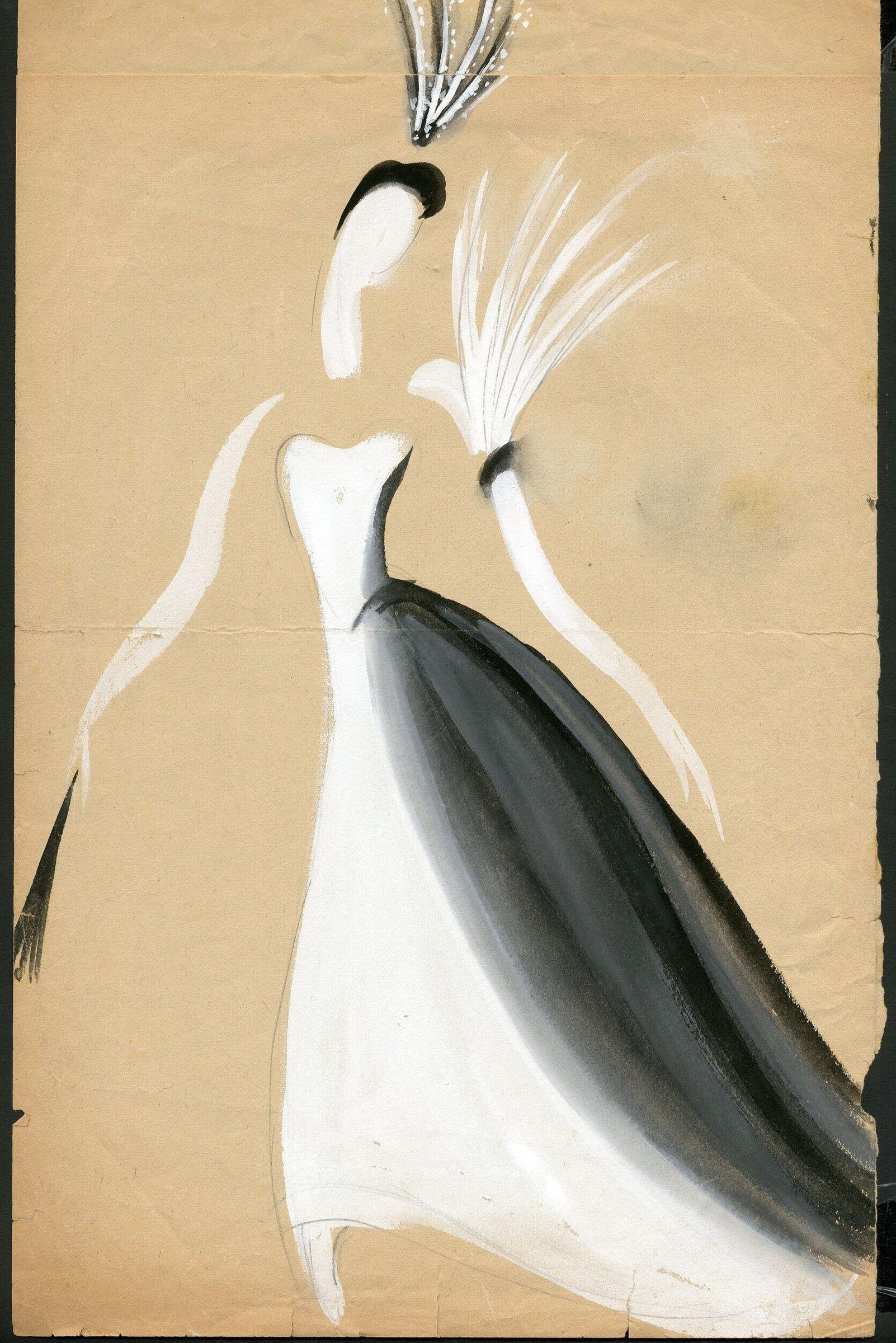
Fedorovitch's designs were influential in establishing a visual language for mid-twentieth-century ballet, one that moved away from ornament and spectacle toward simplicity and emotional clarity. This drawing demonstrates her characteristic approach: the economy of form, the emphasis on the dancer's silhouette and posture, and the integration of costume and body into a unified design concept. For dancers and historians, the work offers insight into how choreographers and designers of the period conceived of the female dancer's role—not as a decorated object but as a presence capable of expressing interior states.
What you are looking at
A single figure stands against a warm, pale ground in a pose of lyrical stillness. The dancer wears a long white dress or tunic with a voluminous dark skirt or train swept dramatically across the lower body in shades of charcoal and black, creating a strong diagonal movement from waist to hem. The figure's upper body is rendered in simple white planes with minimal modeling; the head is small and turned slightly, with dark hair arranged in a simple style. Both arms are raised and extended upward—the left arm straighter, the right arm bent—with the hands rendered as simple white shapes suggesting an open, reaching gesture. Fine white lines at the top and to the right suggest stage props (possibly drapery or set pieces) executed with loose, sketchy strokes. The overall composition is vertical and frontal, with the figure centered. The technique is painterly and economical: the artist has worked in white, black, and grays on paper or board, with areas of the ground left bare, giving the work an unfinished, study-like quality.
The dancing
A solitary dancer is shown in an upright, open stance with both arms raised to near-shoulder height or above. The torso is long and straight, the weight appears centered, and the small, bowed head creates a contemplative or introspective quality despite the upward arm reach. The right arm appears slightly flexed at the elbow, while the left extends more fully; both hands are open and relaxed. There is no clear evidence of weight shift, turnout, or specific footwork—the pose reads as a moment of poise and emotional containment rather than dynamic action. The simplification of the figure suggests the artist was interested in silhouette and line rather than anatomical detail.
The dance depicted
This appears to be a design for a theatrical dance, most likely ballet, executed in the early twentieth century when simplified costume and figure drawing were modes for avant-garde theatre design. The long tunic dress, the absence of pointe shoes, and the formal uprightness are consistent with modern or contemporary dance practice of the 1930s, or with Romantic-era ballet design. The title *Nocturne* suggests mood and introspection—a nighttime or dreamlike quality—which aligns with the contemplative stillness of the pose. Without a signature or additional documentation, the specific choreography and dance company cannot be identified, but the work reads as a costume or set study for a solo or featured role in a theatrical work.
How it was made
This appears to be a design drawing in gouache or poster paint on paper or cardboard, with white and black pigment applied over a tan or cream ground. The economy of means—simple planes of color, minimal shading, and reliance on line—is characteristic of avant-garde theatre design of the 1920s–1930s. The technique allowed for rapid visualization of costume and figure in performance, and such drawings would have circulated among dancers, directors, and other members of a design team. The unfinished quality, with areas of bare ground and sketched props, suggests this is a working study rather than a presentation drawing.
About this work
This is a costume design drawing for a theatrical dance role, attributed to Sophie Fedorovitch and dated 1936. Fedorovitch was a significant figure in twentieth-century ballet design, particularly known for her work with British ballet companies in the 1930s and 1940s. The work depicts a single dancer in a long white tunic and dark dramatic skirt, with both arms raised in a gesture of openness or yearning. The title *Nocturne* and the mood of the composition suggest a work concerned with lyrical, introspective emotion rather than virtuosic spectacle. As a costume design, the drawing served a practical function in the theatre—communicating the visual identity of a role to dancers and production teams—while also standing as a work of modernist visual art in its own right.
How to look at it
Focus on the relationship between the still, frontal pose and the dramatic sweeping movement of the skirt. The contrast between the upright, almost statuesque upper body and the dark, fluid drapery below suggests the artist understood how costume could extend and amplify the dancer's gesture. Notice the small, bowed head—unusual in a figure with raised arms—which gives the pose an introspective quality. The sketchy treatment of the props and setting keeps the viewer's attention on the figure itself, emphasizing the unity of body, dress, and emotional presence.
The artist
Sophie Fedorovitch (1893–1953) was a Russian-born painter, theatre designer, and costume artist who became a central figure in British ballet design. She emigrated to London in the early 1920s and quickly became known for her elegant, modernist approach to costume and set design. Working primarily with the Ballets Russes and the Royal Ballet and its precursors, she designed costumes and scenery for numerous productions and was instrumental in moving ballet design away from the jeweled exoticism of earlier decades toward a more austere, humanistic aesthetic. Her collaborations with choreographers including Frederick Ashton shaped the visual character of mid-century British ballet.
The period
In 1936, European ballet was undergoing significant stylistic shifts. The dominance of the Ballets Russes and its orientalist, decorative aesthetic was waning; in its place, choreographers and designers were developing new vocabularies suited to modernist sensibilities and contemporary subject matter. British ballet in particular was establishing its own identity, distinct from the Russian imperial tradition. In visual art, the 1930s saw increasing interest in simplified form, geometric composition, and the expressive power of line and silhouette—influences visible in Fedorovitch's work. The theatrical climate favored designers who could unite modernist visual principles with the emotional and kinetic demands of dance.
Where it lives
This work is held as a costume design in a theatre or dance collection and is catalogued as a design rather than as a standalone artwork. Costume designs of this period typically circulated within production teams and archives; this example entered a collected holding, where it has been preserved as evidence of Fedorovitch's practice and of mid-century ballet design.
Dance in this work
Questions about this work
Is this a finished artwork or a sketch?
It is a working design drawing, not a finished composition for display. The bare areas of ground, the sketchy treatment of background elements, and the economical technique are all typical of theatre design practice. Such drawings were tools for communication among the design, choreography, and production teams, and their directness and clarity were valued as much as finish would have been.
What dance is being designed here?
The catalogue identifies the work only by its title, *Nocturne*, which suggests a ballet or theatrical dance work with a lyrical, introspective mood. Without additional documentation, the specific choreography and production cannot be identified. The pose and costume are consistent with mid-twentieth-century ballet, but the work could equally represent a modern or contemporary dance design of the period.
Why are the arms raised if the dancer looks so still and inward?
This is a deliberate compositional choice and reveals something about the choreography or the emotional tone of the role. The raised arms suggest openness, yearning, or emotional elevation, while the small, bowed head suggests introversion or melancholy. The tension between these two impulses—between upward reach and inward focus—creates a complex emotional register that many twentieth-century choreographers valued.
What is the dark skirt made of?
From the drawing alone, it is impossible to say whether the dark area represents silk, wool, cotton, or another fabric. Fedorovitch's design drawings typically did not specify material; such decisions would have been made during production in consultation with the costume shop. The emphasis here is on the visual and kinetic effect—how the dark sweep of fabric would read from the audience's perspective and how it would move with the dancer's body.
More dance artwork





