49 works in this view — arrow keys or swipe to move between them.
Dance in Art
Modern Swedish Ballet Designs
Branfield, Peter
- Collection:
- Poster
- Source:
- Victoria and Albert Museum
- Rights:
- Rights vary by item — check the source record before reusing this image. Source record ↗
- Recorded as:
- V&A — check rights per item
This poster documents the intersection of ballet and modernist graphic design at a moment when both were in active dialogue with abstraction and the reduction of the human figure to essential formal elements. The V&A exhibition suggests significant institutional attention to Swedish ballet design and practice, making the poster a window into 1970s transatlantic curatorial interests and the cultural status of Scandinavian modernism.
What you are looking at
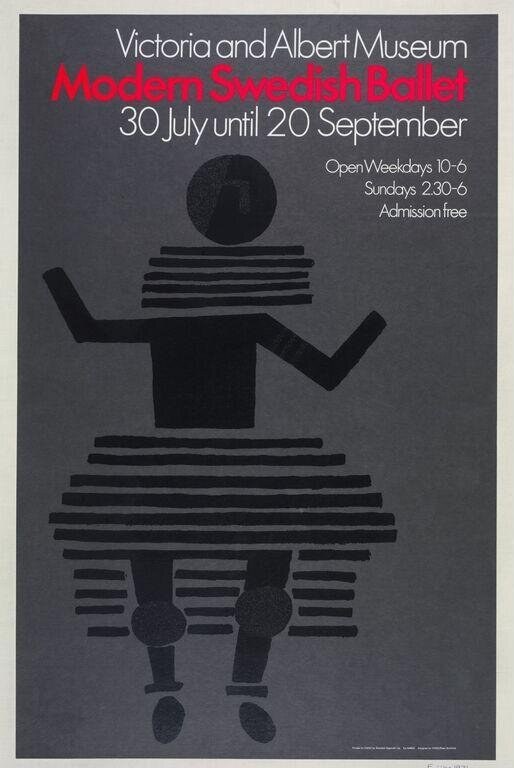
A minimalist graphic poster depicts a figure constructed from geometric horizontal bands and simple shapes in bold black silhouettes against a dark gray background. The figure has a spherical head balanced atop a torso made of stacked rectangular forms of varying widths, creating a rhythmic visual pattern. Two bent arms extend outward to either side at shoulder height, the elbows sharply angled upward. The lower body consists of thick horizontal bands suggesting a voluminous skirt or lower garment, with two simple cylindrical shapes representing legs beneath, and small oval shapes for feet. The entire composition is vertically oriented and centrally placed, with the figure appearing to be in dynamic motion—the bent arms and slight asymmetry of the bands suggest active movement rather than stillness. The design aesthetic is distinctly modernist, likely from the mid-twentieth century, and the figure's posture and construction convey both playfulness and formal sophistication.
The dancing
The single figure presents an abstracted human body rendered as stacked horizontal planes. The torso consists of rectangular bands of decreasing width moving downward, creating a tapered silhouette. The arms are raised and bent at roughly ninety-degree angles with the forearms parallel, positioned in a gesture suggesting either celebration, surprise, or dynamic motion. The legs are represented as simple cylinders with minimal definition. The overall posture—with lifted arms and wide lower stance—conveys buoyancy and energy; the weight appears distributed through the broad base created by the skirt-like lower bands.
The dance depicted
This is a Swedish ballet poster, and the abstract figure most likely represents a dancer or the idea of modern dance itself rather than depicting a specific ballet or dancer. The modernist graphic treatment—reducing the human form to essential geometric shapes—reflects early-to-mid twentieth-century European design philosophy and its engagement with abstraction and the human body in motion. The dynamic arm position and the suggestion of a full, possibly swinging skirt suggest a female dancer, and the composition emphasizes movement and liveliness. The style and execution suggest this is promotional material for a ballet company or production, though without additional context it is difficult to identify a specific work.
How it was made
This is a lithographic poster, a mass-production medium well suited to theater and dance promotion. The design employs bold areas of solid black and gray with no gradation or detail, characteristic of graphic design in the international modernist tradition—similar to the work of Swiss and German designers of the same era. Lithography allowed for crisp reproduction of flat graphic forms and made large runs affordable, suggesting this was created to advertise a specific exhibition or season to a broad public audience. The technical simplicity and graphic boldness indicate an artist working within the modernist design movement's commitment to reduction, legibility, and formal clarity.
About this work
This is a promotional poster for Swedish ballet from 1970, advertising a summer exhibition at the Victoria and Albert Museum in London. The abstract figure—constructed from stacked horizontal planes and rendered in stark black against gray—exemplifies the modernist design language that dominated mid-twentieth-century graphic communication. Rather than depicting a specific ballet or recognizable dancer, the poster uses formal abstraction to convey the idea of dance itself: the figure's raised arms and dynamic posture suggest motion and celebration, while the geometric construction connects the dancer's body to the contemporary visual vocabulary of the period. The work belongs to a tradition of avant-garde theater and dance posters that treated the human figure as a site for formal experimentation.
How to look at it
Attend to the way the artist has deconstructed the dancing body into stacked horizontal units—a compositional choice that emphasizes the body's volume and mass rather than its line or extension. The raised arms are the key gesture; notice how their angle and position create an arrow of energy pointing outward and upward, activating the entire figure. The width of the lower bands (suggesting a skirt in motion) contrasts with the narrower upper torso, a visual device that conveys the dynamics of a spinning or moving body. The color relationship—pure black figure against dark gray field—gives the work a stark, high-contrast clarity suited to advertising, but also invokes the graphic language of fine art printmaking.
The artist
Peter Branfield was a graphic designer working within the British modernist tradition. The poster's aesthetic—spare geometric forms, bold black and gray tonality, sans-serif typography—places him within the lineage of Swiss and English graphic designers influenced by the International Style and the Bauhaus. His work for the V&A suggests involvement in museum and cultural institution promotion, a significant market for graphic designers in the post-war period.
The period
By 1970, Swedish ballet and design held significant prestige internationally, particularly in Britain, where Scandinavian modernism was celebrated for its integration of fine art principles with commercial and utilitarian objects. The poster's graphic language reflects the hegemony of geometric abstraction in design of the 1960s and 70s, when the human figure—even in representation—was often subjected to radical simplification and reconfiguration. In ballet, the period saw growing cross-pollination between classical technique and contemporary/abstract approaches; this poster's abstract figure may reflect that experimental climate as much as it documents a specific Swedish company's work.
Where it lives
This is a lithographic poster held in the V&A's collection of theatrical and design ephemera. It was created as advertising material for an exhibition at the museum itself, running from 30 July to 20 September 1970, indicating the V&A's active curatorial interest in Swedish design and ballet practice during this period.
Dance in this work
Questions about this work
Is this poster advertising a specific ballet?
The poster advertises an exhibition of 'Modern Swedish Ballet Designs' at the V&A Museum, rather than promoting a single ballet or performance. It functions as a general announcement of the exhibition, using an abstract figure to represent the idea of modern dance rather than depicting a specific choreography or dancer.
Why did the artist choose such a geometric, abstract style?
The geometric abstraction reflects the dominant modernist design language of the 1960s–70s, when reducing forms to their essential shapes was valued both aesthetically and functionally. This approach was especially suited to graphic design and advertising, where bold, legible imagery could communicate quickly to a mass audience. The style also mirrors the period's experimental approaches in ballet itself, where abstract movement and non-narrative choreography were increasingly prominent.
What does the figure's posture tell us?
The raised, bent arms and the suggestion of a full skirt (in the thick horizontal bands of the lower body) convey active movement and energy. The posture suggests a female dancer in a moment of dynamic expression—possibly mid-leap, spin, or celebratory gesture. The figure reads as joyful and buoyant rather than static or contemplative.
Who was Peter Branfield?
Branfield was a British graphic designer working in the modernist tradition. He was active in museum and cultural institution design, as evidenced by this V&A commission. His practice reflects the dominance of the International Style and geometric abstraction in 1960s–70s British graphic design.
More dance artwork





