49 works in this view — arrow keys or swipe to move between them.
Dance in Art
Costume design
Braque, Georges
- Collection:
- Costume design
- Source:
- Victoria and Albert Museum
- Rights:
- Rights vary by item — check the source record before reusing this image. Source record ↗
- Recorded as:
- V&A — check rights per item
This design document captures a pivotal moment when visual modernism and theatre were actively reshaping each other, and when the study of costume as sculptural and expressive form became central to avant-garde practice. For historians of dance and design, it demonstrates how the moving body was being conceived—not as a vehicle for virtuosity but as a form to be shaped and abstracted through fabric and line.
What you are looking at
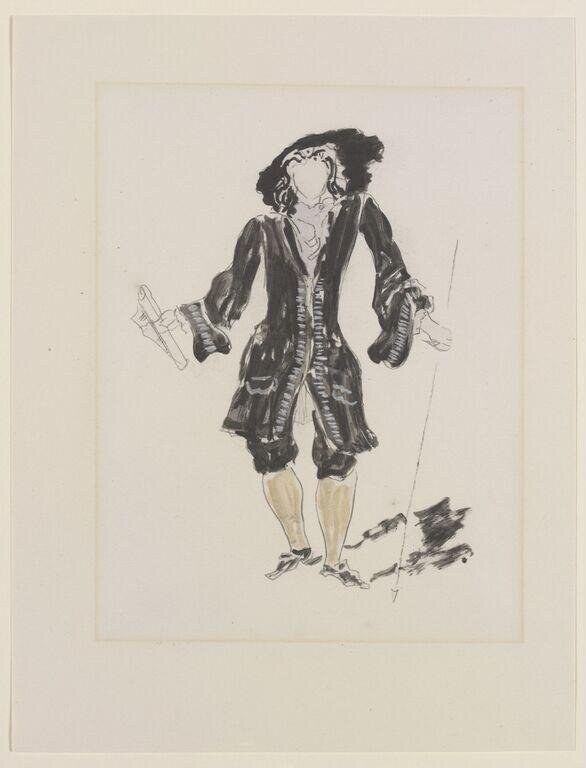
A single figure stands against a plain background in a three-quarter pose, weight shifted onto one leg in a posture of theatrical address. The dancer wears a dark coat or jacket with pronounced horizontal ribbing or pleating across the torso and sleeves, worn open over a lighter shirt with visible neckline. The legs are bare or in flesh-colored stockings, and the feet are small and refined. The head is rendered as a blank oval or egg shape—featureless and abstracted. The figure holds what appears to be a small prop or paper in the left hand, while the right arm extends outward in a gesture of presentation or expression. A curved line at the lower right suggests movement or an abstract ground. The drawing is executed in bold black lines and washes with selective areas of cream or tan wash, particularly on the legs and lower body.
The dancing
A single dancer in a relaxed contrapposto stance, weight supported on the back leg with the front leg lightly flexed. The posture is upright and frontal, arms held wide in an open, expressive frame that suggests address or declaration. The carriage is aristocratic and composed rather than dynamic; there is no sense of violent movement or leap. The treatment of the body is elegant but not balletic—the pose reads as theatrical address or character presentation rather than technical display.
The dance depicted
This appears to be a costume design for theatrical dance, most likely for an early twentieth-century avant-garde or modernist production. The abstracted head, elegant posture, and formal attire suggest a figure from commedia dell'arte, court dance, or modernist theatre dance. The style of the coat and the compositional language point toward a 1920s theatrical context, when Cubism and avant-garde practice were reshaping stage design across Europe. The figure is presented as a character or type rather than as a dancer in motion, suggesting this was conceived as a stationary costume study rather than a representation of choreography in action.
How it was made
This is a drawing in pen or ink with wash, executed on paper. The technique allows rapid notation of form and silhouette while the selective wash creates volume and emphasis, particularly highlighting the legs and lower body. This hybrid approach—combining line drawing with tonal wash—was common in costume and stage design of the period, where the work needed to communicate both precise tailoring and overall visual effect to both director and artisan. The style suggests this was a working drawing or finished design document rather than a fine art work conceived for exhibition.
About this work
This is a costume design study for a theatrical character, likely created for a dance or theatre production in the early 1920s. The work exemplifies the avant-garde interest in abstraction, geometric form, and the stylization of the body that characterized modernist stage design in that decade. The featureless head, elegant silhouette, and refined handling suggest a figure of aristocratic or courtly character—possibly a young nobleman, a commedia figure, or an abstract type. The image is simultaneously specific in its attention to tailoring and deliberately abstracted in its rendering of the face and overall form. This tension between precise craft and modernist reduction is characteristic of the period's theatrical innovation.
The work belongs in a dance art collection as evidence of how visual artists and choreographers were collaborating in the 1920s to reimagine the dressed and moving body on stage. The abstraction of the face draws attention to the body and costume as primary means of expression, a choice consistent with modernist theatre practice and with the emerging vocabulary of abstract dance.
How to look at it
Attend first to the stance and posture: the figure is not captured mid-movement but in a moment of presentation or address, standing still. The economy of the line work and the selective use of wash create emphasis and volume without naturalistic detail. The featureless head is not a limitation but a deliberate choice—it directs attention to the body, the costume, and the silhouette. Notice how the horizontal pleating of the coat creates visual rhythm and breaks the figure into zones, and how the bare or stockinged legs read as refined and aristocratic against the heavily articulated torso. This is costume as visual composition, not as a record of lived dress.
The artist
Georges Braque (1882–1963) was a founder of Cubism and one of the most influential painters of the twentieth century. Beyond his canonical work in easel painting, Braque was deeply engaged with theatre and design, collaborating with impresarios and choreographers on stage sets and costume designs throughout his career. His involvement with the Ballets Russes and other theatrical ventures positioned him within a network of artists—including Picasso, Matisse, and others—who saw modernist painting not as separate from performance but as part of a comprehensive reimagining of visual culture. This costume design reflects that commitment to theatre as a site of artistic innovation.
The period
The 1920s were a period of intense experimentation in European theatre and dance. The Ballets Russes, under Sergei Diaghilev, had established the model of collaboration between visual artists and choreographers, commissioning works from leading painters and sculptors. Cubism and other modernist movements were reshaping how the body could be represented—fragmented, abstracted, and reconceived through geometric form. Simultaneously, there was a revival of interest in historical dance forms and courtly aesthetics, often filtered through modernist sensibility. The abstraction of the face in this design participates in that broader conversation about how the human figure could be stylized and presented on stage.
Where it lives
The work is held in a costume design collection (catalogued as "Costume design"), indicating it was preserved as a working or reference document from theatrical practice rather than as an autonomous artwork. The source attribution (VA) suggests a major institutional holding, likely in the UK.
Dance in this work
Questions about this work
Why is the head blank?
The abstracted, featureless head is a deliberate choice by the artist, consistent with modernist practice in the 1920s. By removing facial detail, Braque focuses attention on the body, costume, and silhouette as primary vehicles of character and expression. This was a common strategy in avant-garde theatre design, where the costume itself—rather than individual features—was meant to communicate identity and type.
Is this a costume design or a fine art drawing?
It is both. The work functioned as a practical design document for theatre production—communicating form, tailoring, and visual effect to directors and seamstresses—but it was executed with sufficient skill and artistic intention to stand as a work of art in its own right. In the 1920s avant-garde, this distinction was deliberately blurred; design was art, and art served design.
What dance or performance was this costume for?
The catalogue record does not specify. The elegance of the silhouette, the formal attire, and the refined posture suggest a courtly, aristocratic, or commedia dell'arte character, but without additional archival information, the specific production cannot be identified. The work remains a study of character and costume rather than a record of a documented performance.
Why would a major painter like Braque design costumes?
For Braque and his contemporaries, theatre was not peripheral to modern art but central to it. The stage offered a space where painting, sculpture, music, and movement could be synthesized; it was a laboratory for modernist ideas about form and abstraction. Collaborating with theatre companies and choreographers was considered prestigious and creatively essential, not a compromise of fine art practice.
More dance artwork





