49 works in this view — arrow keys or swipe to move between them.
Dance in Art
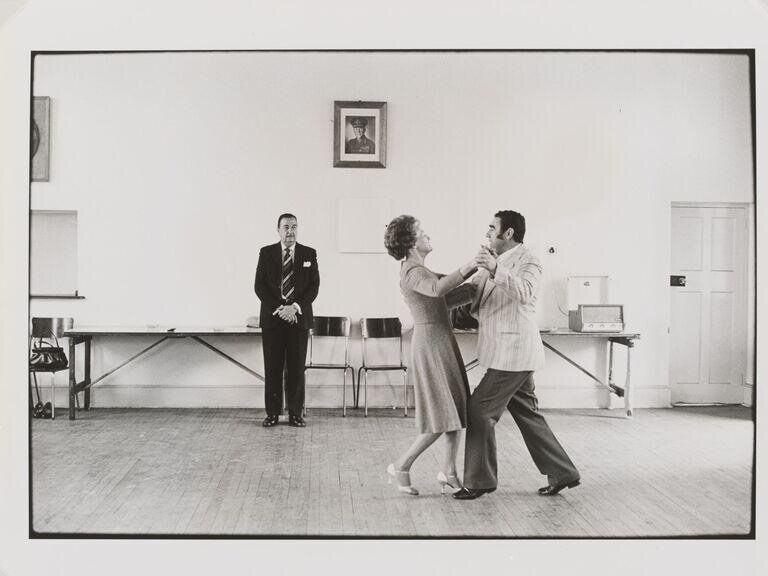
Ballroom dancing teacher, Ted van Rensburg, watches two of his pupils swinging to the music of Victor Sylvester and his orchestra, in the old Court House, Boksburg.
Goldblatt, David
- Collection:
- Photograph
- Source:
- Victoria and Albert Museum
- Rights:
- Rights vary by item — check the source record before reusing this image. Source record ↗
- Recorded as:
- V&A — check rights per item
This is a rare documentary image of ballroom dance instruction as a social practice, showing the formality of the closed frame and the role of the teacher in enforcing proper technique. For dance historians, it documents how a specific ballroom tradition—the Sylvester idiom of strict-tempo International Standard—was transmitted in a particular place and time, revealing the globalized nature of ballroom dance pedagogy.
What you are looking at
A ballroom dance class in progress in a spare, institutional hall—the old Court House in Boksburg. Three figures occupy the wooden floor: in the foreground, a couple executes a ballroom movement, the woman in a pale dress and the man in a light-colored shirt with darker trousers, both in a standard closed ballroom frame. The woman's body leans slightly back into the frame as the man leads. In the middle distance, standing alone and watching with quiet authority, is the instructor Ted van Rensburg in a dark suit with a striped tie, his posture upright and observant. The space is austere: white painted walls, simple wooden tables and chairs pushed to the sides, a small framed picture on the wall above, windows and doors providing institutional architecture. The photograph captures the moment of instruction—not performance, but learning, the couple mid-step while the teacher evaluates.
The dancing
The dancing couple are in a closed ballroom frame: the man's left hand holds the woman's right, his right hand positioned on her back, her left arm extended along his upper arm. Both are upright but with the woman carrying a slight backward sway characteristic of ballroom technique. The instructor stands apart, observing with the detached focus of someone trained to read movement. The spatial relationship between teacher and dancers is formal and hierarchical—he is the authority, they are the subjects of his attention.
The dance depicted
This is a ballroom dance lesson, most likely a waltz or foxtrot, taught in the idiom of the International Standard or American Smooth ballroom tradition—the closed frame, the formal upright carriage, and the institutional teaching context all support this. The reference to Victor Sylvester and his orchestra (a famous ballroom orchestra of the mid-twentieth century) confirms the style: Sylvester was synonymous with strict-tempo ballroom dancing, the formal competition and social dance tradition that dominated Western ballroom culture from the 1930s onward. The photograph documents not performance but pedagogy—the moment of correction and learning, with the instructor as the keeper of proper form.
How it was made
This is a black-and-white photograph, almost certainly gelatin silver print based on the tonal range and the date. The perspective is carefully composed from a slight distance, giving equal weight to the teaching moment and the space itself. The photographer has chosen a moment of active instruction rather than a held pose, capturing the fluid moment of the dance rather than a static demonstration. The print quality and composition suggest this was a professional or semi-professional document, not a casual snapshot.
About this work
David Goldblatt's photograph records a ballroom dance lesson in Boksburg, South Africa, circa 1980. It is a social document of ballroom dance transmission: the formalized instruction in the International Standard or American Smooth tradition, the relationship between teacher and pupil, the institutional space where such teaching took place. The image sits at the intersection of dance, pedagogy, and social history, showing how ballroom dance—a tradition tied to Western European and American cultural forms—was taught and practiced in apartheid-era South Africa. The choice to photograph the lesson rather than a performance moment, and to include the watching instructor as a central figure, makes this an image about dance as learned behavior, not spectacle.
How to look at it
Notice how the photographer has positioned the instructor as a separate, watching figure—he is not dancing, but observing, his stillness a counterpoint to the couple's movement. The closed ballroom frame of the dancing couple is the technical center, but the composition makes the relationship between teacher and learner the subject. Look at the posture of the instructor: his attention is complete and his authority is physical, though he does not touch or correct the dancers in this moment. The institutional emptiness of the room—its plainness, its sparse furnishings—frames ballroom dancing as a disciplined, formal practice rather than a social pleasure.
The artist
David Goldblatt (1930–2023) was a South African photographer renowned for his unflinching documentation of daily life under apartheid and beyond. His work characteristically combined precise formal composition with social and political content, using photography to reveal the structures of society. He was attentive to gesture, posture, and the spatial relationships between people, and to the architecture of public and institutional life. This image exemplifies his practice: an apparently simple scene of instruction becomes a document of social order, formality, and the transmission of cultural practice.
The period
By 1980, ballroom dancing had a half-century history as a codified competitive and social practice, with the International Standard and American Smooth divisions as formal categories. Victor Sylvester's influence on ballroom dance pedagogy had been profound and durable—his strict-tempo method was taught globally and remained the standard for ballroom instruction. In South Africa, ballroom dance was a cultural practice that often reflected European and American norms, taking place in formalized settings like those shown here. The choice of an institutional space (a court house) for the lesson suggests ballroom dance as a legitimized, formalized practice integrated into civic life.
Where it lives
The photograph is held in the collection of the V&A (Victoria and Albert Museum), the source listed as 'va'. It is part of Goldblatt's broader documentary archive of South African life and society.
Dance in this work
Questions about this work
What is the dance being taught here?
Based on the closed ballroom frame, the formal posture, and the reference to Victor Sylvester (an authority on strict-tempo ballroom), this is most likely a waltz or foxtrot in the International Standard or American Smooth tradition. The exact step cannot be determined from a still photograph, but the position and carriage are consistent with classical ballroom technique.
Who was Ted van Rensburg?
The catalogue identifies him as a ballroom dancing teacher based in Boksburg, South Africa. Beyond this, little is recorded. His role here is as an instructor transmitting formal ballroom technique to his pupils.
What does the reference to Victor Sylvester mean?
Victor Sylvester was a British bandleader and a defining figure in twentieth-century ballroom dance pedagogy. His strict-tempo ballroom orchestra was the gold standard for ballroom dancing worldwide, and his approach to teaching ballroom technique was formalized and influential. The reference anchors this lesson in that specific tradition of disciplined, competition-oriented ballroom practice.
Why is this photograph in a dance collection?
Because it documents a fundamental practice of dance transmission: the formalized lesson, the closed frame of ballroom dancing, the role of the instructor, and the integration of a Western dance form into everyday social life. It is a record of how ballroom dance was learned and taught.
More dance artwork





