49 works in this view — arrow keys or swipe to move between them.
Dance in Art
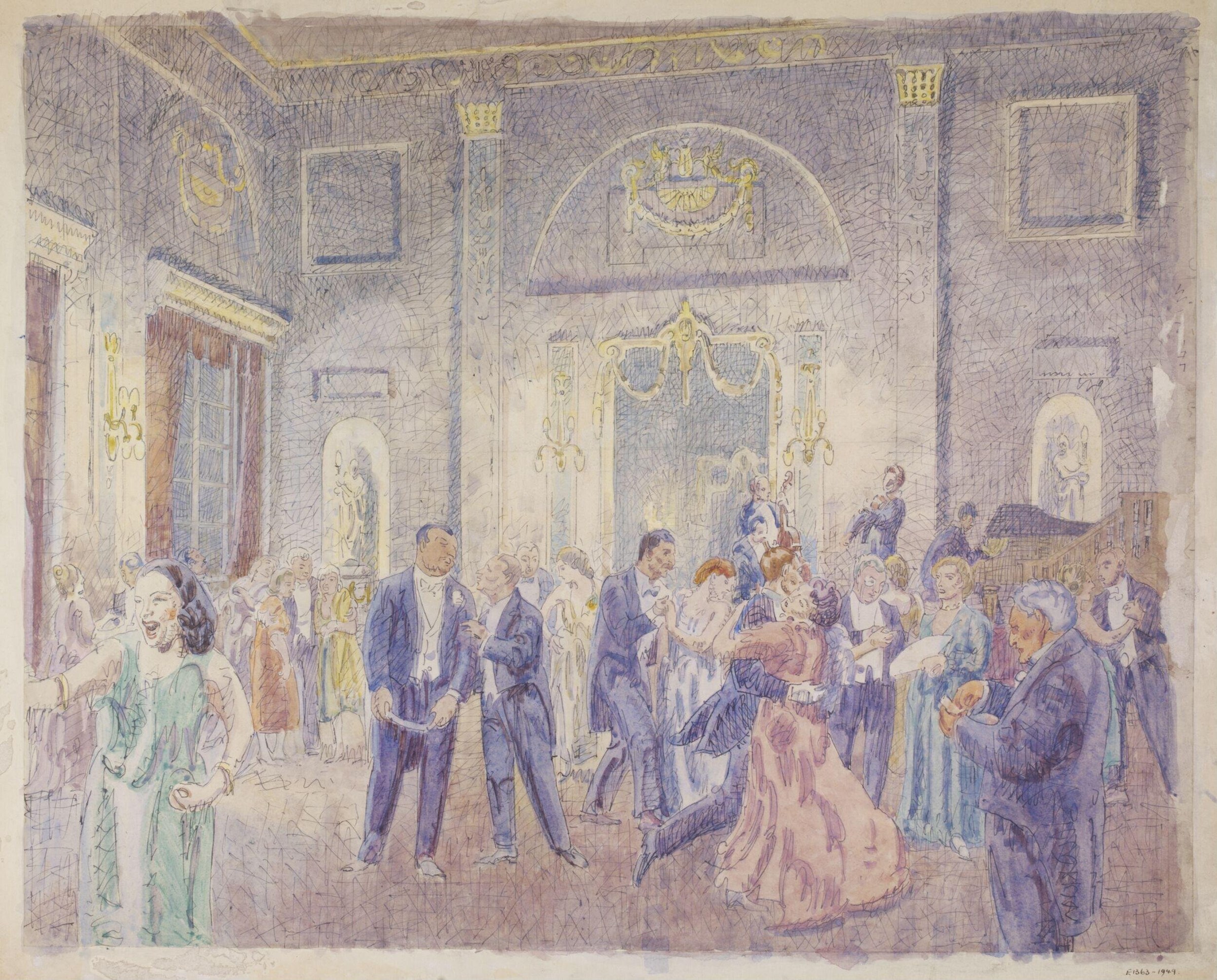
Ballroom at the Shire Hall, Chelmsford
Bayes, Walter
- Collection:
- Watercolour
- Source:
- Victoria and Albert Museum
- Rights:
- Rights vary by item — check the source record before reusing this image. Source record ↗
- Recorded as:
- V&A — check rights per item
The work provides visual evidence of how ballroom dancing was actually practiced in provincial England during the Second World War: the dress, the space, the scale of the event, and the mix of active dancers and spectators. It demonstrates that formal ballroom dancing remained a live social practice in 1940, not yet displaced by later forms of popular dance, and that such events were significant enough to commission an artist to record them.
What you are looking at
A fashionable ballroom scene rendered in watercolour with pale purple and blue washes, showing approximately thirty figures in 1940s dress distributed across an ornately decorated interior. The room has a vaulted ceiling with classical decoration, arched recesses flanked by pilasters, and gilt ornamental details characteristic of Regency or Victorian architecture. Two or three couples are actively dancing in the centre and foreground, while the remainder stand in conversation, observe the dancers, or move between groups. The dancing figures are dressed in evening wear — women in long gowns (one notably in pale pink), men in dark suits. The composition emphasizes the social ritual of the ballroom as much as the dance itself: this is a crowded, lively event where dancing is one activity among many. The artist has used a loose, sketchy line over translucent colour, creating an atmosphere of movement and informality despite the formal setting and dress code.
The dancing
The primary dancing couple visible in the centre-foreground maintains a closed ballroom hold, with the woman's skirt caught mid-turn, suggesting rotating movement characteristic of a waltz or foxtrot. Other dancers visible are similarly paired and upright, with minimal space between partners. Most non-dancing figures stand or converse in small groups; posture is relaxed and social rather than performative. The artist has suggested movement through loose brushwork and the tilt of the bodies rather than through precise anatomical study, making individual footwork unreadable but the overall social choreography clear.
The dance depicted
The work depicts social ballroom dancing as it was practiced in mid-twentieth-century Britain, specifically at a formal dance in Chelmsford. The dances most likely represented are the waltz and foxtrot, the standard couple dances of the English ballroom in the 1940s. The presence of a formal shire hall setting and evening dress indicates a substantial civic or social event, not a private party. The composition emphasizes the ballroom as a space for sociability and social display rather than as a venue for virtuosity or spectacle. The specific style cannot be identified with precision from the image alone, but the hold, frame, and formal setting align with the English tradition of ballroom dancing in this period.
How it was made
The work is a watercolour, a transparent medium that requires confident handling and does not allow for extensive correction. Bayes has layered pale washes of purple, blue, pink, and ochre over a fine linear understructure in pen or pencil, creating an effect of immediacy and spontaneity. The translucency of the medium allows the paper to show through, giving the scene an airy, sketch-like quality despite the composition's complexity. This technique was well suited to the documentation of events or social scenes, and suggests the work may have been made on commission or as a record of a specific occasion.
About this work
This watercolour records a formal ballroom dance held at the Shire Hall in Chelmsford in 1940, capturing both the social choreography of the event and the formal dancing at its centre. It is a document of English ballroom culture at a moment when such dances remained an important ritual of civic and social life, and a record of what the artist identified as worth preserving visually. The work belongs in a dance gallery because it shows not only the dancers and their technique, but the social context in which that technique was performed — the dress, the architecture, the mix of dancers and observers that made ballroom dancing a communal rather than solitary practice.
How to look at it
Attend to the spatial composition: Bayes has arranged the figures to show the ballroom as a social ecosystem rather than a performance space, with dancers, conversationalists, and observers all sharing the same visual weight. Note the architectural setting, which locates the event in a specific place of civic importance. The loose watercolour technique conveys the liveliness and informality of the moment without sacrificing the formality of the dress and setting—a visual paradox that captures the nature of ballroom culture itself.
The artist
Walter Bayes (1860–1956) was a British painter and illustrator known for figurative work, murals, and social documentation. He had a long teaching career at the Royal Academy Schools and the Slade School of Fine Art, and worked across oil, watercolour, and printmaking. His subject matter ranged from intimate domestic scenes to public events and historical subjects. This watercolour appears consistent with his practice of using transparent colour and linear detail to capture social and architectural subject matter.
The period
In 1940, ballroom dancing remained a central form of social recreation for the English middle and upper classes, despite wartime conditions. The formal dances of the Victorian and Edwardian eras—waltz, foxtrot, and quickstep—were still the norm for such events. The venue (a shire hall) indicates a civic or county-level event, the kind of occasion that would have been significant in a provincial town. Simultaneously, popular dance culture was beginning to shift: jazz and swing were influencing dance music, though the formal ballroom style remained dominant for events of this kind.
Where it lives
The work is held by the Victoria and Albert Museum (source: va) as part of their collection of art on dance and social life. It appears to have been made directly for the museum's collection or acquired from the artist, rather than preserved as a historical document of the specific event.
Dance in this work
Questions about this work
What dances are being performed?
The closed hold, upright frame, and rotating motion visible in the central couples are consistent with the waltz or foxtrot, the standard English ballroom dances of the 1940s. The composition does not allow identification of a specific dance, but both would have been common at a formal civic event of this kind.
Was this a real event?
Yes. The title identifies it as a ballroom at the Shire Hall in Chelmsford, a real civic building. The precision of the title and the artist's style suggest Bayes was documenting a specific occasion, though the work reads as a social composition rather than a strict record.
Why are so many people not dancing?
Because ballroom culture in this period was as much about socialising and display as about dancing itself. The work captures the ballroom as a social space where dancing was one activity among many—others stood in conversation, refreshed, or observed the dancers. This was the normal rhythm of such events.
More dance artwork





