49 works in this view — arrow keys or swipe to move between them.
Dance in Art
Drawing
Morten, Thomas
- Collection:
- Drawing
- Source:
- Victoria and Albert Museum
- Rights:
- Rights vary by item — check the source record before reusing this image. Source record ↗
- Recorded as:
- V&A — check rights per item
It shows us that early nineteenth-century ballroom culture included room for physical exuberance and novelty figures that went far beyond the formal figures of the quadrille or cotillion—moments of daring and display that were integral to the social event. Dancers, historians, and scholars of social dance will find this valuable as evidence of the actual movement vocabulary and the permissible transgression of formal ballroom dance, recorded by an artist who clearly attended such events and understood them from the inside.
What you are looking at
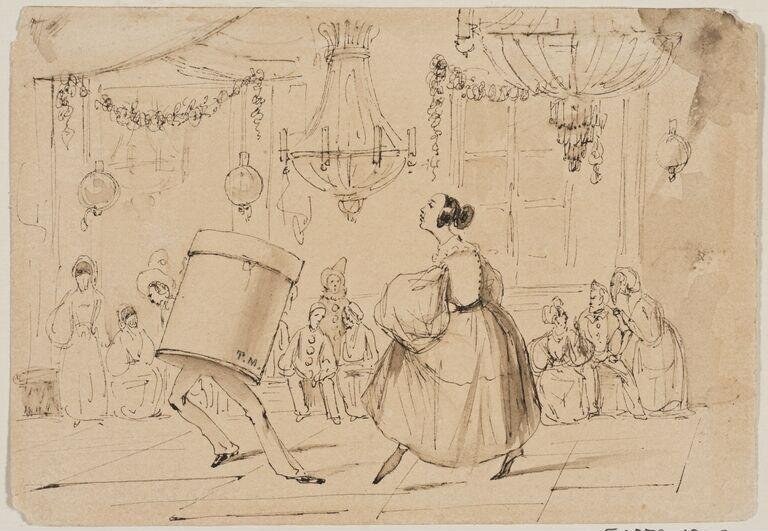
A crowded interior scene of a grand ballroom or assembly room, rendered in pen and ink with light wash. The space is defined by classical architectural elements—tall doors, a fireplace or alcove, ornamental ceiling fixtures including chandeliers and draped swags—that establish an aristocratic setting. In the foreground, a man in dark coat and breeches bends sharply backward at an exaggerated angle, his body nearly horizontal, while a woman in a long pale gown and dark bodice faces him in an equally pronounced lean. This pair dominates compositionally and enacts what appears to be a trick or novelty figure. Around them, roughly twenty figures—mostly women in Empire-waist gowns, some men in formal dress—stand, sit, and cluster in groups, watching the central pair with evident attention. The drawing style is loose and gestural, with figures suggested rather than finished; faces are quick notations, limbs abbreviated. The whole suggests a moment of spectacle within a formal social gathering: this is not a general dance but a featured performance or dare.
The dancing
The two central dancers are locked in a dramatic back-arch duet, their bodies forming near-mirror lines of extreme extension. Both partners lean away from vertical at angles approaching 45 degrees or more, suggesting either a novelty lift-and-arch or a mutual lean-back figure rarely seen in standard ballroom vocabulary. The man's arms are not clearly articulated, but his whole torso is given over to the arch. The woman's skirts billow and spread with the movement. The surrounding figures stand upright in loose clusters; some women's posture suggests they are leaning in to watch, and their static positioning frames the action as observation rather than ensemble participation. The scale and clarity of the central pair against the smaller, more summarily drawn crowd confirms this is a featured moment, not a general ball.
The dance depicted
The image documents what appears to be a ballroom novelty or parlour trick popular in the Regency or early nineteenth-century social season—specifically, a dramatic back-arch or lean-back duet that exceeds the formal figures of standard quadrille or cotillion. Such exaggerated poses were performed within ballroom settings as entertainment between or during dances, often drawing comment and applause. This is not a named ballroom style but rather a moment of exhibition within one. The date 1836 and the setting place this squarely in the world of fashionable English assembly-room entertainment, where such licensed exuberance was tolerated as a display of youth, confidence, and physical mastery.
How it was made
A pen and ink drawing with light gray wash, rendered on paper with visible aging and handling marks. The line work is rapid and assured, suggesting a sketch made from life or from recent memory. The technique prioritizes the central pair with darker, more deliberate hatching and definition, while background figures are indicated in quick, broken strokes, barely more than gesture. This hierarchy of finish—detailed foreground, summary background—is consistent with a working drawing or a study for a larger composition, or alternatively a drawing made to capture and circulate a memorable moment from a specific event. The medium's immediacy and the artist's evident interest in spontaneous, gestural notation suggests this was not intended as a finished work but as a record or note.
About this work
This is a sketch of a spectacular moment in early nineteenth-century fashionable society: two dancers enacting an extreme back-arch or lean-back figure while spectators at a formal assembly watch. The drawing captures not ballet or a set ballroom dance, but a novelty or display performed within the ballroom as entertainment. The Regency and post-Regency period saw a flourishing of such spectacles—acrobatic feats, trick positions, and licensed exuberance that the formal minuet and even the quadrille did not permit. The image is valuable as a record of what actually happened at these gatherings: that is, that the social dance was punctuated by moments of physical daring and exhibition. The artist has documented both the action and the social context—the watching crowd, the formal setting, the dress—that gives it meaning. This is neither a fantasy nor a stage scene, but a document of ballroom practice.
How to look at it
Focus first on the central pair: the severity and symmetry of their backward lean, the spread of the woman's skirts, the engagement of the spectators' gaze. Notice how the artist has used the surrounding figures not as participants but as a frame—their upright stasis and smaller scale emphasize the daring of the central action. The setting, with its architectural markers, locates this not in a fantasy or theatrical space but in the actual ballroom. Look also at the line work: the dark, assured strokes defining the central pair give way to lighter, quicker notation at the edges, a technique that was economical but also sophisticated, directing attention exactly where the artist wanted it.
The artist
Thomas Morten is not well documented in standard art historical sources. The style, handling, and subject matter suggest he was a working draughtsman or illustrator active in London society circles in the 1820s–1840s, with access to or interest in fashionable assembly rooms and the social rituals of the gentry. The fluid, narrative style and the specificity of observation suggest either a professional chronicler of contemporary manners or an amateur observer with good drawing skills and a taste for social documentation. No other attributed works have been identified.
The period
By 1836, the rigid formality of the Regency ballroom was being challenged by Romantic aesthetics and a growing taste for spectacle and virtuosity. The quadrille, imported from France in the 1810s–1820s, had codified ballroom dance, yet society continued to permit and even celebrate individual performers and novelty tricks. The era also saw the rise of narrative and genre painting as a serious subject in British art, reflecting a new interest in documenting contemporary life and manners—evident in the work of artists like Wilkie and Cruikshank. Drawings such as this one sit at the intersection of those currents: a document of actual social practice, rendered in a style alert to movement and psychological observation.
Where it lives
The work is held in the collection marked 'va', which likely refers to the Victoria and Albert Museum (London), though the accession number and current designation are not recorded in the available catalogue entry. It is catalogued only as 'Drawing' by Thomas Morten, dated 1836, with no medium, dimensions, or history recorded. The sparse documentation is not unusual for works of this period and subject, which were often preserved as ephemera or as part of larger collections of social documentary material.
Dance in this work
Questions about this work
Is this a ballet scene?
No. This depicts a fashionable ballroom of the 1830s, not a theatrical stage. The dancers are members of polite society performing for one another as entertainment during a formal assembly. The setting, dress, and presence of spectators all confirm this is a record of social, not theatrical, dance.
What is the couple doing?
They are performing a novelty figure or 'trick' in which both dancers lean or arch sharply backward, almost to the horizontal. This is not a standard ballroom figure like a quadrille step; it is a display of physical daring and agility, the kind of licensed exuberance that punctuated formal assemblies in the Regency and early Victorian periods.
Why did people do this?
Ballroom culture, even at its most formal, permitted and celebrated moments of virtuosity and risk-taking. These novelty figures and trick positions allowed young people—especially women—to display physical confidence and skill, and to entertain the watching crowd. It was a sanctioned form of showing off.
How do we know the date?
The catalogue record gives 1836. The dress, setting, and style of the drawing all support an early nineteenth-century date, consistent with the Regency and post-Regency period (roughly 1811–1837).
More dance artwork





