49 works in this view — arrow keys or swipe to move between them.
Dance in Art
Theatre costume
Georgiadis, Nicholas
- Collection:
- Theatre costume
- Source:
- Victoria and Albert Museum
- Rights:
- Rights vary by item — check the source record before reusing this image. Source record ↗
- Recorded as:
- V&A — check rights per item
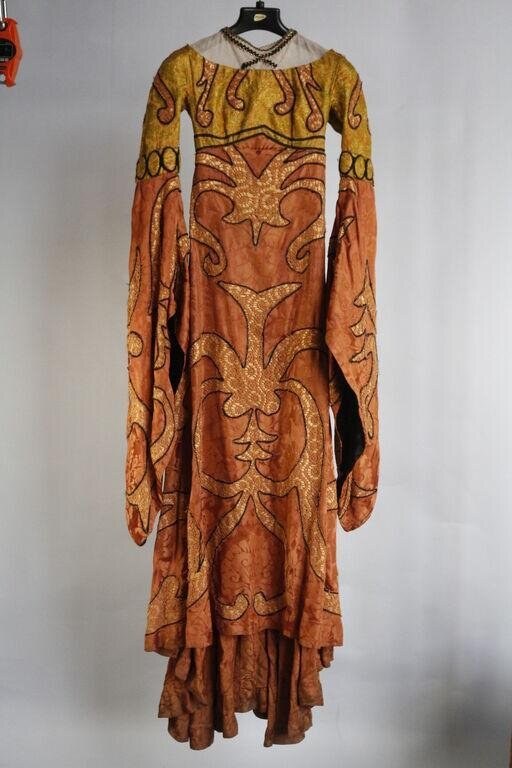
Georgiadis was a major figure in mid-century theatrical design whose costumes and sets defined the visual grammar of mid-twentieth-century ballet and opera across multiple continents and companies. This costume demonstrates the material reality of his design practice—the precision embroidery, the choice of color and ornament, the structural intelligence—in a way that photographs of performance cannot. For historians of theatrical design, costume craft, and mid-twentieth-century ballet aesthetics, the object itself is a primary source.
What you are looking at
A single figure stands against a neutral ground wearing an elaborate theatrical costume dating to the mid-twentieth century. The garment is a long, flowing dress constructed in two contrasting tones: a golden-yellow upper section and a warm terracotta-orange lower section. The entire surface is covered in ornate decorative patterning rendered in gold thread or metallic embroidery—scrolling foliate motifs, paired crescent shapes, geometric borders, and symmetrical ornamental panels that suggest either Byzantine, Persian, or classical theatrical influence. The costume features long fitted sleeves, a high round neckline with dark edging, and a full skirt with a dramatic hemline that falls in uneven tiers or layers, creating movement and dimension. A long cape or shawl element drapes from the shoulders, extending to the hem and emphasizing vertical line and theatrical presence. The embroidery is dense and systematized, organized into repeating formal registers across the torso and legs. The costume reads as designed for a performer of considerable stature in a major theatrical production, with every element calibrated for stage visibility and dramatic impact.
The dancing
The figure stands in a neutral, frontal pose—neither in motion nor in character—displaying the costume for examination. The arms hang naturally at the sides. The body is centered and upright, allowing the full silhouette and the ornamental patterning to be read completely. There is no indication of the wearer's body type or movement quality; this is a costume display, not a performance capture. The garment itself dominates: its weight, volume, and surface decoration are the visual subject.
The dance depicted
This costume almost certainly belongs to a classical or mythological theatrical production, most likely a ballet or opera of the mid-twentieth century. The formality of the ornamentation, the use of gold metallic thread, the symmetrical patterning, and the layered silhouette are consistent with classical ballet costumes designed for secondary or ensemble roles in classical or neoclassical works—particularly roles coded as exotic, ancient, or supernatural. The style and construction suggest a major European or American theatrical house. The costume could represent a priestess, oracle, nymph, or other ceremonial or mythological figure. Without seeing the costume on a moving body or knowing the specific production, the dance vocabulary cannot be determined with certainty.
How it was made
This is a three-dimensional object—the actual costume garment—not an image in any traditional sense. The photograph documents the costume as a museum piece, displayed on a dress form or mannequin against a neutral studio background. The garment appears to be hand-embroidered: the gold patterning is applied to the fabric surface with precision and density that suggests skilled needlework, possibly using metallic threads, beadwork, or both. The construction—the tailoring, seaming, and hemming—is professional; this is a high-quality artifact made for a major theatrical production and preserved as a museum object. The photograph itself is documentary and archival in purpose, showing the object fully and clearly.
About this work
This is a stage costume from a mid-twentieth-century theatrical production, almost certainly a classical ballet or opera, preserved as a museum object. The costume is designed for a supporting or ensemble role in a mythological or ancient-world narrative, rendered in the formal language of classical theatrical dress: a precisely embroidered garment in contrasting warm tones with elaborate gold ornamentation. The costume demonstrates the craft tradition of stage costume making at a high level of theatrical production in the 1960s, and it serves as evidence of how mid-century dance and opera companies conceptualized and materially realized classical and mythological characters. The creator, Nicholas Georgiadis, was a prominent mid-twentieth-century costume and set designer whose work shaped the visual vocabulary of classical ballet during a formative period.
How to look at it
Attend first to the overall silhouette and how the garment moves in space. Then study the ornamental system: how the gold patterning is organized into registers and repeated motifs, how it defines and articulates the body beneath, and what visual impression the embroidery would create under stage lighting. The symmetry and precision of the decoration are intentional; they establish a character as formal, classical, and aligned with order and authority. Notice how the layered hem and flowing cape extend the sense of movement and grandeur. The color choice—warm golds and oranges—suggests both regal or divine status and earthiness or sensuality, depending on the narrative context.
The artist
Nicholas Georgiadis (1923–2001) was a Greek-born costume and set designer who became one of the most influential theatrical designers of the mid-twentieth century. He worked extensively with major ballet and opera companies in Europe and the United States, including the Royal Ballet and the Royal Opera House in London, and created designs for productions of classical and contemporary works. His practice combined classical training with modernist sensibilities; his designs were known for architectural clarity, rich color, and meticulous ornamental detail. He worked across multiple scales and media—from intimate costume detail to large-scale stage environments—and his influence on theatrical aesthetics extended well beyond any single company or tradition.
The period
In 1965, mid-century modernism was reshaping theatrical and dance aesthetics, yet classical ballet remained a central institutional practice in major opera houses and ballet companies. The post-war period saw increased investment in arts institutions and lavish productions of classical ballets, particularly in London and New York. Costume design was understood as a major artistic discipline, and major designers like Georgiadis commanded significant budgets and creative autonomy. At the same time, abstract and minimalist aesthetics were challenging decorative traditions; Georgiadis's work navigated this tension, maintaining formal ornament and classical reference while incorporating modernist principles of clarity and geometric organization.
Where it lives
The costume is held in a theatrical or museum collection, presumably preserved from the production for which it was designed. The catalogue record identifies it as a theatre costume from 1965, attributed to designer Nicholas Georgiadis, and notes the source as 'va' (likely a reference to the Victoria and Albert Museum or a similar institutional archive), suggesting the costume entered an institutional collection at some point.
Dance in this work
Questions about this work
Who was Nicholas Georgiadis?
Georgiadis (1923–2001) was a Greek-born costume and set designer who became one of the most influential theatrical designers of the twentieth century. He worked with major opera and ballet companies including the Royal Ballet and Royal Opera House London, and created designs for classical ballets, contemporary works, and operas. His practice combined classical ornament with modernist clarity, and his influence extended across European and American theatrical institutions.
What production did this costume belong to?
The catalogue record does not identify a specific production. The style, date, and ornamentation suggest a classical or neoclassical ballet or opera from the mid-twentieth century, likely a work in the classical repertory, but the particular production remains unrecorded.
How was the ornamental patterning created?
The dense gold patterning appears to be hand-embroidered, using metallic threads applied to the fabric surface in organized repeating motifs. This would have required skilled needlework and considerable time, and represents a significant investment in the costume's production. The precision and density of the work indicate a major theatrical institution with substantial resources.
What does the costume tell us about mid-century theatrical practice?
The costume demonstrates the material and aesthetic priorities of mid-twentieth-century theatre: substantial investment in handcrafted detail, the centrality of classical reference, and the understanding of costume as a major artistic discipline. The formal ornamentation and precise construction show how theatrical designers of this period created visual splendor and character through material richness and craft.
More dance artwork





