49 works in this view — arrow keys or swipe to move between them.
Dance in Art
Cinderella
Brotherston, Lez
- Collection:
- Costume design
- Source:
- Victoria and Albert Museum
- Rights:
- Rights vary by item — check the source record before reusing this image. Source record ↗
- Recorded as:
- V&A — check rights per item
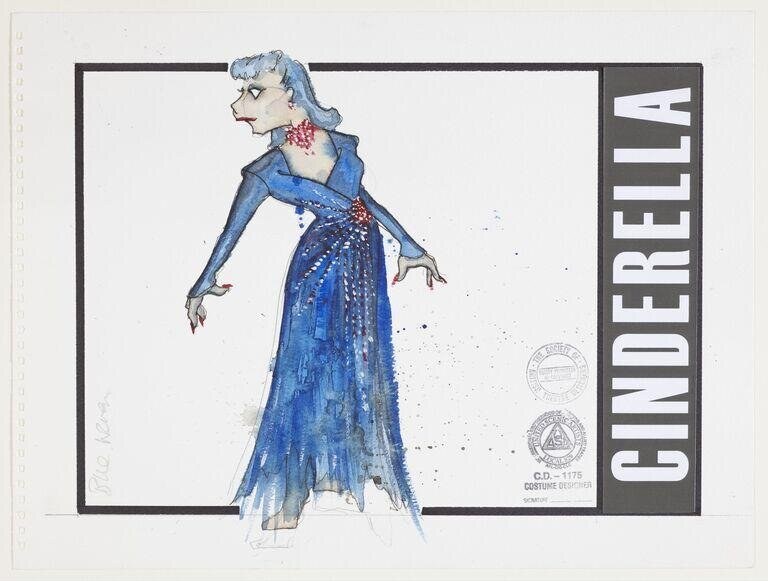
Costume design is central to how ballet is experienced and understood. This drawing shows the deliberate choices—color, silhouette, ornament, material suggestion—that transform an abstract role into a visible, embodied character. For historians and dancers, it documents how a specific production imagined and executed a key moment in a canonical ballet.
What you are looking at
A costume design for a female dancer in a blue ballroom gown, rendered in watercolor or gouache with delicate line work. The figure is shown in profile, facing left, wearing an elaborate floor-length dress with a fitted bodice and a dramatically voluminous skirt composed of tiered panels that cascade to the floor. The dress is predominantly midnight blue with intricate detailing throughout. She wears a short-sleeved wrap or shrug in a lighter blue shade over her shoulders, and her hair is styled in a 1940s-inspired wave set in pale blue-gray. A red jeweled brooch or corsage is pinned at her neckline, and red nail polish is visible on her extended hand. The figure stands in an elegant, balletic pose with one arm extended and the other held gracefully at her side, suggesting both stillness and potential motion. The composition is spare and architectural: the figure occupies the left side of a rectangular frame against a cream background, with the title "CINDERELLA" displayed vertically on the right edge in bold white capitals on a dark gray panel.
The dancing
The dancer is presented in a profile stance that balances poise with theatrical presence. Her posture is upright and dignified, with the extended arm suggesting either a gestural moment or preparation for movement. The weight appears centered, the legs straight, the carriage aristocratic. The artist has captured fine details: the turn of the wrist, the taper of the fingers, the tilt of the head—all suggesting training and refinement. There is one figure only, isolated, presented as a character study rather than a dance scene.
The dance depicted
This is a costume design, not a record of dance in action. The dress itself belongs to classical ballet tradition, and the pale, ethereal quality of the blue fabric and the balletic posture suggest this is a costume for the Fairy Godmother or a similar magical character in a ballet adaptation of Cinderella. The design speaks to mid-twentieth-century ballet practice: the silhouette, the materials, the jewelry all align with Western theatrical ballet of the 1940s–1950s. Without further context, the specific ballet production cannot be identified from the image alone, but the work is clearly preparation for a major classical role.
How it was made
This appears to be a watercolor or gouache costume design on paper, a standard medium for theatrical costume documentation. The technique is precise and controlled: the blue pigments show careful layering and blending to suggest fabric weight and drape, while line work in pen or ink defines the structure of the dress and the figure. The addition of red accents (nail polish, brooch) and the subtle gray-blue of the hair demonstrate the artist's understanding of how color reads on stage. Such designs were made for costume makers, directors, and archives, and this example bears a catalogue stamp or institutional mark, indicating it was part of a theater or dance archive collection.
About this work
This is a costume design drawing by Lez Brotherston for a ballet production of Cinderella, dated 2017. It documents a single character—likely a magical or supernatural figure—in elaborate formal dress. The work sits within the tradition of theatrical design documentation: the precise, annotated drawing that precedes execution and serves as a record of the designer's vision. It belongs in a dance archive because it shows how a major classical narrative ballet is materially constructed and visually realized on stage. The work demonstrates the continued relevance of Cinderella to contemporary ballet and the role of design in establishing character and atmosphere.
How to look at it
Look at how the artist has used the profile view to show the complete silhouette and structure of the dress—this is the designer's primary task, to communicate how the costume reads from the audience's perspective. Notice the proportions: the relatively narrow bodice against the wide, structured skirt creates a silhouette that is both romantic and commanding. The color, a luminous blue, suggests magic and otherworldliness. The extended arm and graceful posture convey the character's authority and elegance, telling the viewer something about who this person is before a word is spoken.
The artist
Lez Brotherston is a renowned British costume and set designer who has worked extensively in theater, ballet, and opera since the 1990s. His work is distinguished by meticulous draftsmanship, sophisticated color sense, and an ability to marry historical reference with contemporary theatrical vision. He has designed for major international ballet companies and is known for both large-scale classical productions and innovative new works.
The period
In 2017, ballet was in a moment of sustained interest in classic narratives alongside experimental new work. Cinderella remains one of the most frequently produced ballets in the classical repertory, with major choreographies by Prokofiev (the standard versions by Ashton and others). The work also attracted contemporary directors seeking to reframe or reimagine the fairy tale. Brotherston's design practice sits in a lineage of theatrical design stretching back to the early twentieth-century innovations in costume and spectacle that defined modern ballet as a visual as well as kinetic art form.
Where it lives
The work is held in the Victoria & Albert Museum's collection as a costume design, catalogued as part of their extensive holdings of theatrical design. The catalogue number and institutional stamp visible on the drawing indicate it has been formally accessioned.
Dance in this work
Questions about this work
What ballet is this for?
The record identifies this as a costume design for Cinderella, dated 2017. The specific production and choreography cannot be definitively established from the image alone, but this is clearly a design for a major classical ballet. Lez Brotherston has designed for numerous productions; checking his professional archives or the V&A's own records would identify the exact commission.
Is the figure dancing?
No. This is a costume design document, not a record of a dancer in action. The figure is shown in an elegant, balletic pose appropriate to the character, but the image is primarily meant to display the dress itself—its structure, proportion, color, and detail—so that a costume maker could construct it.
Why is it in profile?
Profile presentation is standard in costume design because it shows the complete silhouette of the garment in three-dimensional space without foreshortening. It also allows the designer to clearly indicate the back, side, and front contours of the dress in a single, legible view.
What does the blue color mean?
Blue is associated in ballet tradition with magic, otherworldliness, and nobility. For Cinderella, this is likely a Fairy Godmother or similar enchanted character. The pale, luminous quality of the blue in the design drawing suggests how the fabric would catch light on stage.
More dance artwork





