49 works in this view — arrow keys or swipe to move between them.
Dance in Art
Theatre costume
Georgiadis, Nicholas
- Collection:
- Theatre costume
- Source:
- Victoria and Albert Museum
- Rights:
- Rights vary by item — check the source record before reusing this image. Source record ↗
- Recorded as:
- V&A — check rights per item
For dance historians and theatre professionals, this costume demonstrates how classical subject matter was realised on stage in the 1960s, and how a designer of Georgiadis's calibre approached the problem of making antique dress legible and beautiful under stage light. The ornamental technique—hand-applied woven trim in geometric and natural forms—shows the craft skill still expected of theatre costume makers at this date, before industrial reproduction. If this costume survives with a clear production history, it is a direct record of a specific work; if not, it remains evidence of design practice and making technique in post-war European theatre.
What you are looking at
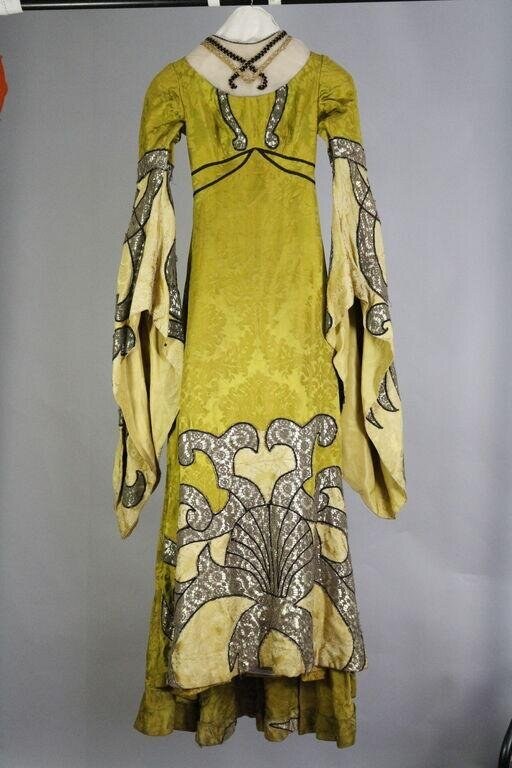
A sleeveless tunic dress in chartreuse yellow-green linen or linen-like fabric, displayed on a dress form without visible feet. The garment features a high waistline marked by decorative cord or braid in dark thread, and the skirt falls in a straight, floor-length column. The most striking feature is ornamental embroidery or tablet-woven trim applied in curving, interlocking patterns: a large fan or peacock-tail motif spreads across the lower front, while narrower scrolling patterns frame the neckline and sweep down the sides. Sleeveless construction with a wide round neckline. The long dramatic sleeves visible on either side of the form appear to be a separate garment—possibly an overdress or tabard—made of the same yellow-green linen but with more elaborate woven or embroidered ornament covering the full length of each sleeve in geometric and foliate designs. A decorative chain or necklace of dark thread with ornamental terminals drapes across the dress form's shoulders, positioned as it would sit on a wearer's chest. The overall effect is of high-status, formal costume, suggesting classical or mythological subject matter rather than contemporary dress.
The dancing
No human figure is present. The costume is displayed on a dress form, which prevents assessment of how it was worn in motion or what posture it implied. However, the loose-fitting, columnar silhouette and absence of fitted bodice suggest the wearer would have had freedom of movement through the torso and hips—consistent with classical or early modern theatrical costume that prioritized both legibility from distance and some physical ease.
The dance depicted
This is a theatre costume, not documentation of dance in action. The style and ornamentation suggest classical Greek or Roman subject matter, typical of early-to-mid 20th-century theatrical design for dramatic or operatic works. The loose column of the dress and the absence of fitted construction would accommodate stage movement, including dance if the production included it. Georgiadis was a leading designer for classical and contemporary theatre, so this likely belongs to a specific production, but the image alone does not identify which dance (if any) was performed in this garment.
How it was made
This is a constructed textile object—a complete garment—not a drawing, print, or painting. It appears to be linen (warp) with hand-embroidered or tablet-woven trim in contrasting dark thread, possibly wool or linen. The ornamental bands show sophisticated technique: the fan motif is symmetrical and densely worked, suggesting either hand embroidery or pre-woven decorative trim applied by hand. The chain ornament draping the shoulders is a separate element, likely metal or metallic thread. As a museum object, it preserves the actual material evidence of how such a costume was constructed and worn, which is richer than any image.
About this work
This is a stage costume designed by Nicholas Georgiadis, dated 1965, for a theatrical production with classical or mythological subject matter. It survives as a complete three-dimensional garment, preserved in a theatre or costume collection. The design shows the hallmarks of mid-20th-century classical theatre design: restrained silhouette, sophisticated hand-applied ornament, and historical reference rendered through material and colour rather than archaeological exactness. Georgiadis was one of the most distinguished costume and set designers of his era, working with major choreographers and directors across ballet, opera, and drama. This piece represents his practice at a moment when theatrical costume design was a serious art form, equal in status to the performance it dressed.
How to look at it
Attend to the ornamental bands: they show the level of hand labour expected even in a single costume for a major production. The fan motif on the skirt is the visual anchor—a focal point the audience would see from the stalls. The plain ground of the tunic sets off this ornament; there is no competing pattern or texture. Notice the colour choice: yellow-green is unusual and risks looking sickly, but under warm stage lighting it would have read as golden or antique. The sleeves, more densely decorated, suggest this costume was designed for a character of importance, since ornament signalled status in both historical dress and theatrical convention.
The artist
Nicholas Georgiadis (1923–2001) was a Greek-born costume and set designer who became one of the most celebrated theatrical designers of the mid-20th century. He worked extensively with the Royal Ballet and Royal Opera House, London, designing for major choreographers including Frederick Ashton and Kenneth MacMillan. His practice was rooted in historical research and a painter's sensitivity to colour and composition; he designed for classical ballet, contemporary works, opera, and drama with equal authority. His costumes were known for combining historical reference with modern elegance and freedom of movement for the performer.
The period
In 1965, classical ballet and opera were experiencing a renaissance of interest in historical dress and mythological subject matter. Ashton's ballets drawing on classical themes, and MacMillan's ambitious full-length works, created demand for costumes that were both historically informed and visually striking on stage. Theatre design in this period was still firmly rooted in handcraft—embroidery, weaving, and dyeing were primary techniques—and there was no expectation that costume would be industrially reproduced. The taste for saturated, unusual colour (here a strong yellow-green) reflects the painterly approach of designers like Georgiadis, who thought of costume as visual composition first. Classical subject matter in dance was itself somewhat conservative in 1965, as contemporary dance and experimental choreography were beginning to challenge the dominance of classical ballet.
Where it lives
The costume is held in a theatre collection (noted as 'Theatre costume' in the catalogue). It is catalogued with Georgiadis's name and the date 1965, suggesting a known production history, though that history is not provided in the record. The source is noted as 'va', likely the Victoria and Albert Museum or a V&A collection partner.
Dance in this work
Questions about this work
What production was this costume made for?
The catalogue record does not identify the specific play, opera, or ballet for which Georgiadis designed this costume. To find out, you would need to consult the full collection records at the holding institution, or cross-reference Georgiadis's productions from 1965.
Could this costume have been worn for dance?
Yes. The loose silhouette, absence of restrictive boning or corsetry, and high waistline are all compatible with movement. However, the garment itself does not document dance—it is a complete costume object. If the production included dance or choreographed movement, this would have been comfortable to move in, but the image alone does not tell us whether it was.
How was the ornament made?
The ornamental bands appear to be tablet-woven trim or hand-embroidered braid, applied by hand to the plain linen ground. The technique is sophisticated and labour-intensive—this suggests either a specialist embroiderer in a theatre workshop, or purchased decorative trim of very high quality. By the 1960s, such ornament would have been relatively expensive to produce.
Who was Nicholas Georgiadis?
Georgiadis (1923–2001) was a Greek designer who became one of the most distinguished costume and set designers of the 20th century. He worked for the Royal Ballet and Royal Opera House for decades, collaborating with choreographers like Frederick Ashton and designers like Rudolf Nureyev on some of the most memorable productions of the era.
More dance artwork





