49 works in this view — arrow keys or swipe to move between them.
Dance in Art
Theatre costume
Georgiadis, Nicholas
- Collection:
- Theatre costume
- Source:
- Victoria and Albert Museum
- Rights:
- Rights vary by item — check the source record before reusing this image. Source record ↗
- Recorded as:
- V&A — check rights per item
Nicholas Georgiadis was one of the most influential theatrical designers of the second half of the 20th century, and his costume designs directly shaped how ballet audiences understood character and narrative. This piece is physical evidence of how ballet in the 1960s created visual meaning through structured embellishment and formal tailoring, a practice that would influence theatrical costume design beyond dance.
What you are looking at
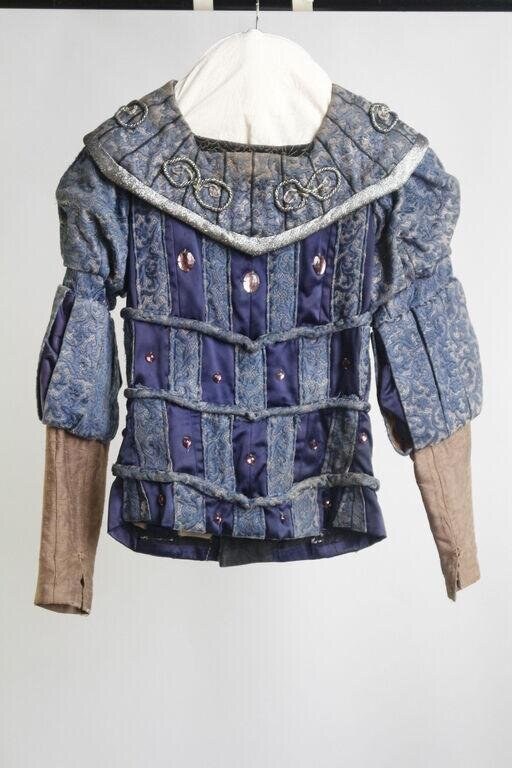
This is a theatrical costume displayed on a dress form, photographed against a neutral background. The garment is a short-sleeved jacket or tunic in deep blue-grey patterned fabric, with a striking large collar piece laid over the shoulders. The collar is elaborately decorated with spiral or concentric circle motifs in metallic thread, arranged in rows across its surface. The main jacket body is structured with vertical panels in contrasting deep navy blue, each panel studded or embellished with metallic ornaments arranged in regular rows. The sleeves are three-quarter length in the same patterned blue-grey fabric as the main body. Underneath or as part of the construction, lighter tan or beige fabric is visible, particularly at the cuffs and in the construction seams. The overall silhouette is compact and structured, with a broad, defined shoulder line created by the elaborate collar. The geometric precision of the embellishment and the formality of the construction suggest this is a costume for a specific character or role rather than everyday dress.
The dancing
This is a costume object, not a depiction of a dancer in motion, so traditional dance analysis of hold and weight does not apply. However, the garment's construction tells us about the wearer's posture and movement: the broad, structured shoulders and rigid collar would enforce an upright, formally-held frame. The relatively short length and fitted waist suggest mobility in the legs and torso, allowing for movement or dancing. The three-quarter sleeves leave the forearm free for gesture or arm extensions. The weight of the embellishments, particularly across the shoulders and chest, would have affected how the wearer carried their upper body.
The dance depicted
This is a theatrical costume, almost certainly from ballet or another formal European theatrical dance tradition of the 1960s. The style of embellishment and the formal geometric patterning suggest a character role—possibly a nobleman, courtier, or mythological figure—rather than a principal dancer's costume. The construction is consistent with mid-20th-century ballet costume practice. Without seeing the costume in motion or knowing which production it belongs to, the specific dance role cannot be definitively named, though the 1965 date and the designer Nicholas Georgiadis (known for his work in ballet) suggest this is from a significant theatrical production of that period.
How it was made
This is a three-dimensional textile object: a tailored jacket with hand-applied embellishment. The construction includes woven base fabrics (the patterned blue-grey and the contrasting navy panels), cut and sewn in a fitted pattern. The embellishment appears to be metallic thread or beads stitched in rows to create the spiral and geometric motifs, applied after the basic garment was assembled. This is hand-craft work typical of high-end theatrical costume production, where durability under stage lighting and movement was a priority. The photograph documents the costume in a museum or archival context, presented on a neutral form to show the garment's construction, volume, and surface detail.
About this work
This is a 1965 theatrical costume designed by Nicholas Georgiadis, a major figure in mid-20th-century ballet design. The garment is a formal, geometrically embellished jacket or tunic, constructed for a character role in a theatrical dance production. The elaborate spiral and circular motifs applied in metallic thread across the collar and vertical panels suggest a wealthy, high-status character—possibly from a classical or mythological narrative. The 1965 date places it in the postwar era of British and European ballet, when theatrical costume became increasingly sophisticated in its use of embellishment and colour.
Georgiadis was principal designer for major ballet companies including The Royal Ballet, and his costumes are recognised for their precise construction and inventive use of pattern and ornament to support characterisation. This piece exemplifies his approach: the costume communicates status, character, and historical or fantastical setting through visual embellishment rather than through literal historical accuracy. For researchers of mid-century ballet costume practice, it is a direct example of how theatrical demand shaped textile construction and ornamental technique.
How to look at it
Look at the precision of the embellishment: the spiral motifs on the collar and the regular rows of metallic studs down the chest and panels are clearly calculated to catch light and create visual interest. Notice how the collar is scaled to dominate the silhouette, creating a formal frame for the wearer's head and neck. The contrast between the patterned background fabric and the solid navy panels with studs creates visual structure and divides the garment's surface. The weight and geometry of the embellishment would have affected how the wearer moved, creating rhythm and emphasis. The three-quarter sleeves and fitted waist suggest this was a character who needed to be both formally presented and capable of movement—the costume was engineered, not merely decorated.
The artist
Nicholas Georgiadis (1923–2001) was a Greek-British designer who became principal designer for The Royal Ballet and a major figure in international theatrical design. He trained as an architect before moving into stage design, and that background informed his approach to costume: he understood garments as constructed objects with geometric precision, often using bold pattern, structured silhouettes, and inventive embellishment to serve narrative and character. His designs for ballets such as *Swan Lake*, *The Sleeping Beauty*, and *Cinderella* in new productions during the 1960s–1980s established visual languages still influential in contemporary ballet. He also designed for opera, theatre, and film, working regularly with major choreographers and directors.
The period
In the 1960s, ballet costume design was undergoing significant change. While classical ballet maintained links to 19th-century practice, designers like Georgiadis were exploring how modern materials, embellishment techniques, and sculptural tailoring could serve both historical narrative and abstract design. The 1965 date places this costume in the era of major British and European ballet production, when companies like The Royal Ballet were reviving and reinterpreting classical repertory with new designs. Theatrical embellishment was becoming more adventurous—metallic threads, beads, and appliqué were used to create visual impact under stage lighting rather than to reproduce historical costume literally. This costume reflects that practice: its geometric precision and modern construction technique serve a theatrical rather than historical purpose.
Where it lives
The costume is held in a theatre collection or costume archive (source listed as 'va', likely the Victoria and Albert Museum Theatre Collection). It is catalogued as a theatre costume object, identified by designer and date but not yet linked to a specific production. The photograph shows it in archival condition on a dress form, a standard method of documenting three-dimensional theatrical objects.
Dance in this work
Questions about this work
Who was Nicholas Georgiadis?
Georgiadis (1923–2001) was a Greek-British designer who trained as an architect and became one of the most influential theatrical designers of the postwar era. He was principal designer for The Royal Ballet and created landmark costume designs for major classical ballets in the 1960s–1980s, establishing visual styles that remain influential. His design philosophy combined geometric precision, bold colour, and inventive embellishment to serve character and narrative.
What kind of character would have worn this costume?
The formal tailoring, elaborate embellishment, and structured silhouette suggest a high-status character—a nobleman, courtier, prince, or mythological figure. The geometric precision and the use of metallic thread are typical of 1960s ballet character costumes for roles that needed to be both visually striking and dramatically significant. Without knowing the specific production, we cannot name the character, but the costume's construction communicates wealth, status, and formal authority.
How was this costume made?
It was hand-tailored from woven fabrics—a patterned blue-grey base with contrasting navy panels—and then embellished by hand. The metallic spiral and circular motifs were stitched onto the collar and the vertical panels of the chest. This hand-craft technique was standard for high-end theatrical costume, where durability under stage movement and lighting was essential. The structured tailoring and precise embellishment suggest this was made by skilled costume makers in a professional theatrical atelier.
What is the geometric pattern on the collar?
The pattern consists of concentric circles or spiral motifs arranged in rows across the collar piece. These are worked in metallic thread or beads, creating a dense, regular surface that would catch stage light and draw visual focus to the wearer's shoulders and neck. The pattern is non-representational and purely decorative, serving to enhance the visual impact and formality of the costume rather than to reference historical or cultural sources.
More dance artwork





