49 works in this view — arrow keys or swipe to move between them.
Dance in Art
Le Bal
Unknown artist
- Collection:
- Theatre costume
- Source:
- Victoria and Albert Museum
- Rights:
- Rights vary by item — check the source record before reusing this image. Source record ↗
- Recorded as:
- V&A — check rights per item
Stage costumes are rarely preserved and even more rarely accessible; this object is direct evidence of how a specific dance work was meant to look and move. The design choices—the spiral motif, the treatment of the neckline, the choice of tulle—reflect deliberate aesthetic decisions by a designer working within a specific moment and artistic movement, making it invaluable for understanding 1920s dance practice.
What you are looking at
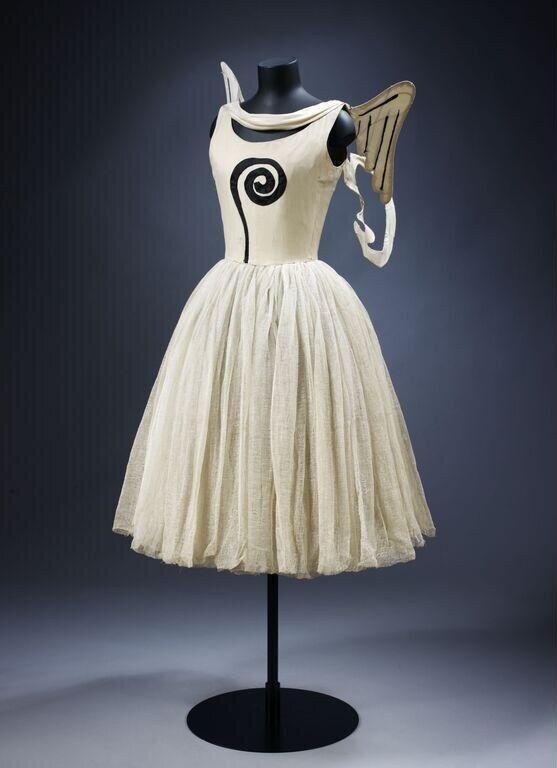
A cream-colored sleeveless dance costume is displayed on a dress form against a dark gradient background. The garment features a simple, elegant design with a fitted bodice and a voluminous skirt that falls to mid-calf in soft, pleated folds. The bodice is decorated with a single black spiral motif on the front and white ribbon trim along the curved neckline. The skirt, made of what appears to be tulle or similar sheer fabric, creates a cloud-like silhouette typical of interwar dance costumes. A matching cream-colored gauze shawl or wrap is draped over one shoulder of the form, its lightweight fabric suggesting a prop for dramatic gesture.
The dancing
No dancer is present; this is a costume object displayed on a dress form. The design suggests a figure of modest height and delicate frame, with the garment proportioned for a slender torso and relatively high waist typical of 1920s fashion and dance wear. The spiral motif and flowing shawl suggest costumes meant to permit arm movement and dramatic gestures, likely in a demi-caractère or lyrical style requiring fluid, sustained positions rather than technical athleticism.
The dance depicted
This is a stage costume from 1929, a period when European ballet and modern dance were actively experimenting with design reform. The aesthetic—simplified line, asymmetrical accent, emphasis on fabric flow—aligns with 1920s modernist approaches to theatrical costume design seen in avant-garde ballet companies and art deco design circles. The spiral motif resembles designs from the Ballets Russes era, though the modest, understated decoration suggests a shift away from the ornate exoticism of earlier decades. Without documentation, the specific dance cannot be identified, but the costume's cut and drape indicate a work requiring legible arm and body movement, possibly a solo or featured role in a lyrical ballet or demi-caractère piece.
How it was made
This is a surviving example of stage costume construction, made from natural fibers (likely silk or linen for the bodice, tulle for the skirt) and hand-finished with ribbon trim and painted or appliquéd decoration. As a preserved garment object, it represents both the designed intention of a choreographer or costume designer and the practical craft of theatrical dressmaking. The condition of the object and the care taken in its preservation indicate its status as a significant work of theatrical or costume history, worthy of museum conservation.
About this work
This is a 1929 theatrical costume, likely from a European ballet or dance work of the interwar period. The design reflects the modernist aesthetic that dominated progressive dance and design during the late 1920s—a moment when the ornamental excess of earlier decades gave way to cleaner lines and an emphasis on movement and light. The costume survives as evidence of how dance practitioners of the period thought about the body, femininity, and the relationship between garment and gesture. It belongs in a dance gallery as a primary document of theatrical practice and as an artifact of the period when ballet was being reformed by artists engaged with contemporary visual modernism.
How to look at it
Look first at the proportion and cut: the high waist, the fitted bodice, and the voluminous skirt are signatures of 1920s fashion and dance costume alike. Note the placement of the spiral—dead center on the torso, a single bold gesture rather than overall pattern—and how it would read from a distance on stage. The shawl is essential: it is not a coat but a prop, and its placement suggests a costume designed to show the arm and shoulder line while permitting large, sustained gestures. The simplicity is the achievement: a designer working in 1929 chose not to ornament this costume further, trusting line and proportion alone.
The period
The late 1920s saw European dance at a crossroads. The Ballets Russes was at its height, but a new generation of artists—including modernist painters, sculptors, and designers—was increasingly involved in dance. Costume design was no longer merely decorative but conceptual: designers like Sonia Delaunay, Alexandra Exter, and others created garments that reflected cubist, constructivist, and art deco principles. In ballet specifically, there was growing interest in simplified, architecturally coherent costume design that did not impede movement. This costume reflects that moment: its restraint and geometric clarity mark it as a work of the late 1920s, not the more exuberant or exotic designs of the 1910s.
Where it lives
The garment is held as part of a theatre costume collection, catalogued by the V&A (Victoria and Albert Museum) in London. It entered the collection during the museum's systematic acquisition of twentieth-century stage costume and design, making it part of a larger effort to preserve the material culture of theatre history.
Dance in this work
Questions about this work
Is this costume from a specific ballet or dance work?
The catalogue record does not identify the original work, choreographer, or dancer. The title 'Le Bal' (The Ball) is the only attribution, but without further documentation it cannot be confirmed whether this refers to a known choreography or is simply a descriptive label applied later. Records for many twentieth-century costumes have been lost or are incomplete.
Why is the costume preserved on a dress form rather than flat?
Museum conservation practice for fragile textiles typically calls for support on a padded form to prevent creasing, distortion, and stress on seams and closures. This also permits the costume to be displayed and studied in its intended three-dimensional form, showing how the garment would have moved on a dancer's body.
What does the spiral motif mean?
The spiral was a common geometric motif in modernist design of the 1920s, appearing in visual art, fashion, and stage design. Its meaning here is primarily formal—a bold, centered accent that reads clearly from stage distance—though spirals also carried associations with motion and energy in avant-garde circles of the period.
Could this costume have been worn for ballroom dancing?
No. The construction, materials, and cut are distinctly theatrical. The tulle, the delicate trim, and the shawl are appropriate for stage performance under lights but not for social dancing. This is a costume for trained performers in a theatrical setting.
More dance artwork





