49 works in this view — arrow keys or swipe to move between them.
Dance in Art
Theatre costume
Unknown artist
- Collection:
- Theatre costume
- Source:
- Victoria and Albert Museum
- Rights:
- Rights vary by item — check the source record before reusing this image. Source record ↗
- Recorded as:
- V&A — check rights per item
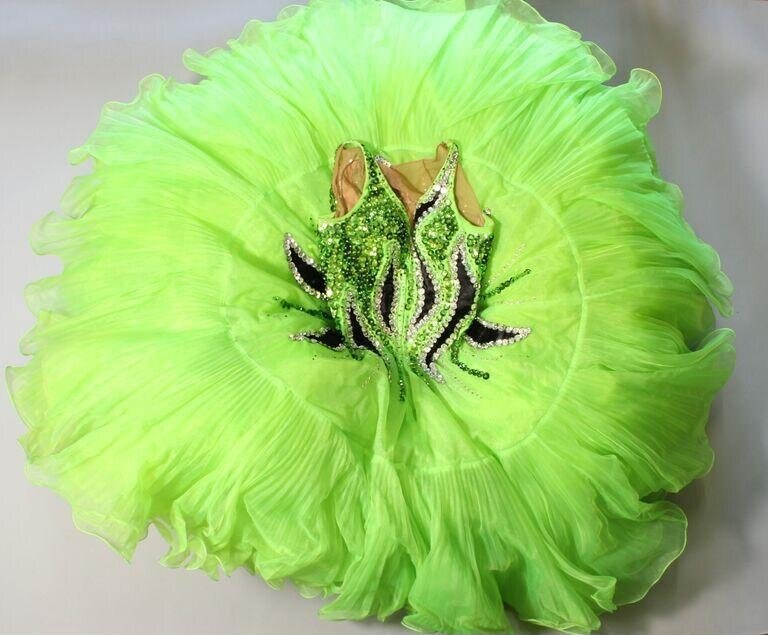
Costume design is integral to dance history, yet theatrical costumes are often preserved poorly or studied less rigorously than choreography or performance footage. This photograph documents the specific material choices, construction, and visual language of 1980s theatrical dance design, including the use of vivid synthetic color and ornamental beading that characterized the era. For costume historians and theatrical designers, it provides concrete evidence of how spectacle and color theory were deployed in late twentieth-century dance.
What you are looking at
A single dancer is photographed or captured against a stark white background, wearing an extraordinary lime-green tulle skirt that billows dramatically outward in a full, voluminous circle. The skirt dominates the composition, creating an almost abstract radial pattern of fine, pleated tulle folds that radiate from the dancer's body. At the center, the dancer wears a striking green beaded or sequined costume piece—possibly a bodice or chest ornament—decorated with black beading or black fabric elements that create a theatrical, insect-like or abstract design. The green beading suggests a high degree of ornamentation typical of theatrical costumes. The tulle extends to create an enormous silhouette, suggesting this is a studio photograph taken from above or at a slight angle to emphasize the dimensional quality of the garment. The extreme fullness of the skirt and the precise centering suggest this was a deliberate costume study, likely taken to document the design or silhouette of a performance costume.
The dancing
The dancer's body is almost entirely obscured by the costume's volume. Only the upper torso and the ornate chest piece are clearly visible, with the dancer appearing to stand relatively still or in a neutral stance. The pose seems designed to showcase the costume itself rather than to display active dance movement or technique. The dancer's positioning—centered and still—suggests this is a costume documentation photograph rather than a capture of movement in performance.
The dance depicted
The lavish, ornamental costume and theatrical green coloring suggest this is from a theatrical dance production, most likely ballet or a theatrical performance from the 1980s. The elaborate beading and sequin work on the chest piece, combined with the extreme volume of the tulle skirt, points to a fantasy or spectacle-based ballet narrative—possibly a character such as a fairy, magical creature, or stylized animal role. The costume's design emphasizes visual spectacle and silhouette over movement functionality, which was characteristic of late 20th-century theatrical and contemporary dance productions that prioritized visual design.
How it was made
This appears to be a color photograph, likely taken in a studio with controlled lighting to emphasize the bright lime-green color and the dimensional quality of the tulle. The white background and even lighting suggest professional costume documentation photography, possibly taken during costume fittings or for production records. The photographic medium allowed the designer and production team to document the full three-dimensional silhouette and construction details of the garment before or during production.
About this work
This 1983 theatre costume is a striking example of late twentieth-century theatrical design, prioritizing visual spectacle and ornamental detail. The lime-green tulle skirt and beaded bodice represent the kind of elaborate, fantasy-based costume design common in ballet and theatrical dance productions of that era. The photograph documents not a moment of dance but the costume object itself—its construction, color, and silhouette—making it a record of the material and visual culture of 1980s dance theatre.
The work sits at the intersection of fashion, dance design, and theatrical production. It demonstrates how costume operated as a primary element of storytelling and visual impact in theatrical dance, and it offers insight into the construction techniques and aesthetic priorities of that moment in dance production history.
How to look at it
Attend to the color first—the vivid lime green is not naturalistic and signals a deliberate, abstract or fantastical character. Notice how the tulle is structured: the pleating is precise and geometric, radiating outward, which required specific construction technique. Look at the beaded chest piece and how it contrasts with the translucence and delicacy of the tulle—it is the visual anchor that grounds the otherwise ethereal skirt. The photograph's centered framing and white background are typical of costume documentation, used to make the garment readable and measurable as a design object.
The period
In 1983, theatrical dance in North America and Europe was marked by a move toward spectacle, elaborate costume design, and visual maximalism—a reaction against the austerity of 1970s postmodern dance. Ballet companies were investing in lavish productions with strong narrative content, while contemporary dance was becoming more theatrical and design-forward. The lime-green synthetic color and the volume of tulle reflect the technological capabilities of the era: synthetic fabrics were increasingly available in vivid colors, and theatrical budgets allowed for experimental, visually bold designs. This costume represents the optimism and visual exuberance of 1980s theatrical dance production.
Where it lives
The work is catalogued as a theatre costume held in a collection marked 'va' (likely a reference to a specific institution or archive). The costume itself is the primary object; this photograph documents it. The 1983 date suggests the costume was either created or documented that year.
Dance in this work
Questions about this work
What character or role would have worn this costume?
The design suggests a fantasy or magical character—possibly a fairy, sprite, insect, or otherworldly being in a ballet or theatrical dance production. The ornamental chest piece and vivid color support a non-realistic or abstract character identity. Without access to production records, the specific role cannot be determined from the costume alone.
How much of this costume is visible in the photograph?
The photograph shows the skirt and the upper bodice/chest ornament. The dancer's legs, feet, arms, and full upper body are not visible—they are either obscured by the tulle or cropped out of the frame. This framing was likely intentional, focusing documentation on the skirt's structure and the bodice detail.
Is this garment made to move in, or is it purely decorative?
The extreme volume and weight of the tulle would significantly restrict movement. While the dancer could walk, turn, and perform some basic actions, large traveling steps or rapid footwork would be difficult. The costume prioritizes visual impact and silhouette over movement ease, suggesting it was designed for a character who moved deliberately, posed dramatically, or remained relatively still on stage.
What does the lime-green color tell us about 1980s theatre design?
The vivid, synthetic green reflects both the technological availability of bright synthetic dyes and a deliberate aesthetic choice toward visual spectacle and artifice. In 1983, such bold, unnatural colors were markers of theatrical fantasy and sophisticated design, not naturalism.
More dance artwork





