49 works in this view — arrow keys or swipe to move between them.
Dance in Art
Set design
Stevenson, Hugh
- Collection:
- Set design
- Source:
- Victoria and Albert Museum
- Rights:
- Rights vary by item — check the source record before reusing this image. Source record ↗
- Recorded as:
- V&A — check rights per item
Set design is as integral to theatrical dance as choreography: it defines the world the dancer inhabits, frames the body, and shapes the audience's emotional response. Stevenson's work shows how a designer uses classical theatrical language—drapery, perspective, ornament—to create a romantic fantasy space, a vocabulary that dominated European ballet design for much of the 20th century.
What you are looking at
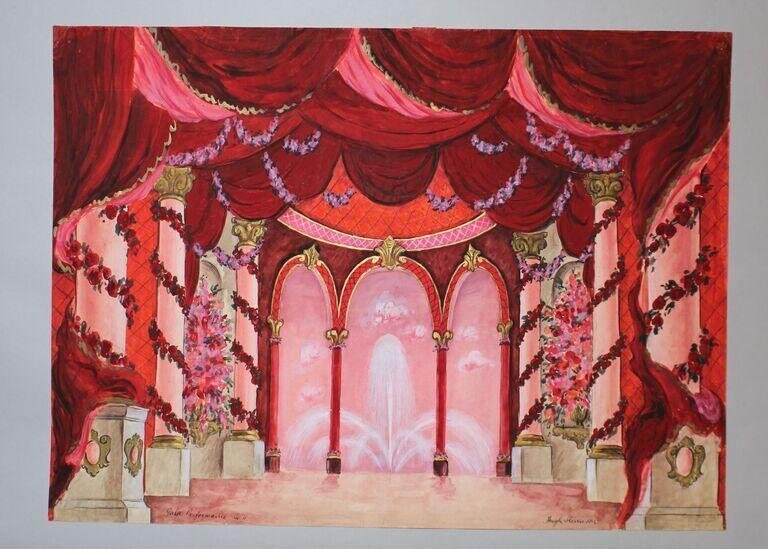
This is a theatrical set design rendered in watercolor and gouache, depicting an elaborate proscenium stage interior. The stage is framed by swags of deep red velvet drapery with gold trim, arranged in classical festoons and suspended from ornamental brackets. The background opens to three tall arched alcoves with rose-pink paneling, receding in perspective and suggesting a ballroom or palatial interior. Climbing roses or flowering vines in deep magenta and crimson wind around pale stone pedestals or pilasters on either side, creating a romantic, garden-like atmosphere within the architectural frame. The foreground is a pale peachy-rose floor. The color palette is dominated by reds, pinks, golds, and creams, creating an impression of luxury, artifice, and theatrical spectacle. The composition suggests a romantic or mythological narrative set in a grand classical or Renaissance-inspired space.
The dancing
No human figures are visible in this image. This is a stage set design rather than a depiction of dancers or choreography in action.
The dance depicted
Without figures, it is impossible to identify a specific dance from this image. However, the setting—a classical interior with formal architectural elements—suggests a theatrical or court dance context, likely from the 19th-century Romantic ballet tradition or early 20th-century theatrical design. The elaborate, fantastical staging and the emphasis on romantic flora and grand perspective indicate a ballet or opera-ballet milieu rather than social or folk dance.
How it was made
This appears to be a watercolor and gouache design on paper, a standard medium for theatrical set designs in the early 20th century. The technique allows for rapid, vivid color studies and clear communication of the spatial and decorative intentions to production teams. The rendering shows careful attention to perspective, lighting effects (especially the graduated coloring to suggest depth), and the texture of fabrics and architectural surfaces. This is a working design document, likely created for a specific production.
About this work
This is a stage set design by Hugh Stevenson, dated 1940, depicting a romantic interior stage space framed by lavish red velvet drapery and classical architectural elements. The design prioritizes theatrical spectacle, grandeur, and an atmosphere of romantic fantasy. Stevenson was a prominent mid-20th-century British theatrical designer who created sets for ballet, opera, and dramatic theater. This work exemplifies the aesthetic of early-20th-century theatrical design: layered, decorative, emphasizing linear perspective and rich color to create immersive fantasy worlds for performers. The design belongs in a dance collection because it represents the visual and spatial context in which dance was performed, and the designer's choices fundamentally shape how dance is seen and experienced.
How to look at it
Observe the use of color gradation to create depth: the arches recede from pink to nearly white at the center background, drawing the eye inward. Notice how the architectural frame (the swags and brackets) creates a "stage within the stage," a classical device that emphasizes the theatrical artifice. The climbing roses create a visual tension between the geometric severity of the columns and the organic, romantic sensibility of the flowers—a balance characteristic of mid-century romantic design. The design invites the viewer to imagine a dancer's body moving through this space, positioned against the architectural grid and framed by the sumptuous drapery.
The artist
Hugh Stevenson (1910–1973) was a British theatre and ballet designer who worked extensively with major British ballet companies in the mid-20th century, including the Ballet Rambert and the Sadler's Wells Ballet. He was known for his sophisticated, architecturally informed approach to set design, often drawing on classical and historical references. His designs combined practical stagecraft with painterly sensibility, and he created sets for both dramatic theater and dance productions.
The period
In 1940, British theatrical design was at a pivotal moment. The interwar period had seen the rise of modernist and constructivist approaches to stage design, but classical and romantic aesthetics remained powerful, especially in ballet. The Second World War was underway, and yet theatrical production continued. Stevenson's lush, decorative approach represents a continuation of the romantic-classical tradition in ballet design, even as avant-garde movements challenged it elsewhere. The 1940s in Britain saw continued investment in prestigious ballet companies as cultural institutions, and designers like Stevenson were central to their visual identity.
Where it lives
This design is held in the collection listed as 'va' (Victoria and Albert Museum, London), which maintains extensive archives of British theatrical design. The work is a set design document from 1940, part of the institutional record of theatrical production.
Dance in this work
Questions about this work
Why is a set design in a dance gallery if there are no dancers?
Set design is a fundamental part of theatrical dance. It shapes the space dancers move through, defines the visual world of the performance, and profoundly influences how the choreography is perceived. Understanding dance history requires understanding the visual and spatial contexts in which it was performed, and designers like Stevenson were as essential to that experience as choreographers.
What ballet or dance work was this design for?
The catalogue record does not specify a particular work or production. Without additional archival information, it is not possible to identify which ballet or theatrical work this design was created for. The style and aesthetic suggest a romantic or classical ballet from the 1940s British theatrical tradition, but the specific production remains uncertain.
What does the architectural style tell us about the dance?
The classical arches, ornamental brackets, and perspective recall Renaissance or Baroque palatial interiors. This suggests a narrative or themed ballet set in a grand, historical, or mythological world—ballrooms, palaces, or heaven-like spaces were common settings for romantic and classical ballet. The formality of the architecture would frame the dancers as graceful figures moving through an idealized, elevated space.
More dance artwork





