49 works in this view — arrow keys or swipe to move between them.
Dance in Art
Parisiana
Campbell & Gray
- Collection:
- Photograph
- Source:
- Victoria and Albert Museum
- Rights:
- Rights vary by item — check the source record before reusing this image. Source record ↗
- Recorded as:
- V&A — check rights per item
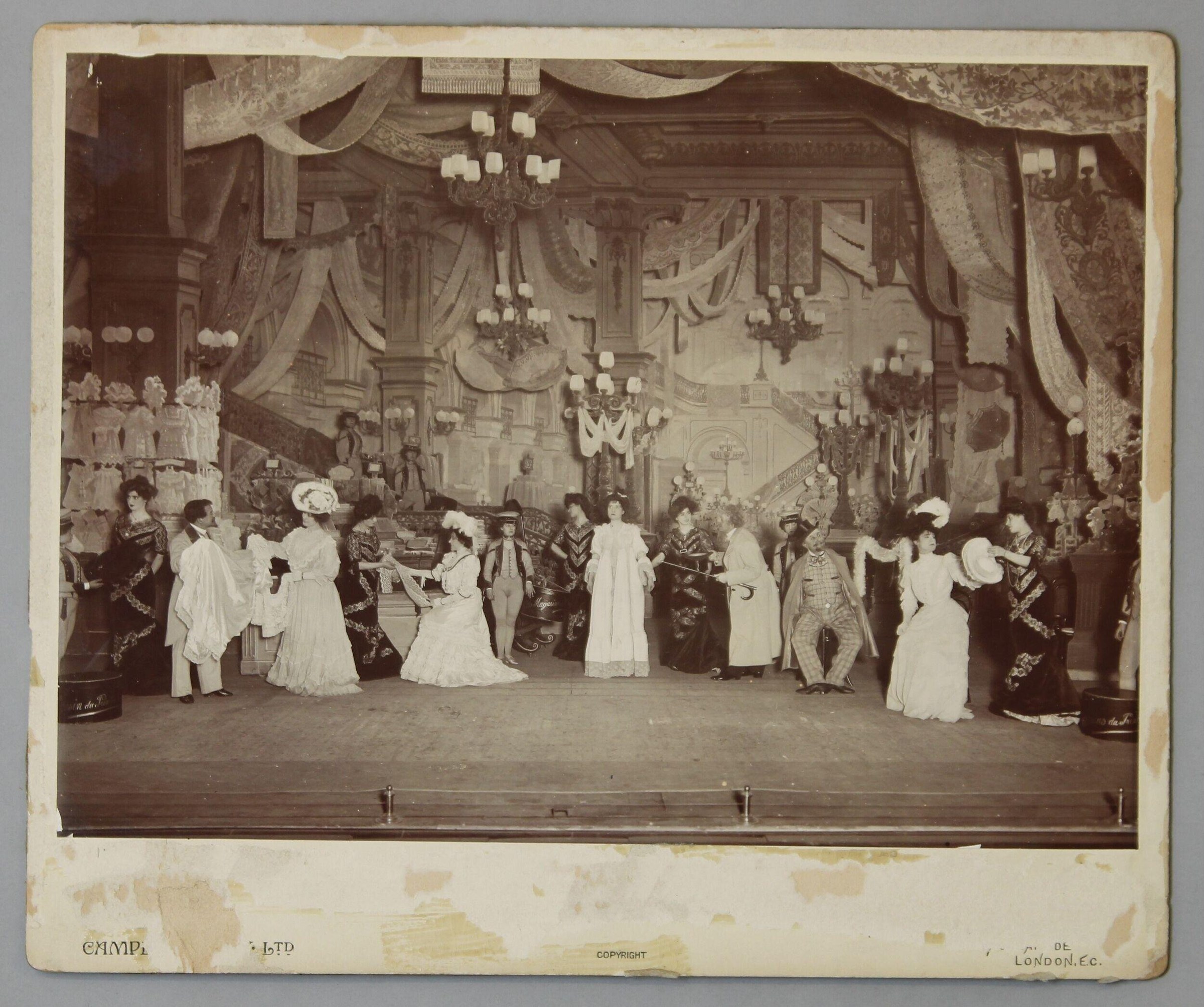
This image is a rare theatrical production photograph from the pre-cinema era, showing how ballroom scenes were staged and photographed for commercial distribution around 1905. It reveals the visual grammar of theatrical Edwardian dance: spectacle, costume, architectural grandeur, and social density outweighing any legible choreographic content. For historians of ballroom dance, musical theatre, and theatrical photography, it documents how dance was integrated into operetta and musical comedy in London at the turn of the twentieth century.
What you are looking at
A grand ballroom scene of operatic or theatrical scale, photographed as a stage set or production still. The space is dominated by elaborate Edwardian or Belle Époque interior design: ornate wooden ceiling beams, swags of pale fabric draped from the ceiling corners, and a central multi-tiered chandelier with clustered globes. The far wall features neoclassical architectural detail—pilasters, arches, and what appears to be a painted roundel or decorative panel. The floor is a polished dance floor, and the space is densely populated with figures in formal evening dress. Women in white or pale gowns dominate the foreground, several wearing large picture hats; men wear dark tailcoats and military or formal jackets with insignia. The lighting is theatrical—bright and even across the stage—and the scene captures a moment of mingling and movement, not a single unified choreographic moment. Elaborate floral displays in tall vases sit at stage left. The entire composition suggests a fin-de-siècle society ball, operatic intermezzo, or theatrical masquerade rather than a concert dance.
The dancing
The figures are in social ballroom proximity rather than partnered dance holds. Most stand or walk with upright, formal posture typical of Edwardian etiquette. A few figures in the center suggest the possibility of active dance—one woman in white appears to be in motion, her posture suggesting rotation or a step-turn—but the overall composition reads as a social gathering in which dance is ambient rather than focal. The military dress and insignia on several male figures, and the extreme formality and density of the gathering, suggest this is a court or state occasion rather than a ballroom dance competition or concert performance.
The dance depicted
This is almost certainly a theatre or opera production scene rather than documentary of social dancing. The title 'Parisiana' and the Belle Époque setting suggest a theatrical work set in or celebrating Paris, possibly an operetta, musical comedy, or grand opera with a ballroom or society act. The choreography, if present, is submerged in the spectacle of costume, architecture, and social tableau. The dress and decorum are consistent with ballroom social dances of the period—waltzes, quadrilles, and slow promenade figures would be the likely vocabulary—but the image presents choreography as setting and mood rather than as a legible sequence of steps.
How it was made
This is a sepia-toned photograph on paper, printed from a theatrical production. The photographer is credited as Campbell & Gray (visible on the print itself), and the publication mark 'London, E.C.' indicates it was a commercial theatrical photograph, likely sold to the public as a souvenir or to the press. Theatrical production photography of this period was a key medium for disseminating images of stage spectacle before cinema; it required strong lighting, fast film stock, and careful staging to capture the scene in a single exposure. The quality and composition suggest a professional stage photographer working for a major London theatre.
About this work
This is a theatrical production photograph from the Edwardian era showing a grand ballroom scene from 'Parisiana,' a theatrical work—likely an operetta or musical comedy—staged by Campbell & Gray in London around 1905. The photograph captures the Belle Époque aesthetic: an elaborately decorated neoclassical interior, formal evening dress, military uniforms, and a crowded social tableau in which ballroom dancing is the implied occasion but not the explicit choreographic content. The work is important as evidence of how dance was represented in early 1900s theatre: as spectacle, luxury, and social order rather than as a vehicle for virtuosity or innovation. It belongs in a dance collection both as a document of theatrical practice and as a window into the cultural meanings of ballroom dance in the Edwardian theatre.
How to look at it
Observe first the architectural and decorative frame: the ceiling beams, swags, chandelier, and painted wall are as much the subject as the figures. The photograph captures a moment of social mingling and circulation rather than a frozen step; notice how many figures are in transit, turning, or standing in conversation, rather than in partnered positions. The dress—particularly the women's large hats and white gowns, the men's military insignia—establishes this as a state occasion or high society event, not a ballroom dance demonstration. Look at the lighting: it is theatrical, even, and bright, designed to render the entire scene legible, not to isolate or emphasize any one moment of choreography. The photograph's purpose was not to document the dance but to sell the vision of a luxurious, cosmopolitan theatrical world.
The artist
Campbell & Gray were London theatrical photographers operating in the Edwardian era. Their studio produced commercial production photographs and souvenir prints for London theatres, with their studio mark visible in the lower right of this print. Little is known of their individual biographies, but their work represents the standard practice of professional theatrical photography at a moment when such images were key to marketing stage productions to the public and press.
The period
In the 1890s and early 1900s, operetta and musical comedy were hugely popular in London and Paris, following the success of Gilbert and Sullivan and continental works by composers such as Messager and Offenbach. These theatrical forms routinely featured ballroom scenes, grand finales set at society events, and ensemble spectacle. Simultaneously, theatrical photography was a major commercial enterprise: large-format photographs of staged scenes were sold as souvenirs and press images, before cinema displaced them. The Belle Époque style visible in this photograph—neoclassical interiors, Edwardian evening dress, military uniforms, abundant floral decoration—was the visual language of luxury and modernity in this period. Ballroom dancing itself, in social and theatrical contexts, was undergoing codification and systematization during these decades, the process that would eventually yield modern ballroom dancing.
Where it lives
This is a commercial theatrical production photograph by Campbell & Gray, credited on the print itself. The mark 'London, E.C.' (East Central London) indicates the studio location. Such photographs were printed and sold as souvenirs and to the press; this example is held in the collection identified as source 'va,' which the record does not further specify.
Dance in this work
Questions about this work
Is this a real ballroom or a stage set?
This is a stage set for a theatrical production, photographed by a professional theatre photographer. The ornate interior, the precise lighting, and the theatrical composition all indicate this is a constructed scene, not a documentary photograph of an actual social event. However, the architectural and decorative details were designed to be readable as a luxurious real ballroom.
What is Parisiana?
The record identifies this as 'Parisiana,' a theatrical work staged around 1905. It was likely an operetta or musical comedy, a genre hugely popular in London and Paris in the 1890s–1910s. Without further documentation, we cannot determine whether 'Parisiana' was an original work or a revival of an existing piece. Ballroom and society scenes were standard set pieces in operetta.
Can you see actual dancing in this photograph?
Not in the sense of legible steps or choreographed figures. The scene is composed as a social gathering at a ballroom rather than as a choreographic tableau. A few figures suggest movement or dance posture, but the overall effect is of dancers in social mingling rather than in performance of a set piece. The photograph captures the theatrical idea of ballroom dancing rather than its execution.
Who were Campbell & Gray?
They were professional theatrical photographers operating in London in the early 1900s. Their studio was located in East Central London. They produced commercial production photographs for London theatres, which were printed and sold as souvenirs and to the press. Theatrical photography of this kind was a major visual medium for marketing stage productions before cinema.
More dance artwork





