49 works in this view — arrow keys or swipe to move between them.
Dance in Art
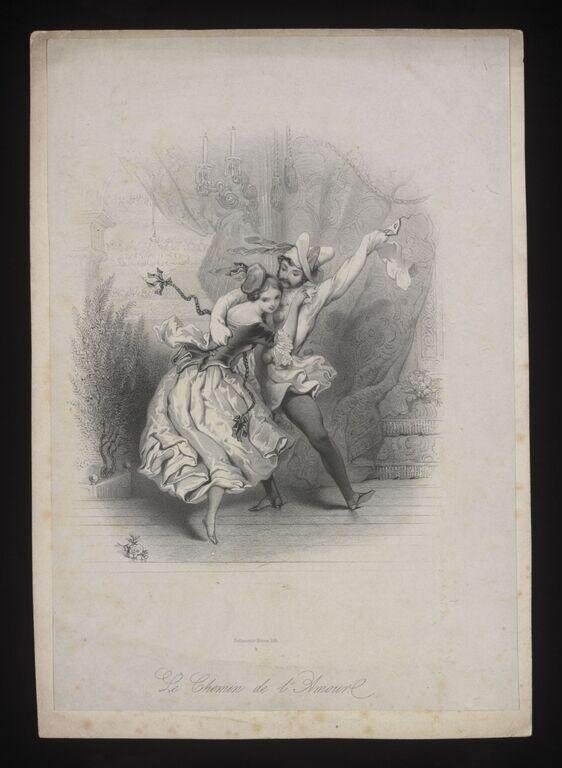
"Le Chemin de l'Amour."
Bettannier frères
- Collection:
- Source:
- Victoria and Albert Museum
- Rights:
- Rights vary by item — check the source record before reusing this image. Source record ↗
- Recorded as:
- V&A — check rights per item
This image captures the moment when theatrical spectacle and acrobatic partnering emerged as entertainment forms in the 19th century. For dancers and historians, it documents the vocabulary of support, lift, and theatrical abandon that would become central to later performance practices, from music hall to modern dance partnering.
What you are looking at
A young woman in a pale, high-waisted Empire-silhouette dress dances with a dark-clothed male partner in what appears to be an ornate interior, possibly a palace or grand salon. The woman's body is caught mid-leap or lift, her skirts billowing around her, her arms extended upward in abandon. The man, seen from behind, supports or catches her with both hands at her waist. The background is atmospheric and lightly sketched—classical architecture with columns and draped fabrics suggests a formal theatrical or courtly setting. The overall mood is one of playful eroticism: the woman's pose is entirely dependent on her partner's strength, her body open and vulnerable, her expression one of delight. The composition is intimate despite the grand setting, focusing the eye on the couple's physical connection. The line work is delicate but assured, with careful attention to the fall of fabric and the musculature of the man's exposed arms and torso.
The dancing
The male dancer stands in a deep lunge or squat position, his legs bent and braced, his torso upright and muscular, wearing only dark breeches and a draped cloak or jacket. The female dancer is lifted or leaping, her weight entirely on her partner—she is not supporting herself. Her legs are bent and drawn up, her arms flung backward and upward in a pose of complete trust and exuberance. Her head is thrown back. The spatial relationship is one of physical intimacy and asymmetrical support: he is stable and grounded; she is weightless and surrendered. This is not a partner dance in the ballroom sense—it is acrobatic, carnivalesque, or mythological in character.
The dance depicted
This does not depict social ballroom dance or folk-regional forms. The imagery suggests either pantomime, commedia dell'arte, or a romantic theatrical fantasy of the kind that appeared in 19th-century vaudeville and music-hall performance. The pose recalls the stock gesture of seduction and abandon in French erotic print culture of the 1830s–1860s. The title 'Le Chemin de l'Amour' (The Path of Love) frames this as a romantic narrative moment rather than a specific dance form. The physical vocabulary—the lift, the submission, the theatrical grandeur of the setting—suggests theatrical entertainment or artistic fantasy rather than any codified dance technique.
How it was made
This is a steel or copper engraving with hand-applied tone or wash, possibly a stipple engraving given the soft modeling of light and shadow. The technique allowed for fine detail and subtle gradation, making it suitable for circulation as a print in albums or periodicals aimed at a middle- to upper-class audience. Engraving of this quality was labor-intensive and expensive, indicating this was a significant commercial or artistic product. The soft, romantic handling of form and the erotic subject matter are characteristic of 19th-century French reproductive prints.
About this work
This is a French engraving, probably from the 1840s–1860s, depicting a moment of romantic and physical exuberance framed as 'The Path of Love.' A young woman in Empire-silhouette dress is lifted and supported by a male partner in an acrobatic pose that combines elements of theatrical spectacle, commedia dell'arte, and erotic fantasy. The work is not a record of any specific dance form but rather a romantic narrative image—a frozen moment of gallantry, trust, and desire rendered in a classical interior.
The image belongs in a dance gallery because it documents how theatrical entertainment, physical comedy, and romantic narrative were performed and imagined in the 19th century. The pose itself—the lift and the asymmetrical relationship between the partners—became a staple vocabulary of later theatrical dance, from music-hall performance through early 20th-century cabaret and dance theater.
How to look at it
Attend to the moment of suspension: the woman is entirely airborne and unsupported except by her partner's hands. This is the climactic gesture, the moment of maximum vulnerability and trust. Notice the contrast between the man's grounded, muscular stillness and the woman's weightless, ecstatic abandon. The classical interior—columns, drapery, architectural perspective—frames this as a moment of civilized leisure and refined entertainment, not street performance or folk custom. The soft modeling and atmospheric perspective give the scene a dreamlike, fantasy quality characteristic of Romantic-era erotic imagery.
The artist
Bettannier frères (the Bettannier brothers) were 19th-century French engravers and printmakers active in the production of commercial reproductive prints and book illustrations. They are not widely documented in standard art-historical sources, but their work circulated in print albums and periodicals aimed at a popular audience. The subject matter—romantic and slightly erotic scenes—was typical of the commercial print market of the period.
The period
In the 1840s–1860s, European theater and dance entertainment was marked by Romanticism and a fascination with spectacle, exoticism, and the private drama of desire. Theatrical dance was still dominated by ballet, but music-hall and vaudeville performance was growing, introducing acrobatics, partnering tricks, and pantomime into popular entertainment. The fashion visible here—the Empire waist and diaphanous skirts—echoes the aesthetic of Romantic ballet, which was at its height during this period. In visual culture, erotic and romantic scenes of this kind were extremely popular in printmaking, particularly in France.
Where it lives
The work is recorded as a print in the collection designated 'va' (likely an abbreviation for Virginia or a museum in Virginia), but no accession number, date of acquisition, or fuller provenance is documented. It survives as part of a body of commercial prints from the 19th-century European market.
Dance in this work
Questions about this work
Is this a real dance or a fantasy?
Both. The pose—the lift and the exuberant gesture—draws on real theatrical and acrobatic practice of the 19th century, particularly commedia dell'arte and music-hall performance. But the scene is framed as romantic narrative fantasy, not documentary. The title suggests that the viewer is meant to read it as a story about love and desire, not as a technical record of a specific dance form.
Who would have bought or looked at this print?
Middle- and upper-class Europeans with access to print albums, periodicals, or art shops. The subject matter—romantic and slightly erotic—was commercially popular throughout the 19th century. The quality of the engraving suggests it was aimed at a fairly affluent audience, though prints were cheaper than paintings and circulated more widely.
What does this tell us about partnering in 19th-century dance?
It shows that asymmetrical, acrobatic partnerships—where one dancer is lifted, caught, or made to appear weightless—were already established as a vocabulary of spectacle and entertainment. This language would become foundational to later theatrical forms, from music-hall to modern dance. The image suggests that partnering was understood as a display of one partner's strength and the other's surrender.
More dance artwork





