49 works in this view — arrow keys or swipe to move between them.
Dance in Art
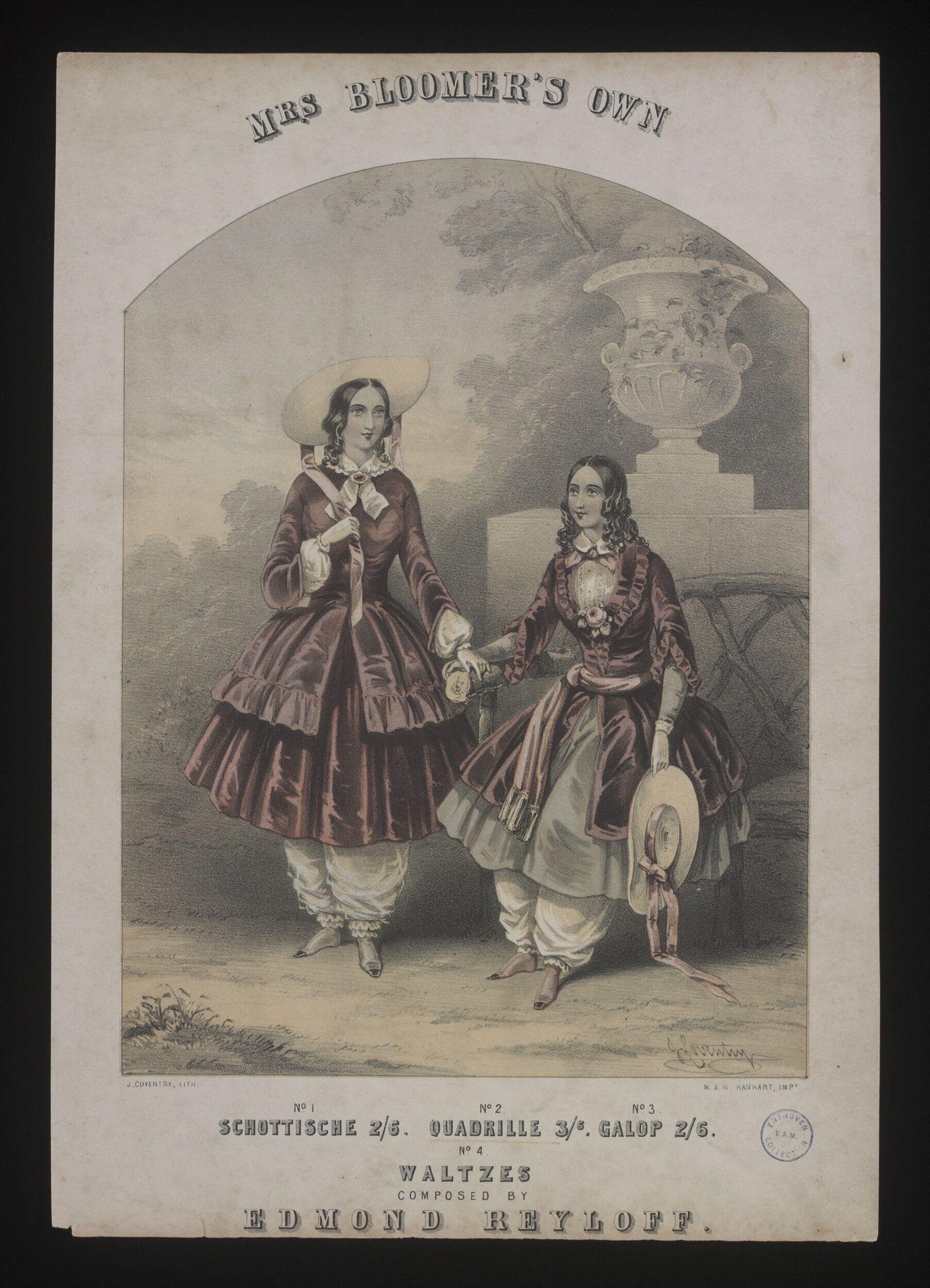
Mrs. Bloomer's Own
E. Reyloff
- Collection:
- Music
- Source:
- Victoria and Albert Museum
- Rights:
- Rights vary by item — check the source record before reusing this image. Source record ↗
- Recorded as:
- V&A — check rights per item
The work provides evidence of how nineteenth-century ballroom culture was commodified and circulated through sheet music and prints, and how dance was understood as an inseparable element of genteel fashion and social identity. The reference to 'Mrs. Bloomer' opens a conversation about gender, dress, and the politics of ballroom dance in an era of social reform.
What you are looking at
Two women in fashionable mid-nineteenth-century dress stand in conversation in a classical garden setting. Both wear deep burgundy silk dresses with voluminous skirts gathered at the hem with deep flounces or pleats, paired with cream or pale-colored pantalettes visible at the ankle. The woman on the left wears a wide-brimmed straw hat; the woman on the right holds a hat in her hand. They stand before a large classical urn on a pedestal, with columned architecture and foliage visible in the soft-lit background. The engraving captures a moment of social promenade or leisure—the women are poised, upright, and engaged with one another in the manner of fashionable society. The print is labeled as music for waltzes composed by Edmond Reyloff, with three numbered pieces marked as schottische, quadrille, and galop.
The dancing
Both figures stand in a relaxed but dignified posture characteristic of Regency and early Victorian ballroom deportment. The woman on the left gestures expressively with her gloved hand raised; the woman on the right stands more formally, one arm at her side. Neither figure is in active dance position, but their upright carriage, the formal dress, and the refined setting establish the context of ballroom society. The composition suggests a moment of social interaction rather than active dancing.
The dance depicted
This print documents three ballroom dances popular in the mid-nineteenth century: the schottische (a lively four-beat partner dance with a step-hop character), the quadrille (a square-formation dance for four couples), and the galop (a rapid turning dance in 2/4 time). These were staples of fashionable society balls. The women's dress—the voluminous skirts with flounces, the pale pantalettes, the formal hats—is consistent with 1840s–1850s ballroom fashion. The image does not depict actual choreography in motion, but rather presents the dancers as fashionable society figures, advertising the music for these dances.
How it was made
This is a hand-colored or tinted engraving, a common format for music covers and sheet music illustration in the nineteenth century. The soft tonal values, the fine linear detail in the dresses and background, and the careful registration of the figure composition suggest professional engraving, likely from a commercial music publisher. The medium allowed for mass circulation of music and dance culture to an affluent domestic market. The artist's hand (here 'E. Reyloff' and credited to engravers J. Courboin and P. E. Gaugert) is visible in the confident rendering of fabric texture and the composed balance of the scene.
About this work
This is a cover sheet for a waltz suite published in the mid-nineteenth century, illustrated with two fashionable women in a ballroom setting. Rather than depicting choreography, the image serves as a social document and marketing material: it frames ballroom dancing as a leisure activity of refined society and sells the music through the appeal of fashionable dress and elegant setting. The title 'Mrs. Bloomer's Own' is a witty reference to the 1850s American dress-reform movement and Amelia Bloomer's advocacy for rational dress—here playfully invoked for women engaged in the height of fashion. The print sits at the intersection of dance documentation, commercial music publishing, and social history, capturing how ballroom dancing was marketed and consumed as an element of respectable domestic life.
How to look at it
Attend to the fine engraving of the dress: the flouncing of the skirts, the texture of the silk, and the careful rendering of the light pantalettes suggest how these dances were performed in motion—with full, sweeping skirts and upright, elegant carriage. Notice the woman on the left mid-gesture, her hand raised in a naturalistic conversational pose; this captures the social world in which dancing occurred, as much as the dancing itself. The classical garden setting—the urn, the columns—frames ballroom dance as an activity of refinement and taste. The titled dances and the composer's name identify this as commercial sheet music, not fine art, yet the quality of the engraving and the care of the composition signal serious attention to marketing and appeal.
The artist
Edmond Reyloff was a mid-nineteenth-century composer and arranger of ballroom dance music. The print credits the engravers J. Courboin and P. E. Gaugert, professional artisans of the music publishing trade in Paris or London. Their role was to produce appealing commercial imagery that would drive sales of domestic music. Little further biographical detail is currently recorded.
The period
The 1840s–1850s were the height of the waltz craze in fashionable Europe and America, and quadrilles and galops were equally central to ballroom life. The schottische emerged as a popular partner dance in the 1840s. This period saw explosive growth in music publishing aimed at the domestic market, particularly for amateur musicians and dancers in middle- and upper-class households. Sheet music covers became increasingly elaborate and visually marketed. The 'Bloomer' reference dates the work to the 1850s, when Amelia Bloomer's advocacy for loose-fitting trousers for women provoked intense debate and humor in popular culture; the title here is a playful jab at fashion reform from the perspective of high-fashion ballroom culture.
Where it lives
The work is held in the collection's Music materials, indicating it was catalogued as a published sheet music cover or music-related print. It entered the holdings through the 'va' source (likely a Virginia collection or archive), though full provenance and accession details are not currently recorded.
Dance in this work
Questions about this work
What is 'Mrs. Bloomer's Own'?
The title is a witty reference to Amelia Bloomer and the 1850s 'rational dress' movement, which advocated for less restrictive clothing for women. The print uses the reference playfully, ironically advertising music for dances performed in the height of fashionable—not reformed—dress. It capitalizes on the topical humor and publicity surrounding the Bloomer controversy.
Are these three separate dances or one waltz in movements?
The print advertises three separate dances: a schottische, a quadrille, and a galop. These were typically published together as sets or suites of ballroom music, allowing dancers to program an evening of varied dances. All three were essential to mid-nineteenth-century ballroom repertory.
How were prints like this used?
Sheet music covers like this were commercial products sold in music shops and by subscription. They advertised compositions to amateur musicians and dancers in the home, while the printed engraving also served as wall decoration or a collectible. The fashionable imagery made the music appealing to buyers who saw themselves or aspired to the social identity depicted.
What can this tell us about how these dances looked?
The dress—voluminous skirts with flounces, tight bodices, and pale pantalettes—tells us that these dances were performed with upright carriage and flowing, sweeping movement. The women's posture and gesture suggest the formality and social refinement with which ballroom dances were conducted. However, this is a social portrait, not a choreographic illustration, so detailed footwork cannot be inferred.
More dance artwork





