49 works in this view — arrow keys or swipe to move between them.
Dance in Art
All the Year Round
London Stereoscopic Company
- Collection:
- Photograph
- Source:
- Victoria and Albert Museum
- Rights:
- Rights vary by item — check the source record before reusing this image. Source record ↗
- Recorded as:
- V&A — check rights per item
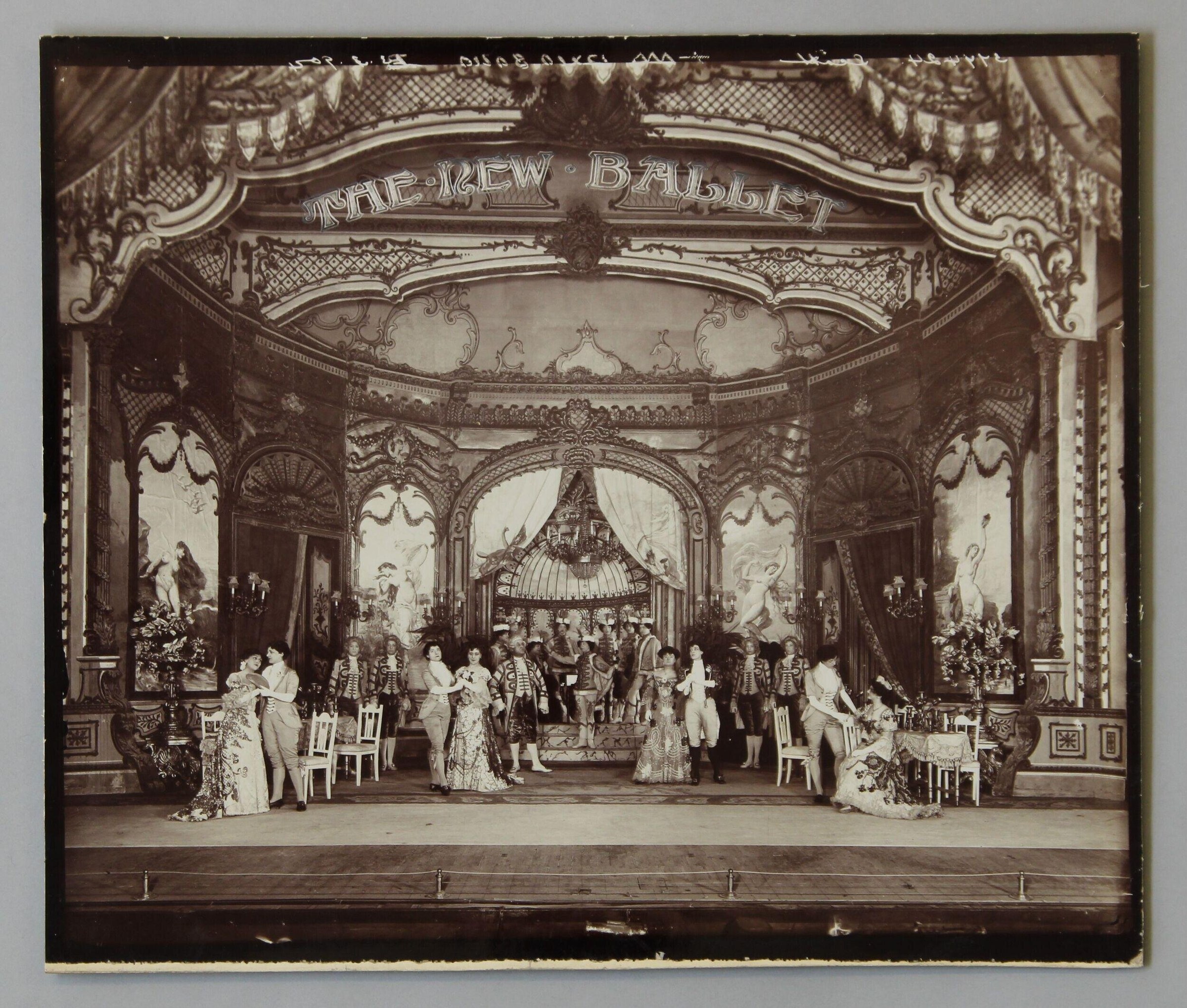
This photograph is a rare visual record of early twentieth-century theatrical ballet design and stagecraft, showing the elaborate architectural and scenic effects that were central to the spectacle of Imperial and European ballet. For historians, it provides concrete evidence of costume design, lighting practice, and the composition of crowd scenes in narrative ballet. For dancers and choreographers, it illustrates how the formal social scene was used as dramatic context and visual composition in the theater of the period.
What you are looking at
This is a stage photograph of a theatrical interior, likely a ballet or opera scene from the early 1900s. The setting is an ornate, rococo-style ballroom or palace interior rendered in elaborate architectural detail: gilded pilasters frame the scene, a coffered dome dominates the background, and the side walls feature tall arched niches with sculpted figures. The proscenium opening itself is framed by an elaborate banner reading "THE NEW BALLET" in ornate lettering. The stage floor is deep, with groups of figures distributed across it in formal postures of repose and social grouping rather than active movement. The figures wear period dress—the women in long pale gowns, the men in dark jackets and lighter breeches or trousers, some in military dress uniforms with decorative details. The composition is symmetrical; figures cluster near the center and foreground with pairs and groups on either side. The lighting is even and staged, with vertical elements (columns, curtains) dividing the space. The overall mood is one of a formal ballroom gathering or reception scene, not an action sequence. Foreground figures are seated or standing at ease; mid-ground figures are scattered in conversation or observation; background figures cluster around a central architectural feature that suggests a fountain or focal point.
The dancing
The dancers stand and sit in the posture of social assembly rather than in active dance hold. Bodies are upright and formal; many figures are seated on white chairs arranged informally. Where couples are visible, they stand at social distance, not in closed or open holds used for ballroom dance. Arm positions are lowered and natural. The overall frame is static; there is no visible weight shift, rise, or traveling action. The composition suggests a moment of repose within a longer theatrical spectacle—possibly a scene change, a dramatic pause, or a tableaux vivant. No footwork is visible; weight appears centered and grounded.
The dance depicted
This image is difficult to identify as any single named dance form. It appears to depict a theatrical tableau or formal ball scene from a narrative ballet, possibly from an Imperial Russian or European ballet production of the early 1900s. The title "The New Ballet" and the archival date of 1904 suggest a work from the height of the Imperial Ballet era. The scene is not a dancing scene but a dramatic or ceremonial gathering—the kind of ballroom or palace scene that would appear in a multi-act narrative ballet as context for dramatic action, character interaction, or plot development. The costumes, setting, and composition are consistent with the romanticism and formalism of early twentieth-century European theatrical dance.
How it was made
This is a stage photograph, printed from a photographic negative. The sepia tone, contrast, and slight softness of focus are typical of early photographic printing from the early 1900s. The vantage point is from the audience perspective, taken straight on from the stalls or pit level, capturing the full proscenium opening. The photograph was likely taken during a performance or a staged run-through, as the lighting appears to be theatrical stage lighting. Such photographs were common documentation of major theatrical productions and were often sold as postcards or reproductions for distribution to the public, making them valuable records of both costume and scenic design of the period.
About this work
This is a stage photograph documenting a tableau or scene from a theatrical ballet production titled "The New Ballet," dated 1904 and attributed to the London Stereoscopic Company. The image shows an ornate rococo ballroom interior populated by formally dressed figures in postures of social repose rather than active dance. The photograph is a record of theatrical design, costume, and mise-en-scène from the early 1900s, when such elaborate narrative ballets were a dominant form of theatrical entertainment in Europe. It belongs in a dance archive not because it depicts dancing per se, but because it documents a significant theatrical form and its visual and spatial conventions.
How to look at it
Attend to the composition and symmetry of the scene: the balanced placement of figures, the use of architectural framing, and the carefully controlled depth of the stage space. Note the distinction between foreground, mid-ground, and background—a theatrical technique for drawing the eye and controlling attention. Observe the costume detail: the formality and precision of dress indicates this is a high-production theatrical event, not a popular or vernacular entertainment. Look at the still poses and the absence of action; the photographer has captured a moment of dramatic suspension or social formality, which may have been brief within a longer scene of movement or narrative action.
The artist
The London Stereoscopic Company was a major photographic publishing house founded in 1854, based in London. It specialized in stereoscopic photographs and theatrical photography, and by the early 1900s was documenting stage productions as records for commercial sale and public interest. The company operated a large studio and employed professional photographers. Stage photography was a significant sideline business for such firms, and the images were often sold as postcards, lantern slides, or prints to theater-goers and collectors.
The period
In 1904, European theatrical ballet was in a state of high formalism and narrative elaboration. The Imperial Russian Ballet, under the direction of Sergei Diaghilev and the choreographer Michel Fokine, would begin to challenge conventional ballet aesthetics within a few years; the 1905 premiere of Fokine's "The Dying Swan" for Anna Pavlova marked a turning point toward modernism. However, in 1904, the dominant mode was still the multi-act narrative ballet with elaborate scenic design, crowd scenes, and formal ballroom or court settings as dramatic context. This image captures that moment at the end of the nineteenth-century classical ballet tradition, before the radical innovations of the early twentieth-century avant-garde.
Where it lives
This photograph is held in the Victoria and Albert Museum (VA) collection, catalogued as a photograph in the Museum's dance and theater holdings. The attribution to the London Stereoscopic Company and the date of 1904 come from the museum record. The photograph exists as a print; the original negative, if it survives, is not noted in the available record.
Dance in this work
Questions about this work
Is this a photograph of an actual ballet performance?
Yes, this appears to be a staged photograph taken during a theatrical production, not a posed studio photograph. The lighting, perspective, and the presence of an audience sight line (the photograph is taken from the stalls) indicate it was made during a performance or a dress rehearsal under stage lighting.
What ballet is this, and who choreographed it?
The title "The New Ballet" is inscribed on the proscenium banner, but the archive record does not provide further identification of the choreographer, composer, or the full production history. The style and date suggest a European ballet from the early 1900s, but without additional research, the specific work cannot be confirmed.
Why are the dancers not dancing?
This photograph captures a tableau or ceremonial scene—a moment of narrative or dramatic pause within a longer ballet. In multi-act narrative ballets of this period, such formal ballroom or court scenes provided context for character and plot, and were not always danced scenes. The photographer has chosen to document the scenic and costume design of this moment.
How was this photograph made and distributed?
The London Stereoscopic Company photographed the stage during performance using theatrical lighting and large-format camera equipment. The resulting negative was printed and sold as a photograph or collotype for commercial distribution, often as a postcard or print. Such images were popular souvenirs of major theatrical productions and are now primary sources for the history of stage design and costume.
More dance artwork





