49 works in this view — arrow keys or swipe to move between them.
Dance in Art
Set design
Georgiadis, Nicholas
- Collection:
- Set design
- Source:
- Victoria and Albert Museum
- Rights:
- Rights vary by item — check the source record before reusing this image. Source record ↗
- Recorded as:
- V&A — check rights per item
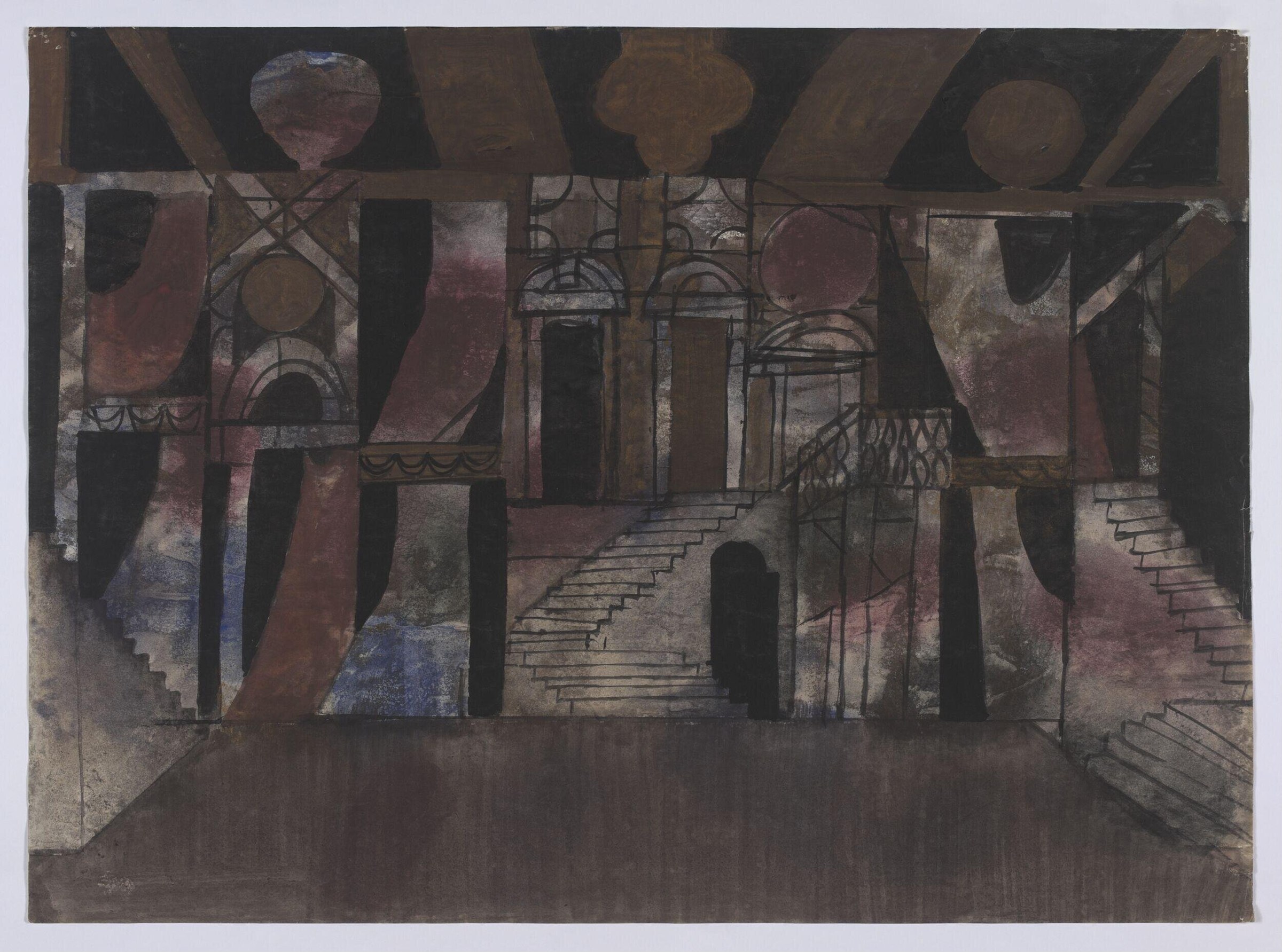
Georgiadis was the designer of choice for some of the most significant ballet works of the 1960s-70s, including for Ballets Russes de Monte Carlo and major European companies. This design sketch reveals how professional theatre approached the creation of grand spectacle during the period when ballet was reasserting itself as a major art form after World War II; it shows the visual thinking behind the stage worlds dancers inhabited.
What you are looking at
This is a theatrical set design rendered in muted earth tones—browns, grays, dusty reds—depicting an imagined interior architectural space. The composition is layered and fragmented, with overlapping planes suggesting a palazzo or opera house interior seen from multiple viewpoints simultaneously. Arched doorways and classical columns recede into the distance, their dark silhouettes contrasting with lighter walls. In the foreground, a broad staircase descends with pronounced perspective lines. The upper portion of the composition is dominated by geometric shapes—hearts and circles—suspended or floating above the architectural framework, abstracted ornamental elements that float free of strict perspective. The lighting is dramatic but dim, creating pools of shadow and illumination that suggest how stage light would fall on this set during performance. The overall effect is dreamlike and modernist, abstracting classical architecture into a symbolic space rather than rendering it realistically.
The dancing
No human figures are depicted in this work. This is pure architectural design for performance space, with no dancers shown.
The dance depicted
This is a stage set design rather than a depiction of dance or dancers in action. However, the monumental staircase, grand interior proportions, and formal architectural vocabulary suggest a theatrical work of classical or neoclassical character—the kind of stage space that would accommodate corps de ballet or grand ensemble scenes in traditional theatre. The modernist abstraction overlaid on classical forms suggests a mid-twentieth-century approach to design that reinterprets historical style for contemporary performance.
How it was made
Based on the image, this appears to be a mixed-media work, likely watercolor or gouache over pen or ink drawing on paper. The mottled, stained quality of the background suggests wet pigment applied to prepared paper, while the architectural line work—doorways, columns, arches, stairs—is rendered in pen with crosshatching for shadow and depth. This is characteristic of professional theatre design practice in the 1960s, when set designers would present concepts through mixed-media sketches for approval by choreographers and directors before construction.
About this work
This is a stage set design by the renowned Greek-British theatre designer Nicholas Georgiadis, dated 1964. It presents an idealized theatrical interior—a grand hall or palazzo with classical proportions and ornament—but rendered through modernist abstraction. The architectural vocabulary (columns, arches, staircases) speaks to hierarchy, formality, and the grandeur associated with classical ballet or theatrical spectacle, while the geometric ornaments floating above ground suggest a designer willing to fragment and reinterpret historical forms. Georgiadis was a major figure in mid-twentieth-century ballet design, and this work exemplifies the post-war European approach to rethinking classical style through contemporary visual language.
How to look at it
Begin with the perspective lines of the staircase drawing your eye downward and back into the space—this is where the action would unfold, the depth the dancers would traverse. Notice how the architectural elements (doors, columns, arches) are rendered in dark outline against lighter walls, creating a rhythmic pattern; these frame the space and would guide the choreography. Then look upward to the floating geometric ornaments—hearts and circles in the upper register—which break the classical symmetry and introduce a lyrical, almost dreamlike quality. The color palette of muted earth tones avoids spectacle in favor of subtlety; the stage light would do the dramatic work. This is a working design, not a finished artwork, and is meant to communicate spatial possibility rather than visual completeness.
The artist
Nicholas Georgiadis (1923–2010) was a Greek-born painter and stage designer who became one of the most influential theatre designers of the second half of the twentieth century. He trained as a painter but moved into theatre design, collaborating extensively with choreographers and opera directors across Europe and America. His work was marked by a sophisticated engagement with historical style—Romantic, Classical, Baroque—filtered through modernist sensibility. He designed for major ballet companies and created sets for works that remained in the repertory for decades.
The period
In 1964, classical ballet was experiencing a major international revival after the cultural disruptions of World War II. The 1960s saw increased cultural exchange between Eastern Europe and the West, and a generation of designers was rethinking how to stage classical works for modern audiences. Simultaneously, the visual arts were deeply engaged with abstraction and the interrogation of historical forms. Georgiadis' work sits at the intersection: respecting the theatrical grandeur and formal beauty of classical ballet while employing the visual language of contemporary art. The staircase motif in particular carries symbolic weight—a traditional element of Romantic ballet staging, here abstracted and made monumental.
Where it lives
Held in a theatre design collection (marked 'Set design' in the record). This is a working sketch or preliminary design proposal, typical of the materials theatre companies maintain to document their productions and design development.
Dance in this work
Questions about this work
Was this set actually built and used in a ballet?
The record does not specify which ballet or production this design was created for. Many such sketches were proposals that influenced later designs or were modified significantly during construction. Without additional documentation, we cannot confirm whether this exact design was realized on stage.
Who was Nicholas Georgiadis?
Georgiadis was a major theatre and ballet designer of the mid-to-late twentieth century, known for his sophisticated approach to historical style. He designed for prestigious companies and created iconic stage environments for classical and contemporary works. His training as a painter gave his theatre work a distinctive visual sophistication.
What do the floating shapes mean?
The hearts and circles are likely ornamental motifs suggesting decoration and elegance, abstracted from their architectural context. In modernist design, such elements often carry symbolic meaning—hearts suggesting Romantic sensibility, circles suggesting completeness or cosmic order—while also breaking the strict geometry of the classical architecture below.
More dance artwork





