49 works in this view — arrow keys or swipe to move between them.
Dance in Art
The second Christmas card
Egley, William Maw
- Collection:
- Drawing
- Source:
- Victoria and Albert Museum
- Rights:
- Rights vary by item — check the source record before reusing this image. Source record ↗
- Recorded as:
- V&A — check rights per item
Christmas cards are the most widely circulated dance images of the Victorian era, reaching a mass audience far beyond theater audiences or aristocratic patronage. This work shows how social dance—the waltz and quadrille—had become so normalized as an emblem of Christmas and family joy that it could be the central feature of a mass-produced seasonal greeting. For historians of social dance and costume, the image preserves accurate detail of how these dances were dressed, structured, and valued in their own time.
What you are looking at
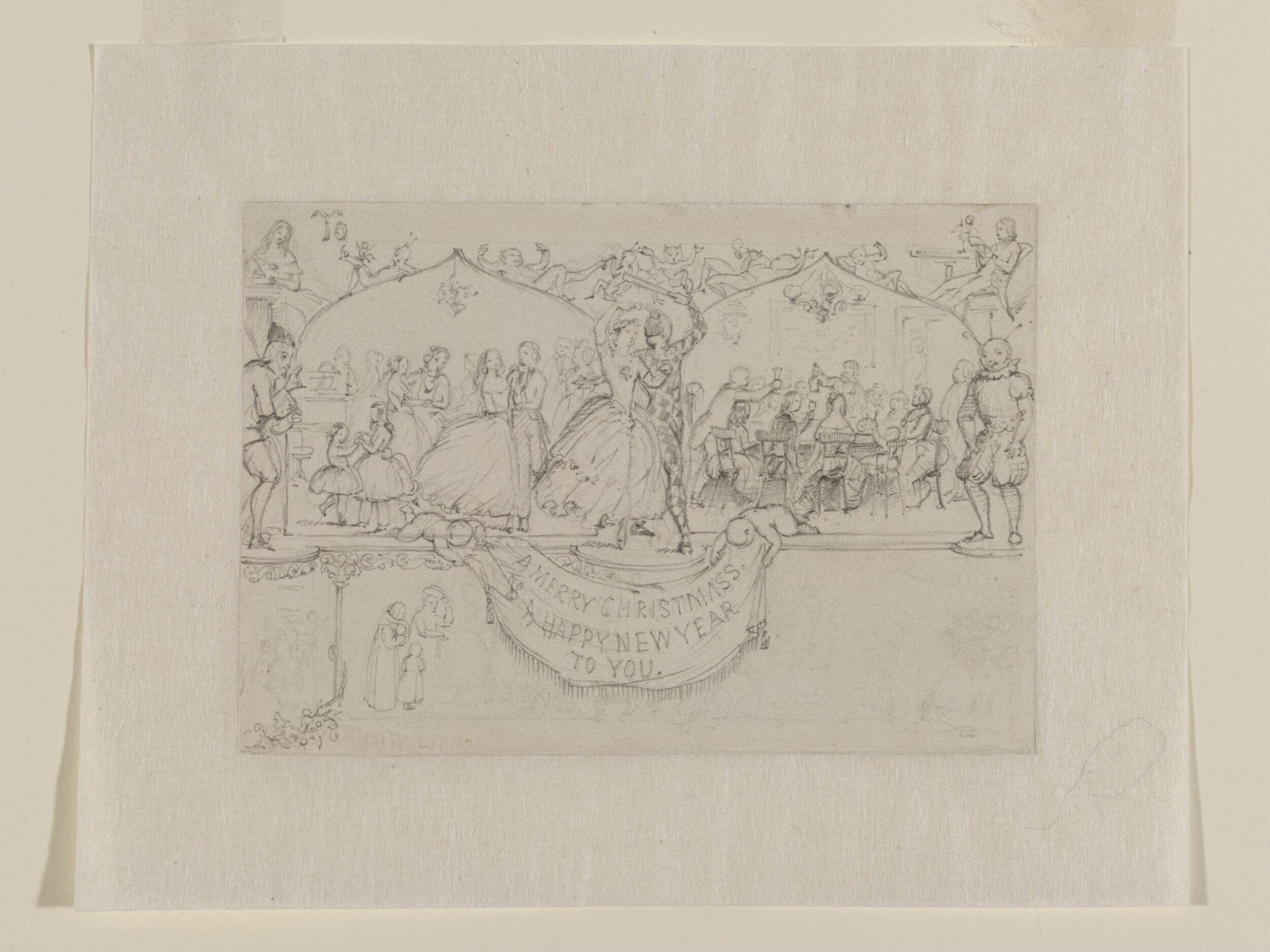
A festive indoor scene, likely a ball or Christmas celebration, unfolds under a draped tent or canopy with swags of fabric and decorative garlands suspended above. The composition is horizontal and densely populated with figures in Victorian dress—men in tailcoats and women in full skirts—distributed across the space in small groups and couples. Some figures dance or embrace in the center; others stand in conversation or observe from the sides. The left edge shows a woman seated, possibly at a table; the right edge frames standing male figures in formal dress. A banner or ribbon runs across the lower portion inscribed "MERRY CHRISTMAS & HAPPY NEW YEAR TO YOU." The whole scene is rendered in fine pen line, with delicate shading suggesting the volume of fabric and the architecture of the space. The crowded, sociable composition and the Christmas greeting position this as a festive seasonal card rather than a formal dance performance.
The dancing
The bodies are rendered with attention to the fashionable silhouette of the 1840s—women in bell skirts and fitted bodices, men in narrow tailcoats. Poses vary from upright and formal to more animated: some couples appear to be in the early stages of a waltz or quadrille, with women and men in close but decorous proximity. Arm positions are varied, some held at shoulder height as if for a dance hold, others gesturing in conversation. The density of figures and the mix of dancing, standing, and sitting poses suggest a social gathering where dance was one activity among many—the moment is deliberately one of mingling and pleasure rather than performance.
The dance depicted
The scene depicts social dancing, most likely quadrilles or waltzes, which dominated Victorian ballroom culture in the 1840s. These were group dances or couple dances performed at private entertainments like Christmas balls. The artist has not frozen a moment of virtuosic movement but rather captured the social atmosphere in which dance took place—a gathering where courtship, conversation, and music were as important as the steps themselves. The painting treats dance as a marker of festivity and sociability rather than as a technical or theatrical subject.
How it was made
This is a pen-and-ink drawing, likely executed as a design for a wood-engraved Christmas card—a popular commercial form in the 1840s. The fine parallel lines and delicate cross-hatching create tone and volume without heavy shading, a technique suited to the sharp lines of engraving. The horizontal format and the celebratory banner suggest this was intended for reproduction as a printed card, circulated among family and friends or clients. The precision and fine detail reflect the technical demands of wood engraving, which required the artist to work in reverse and allow for the logistics of printing.
About this work
This is a Christmas greeting card drawn by William Maw Egley in 1848, depicting a festive ball or private dance in Victorian middle-class dress. The work is a small-scale, commercially produced print designed for circulation during the Christmas season. It belongs in a dance archive because it documents the social context and costume of ballroom dancing in the mid-nineteenth century and preserves the conventional representation of dance as an essential feature of polite seasonal entertainment. The work is not a study of dance technique or a theatrical performance, but rather a social document of how dance functioned as a marker of propriety, pleasure, and festivity in Victorian life.
How to look at it
Observe the variety of poses and the deliberate lack of freeze-frame clarity: this is not a moment of technical precision but of social fluidity. Notice how Egley has distributed figures across the space—some dancing, some watching, some in conversation—to convey the mixed and informal nature of the entertainment. The delicate line work and fine shading create a sense of gaiety and movement without rendering individual steps or formations clearly. The eye travels from the intimate couples at the center to the observers at the edges, and finally to the banner below, which directs the viewer to read the scene as a seasonal greeting rather than a ballet or performance.
The artist
William Maw Egley (1826–1916) was a prolific English painter and illustrator known for domestic and narrative scenes. He was active in the mid-Victorian period and produced both easel paintings and commercial designs for prints, cards, and book illustrations. His style is characterized by fine, precise draftsmanship, attention to period costume, and a taste for social comedy and domestic sentiment—qualities evident in this Christmas card, which treats the ballroom scene with gentle humor and affection.
The period
The 1840s saw the rise of the Christmas card as a commercial and social phenomenon in Britain, with the first mass-produced cards appearing in the 1840s–1850s. The waltz and quadrille were the dominant social dances of the period, having spread from continental Europe and aristocratic circles into middle-class drawing rooms and ballrooms. Dance was understood as a necessary accomplishment for respectable young people and a central feature of courtship. The Christmas ball became an iconic setting in Victorian literature and visual culture as a space of social mingling, romance, and festive ritual. Egley's card captures this cultural moment, positioning dance as the natural expression of Christmas joy and social harmony.
Where it lives
The work is held as a drawing by the Victoria and Albert Museum, London, identified as the second of Egley's Christmas cards. It is a design for a wood-engraved Christmas card, and the present sheet is likely a finished drawing submitted for engraving or a proof print pulled before engraving.
Dance in this work
Questions about this work
Is this a real event or an invented scene?
This is an idealized or composite scene designed as a Christmas greeting card, not a documentation of a specific ball or family event. However, it is based on accurate observation of Victorian ballroom culture, costume, and social custom. The artist has depicted the typical features of a private ball or dance in the 1840s—the dress, the mix of activities, the architectural setting—in a way that would have been immediately recognizable to his audience.
What dances are being performed here?
The specific dances cannot be clearly identified from the composition, but the context and period strongly suggest quadrilles and waltzes, which were the principal social dances of the 1840s. The proximity of some couples and the upright, formal bearing of the dancers are consistent with both forms. Egley has prioritized the social and festive atmosphere over the accurate rendering of individual steps or formations.
Why is this a Christmas card and not a painting?
The horizontal format, the crowded festive scene, and the printed banner bearing the Christmas greeting indicate that this was designed for reproduction as a wood-engraved card—a popular commercial form in Victorian Britain. These cards were printed in quantity and distributed to friends and family. The present sheet is a drawing, but its purpose was to be engraved and printed.
What does the clothing tell us?
The women wear full-skirted dresses with fitted bodices and small waists, typical of the 1840s silhouette. Men are in tailcoats and trousers. The formality and precision of the dress indicate a private ball or entertainment among the respectable middle or upper-middle class—not a public assembly or lower-class gathering. The clothing is historically accurate and was an important marker of social propriety and status.
More dance artwork





