49 works in this view — arrow keys or swipe to move between them.
Dance in Art
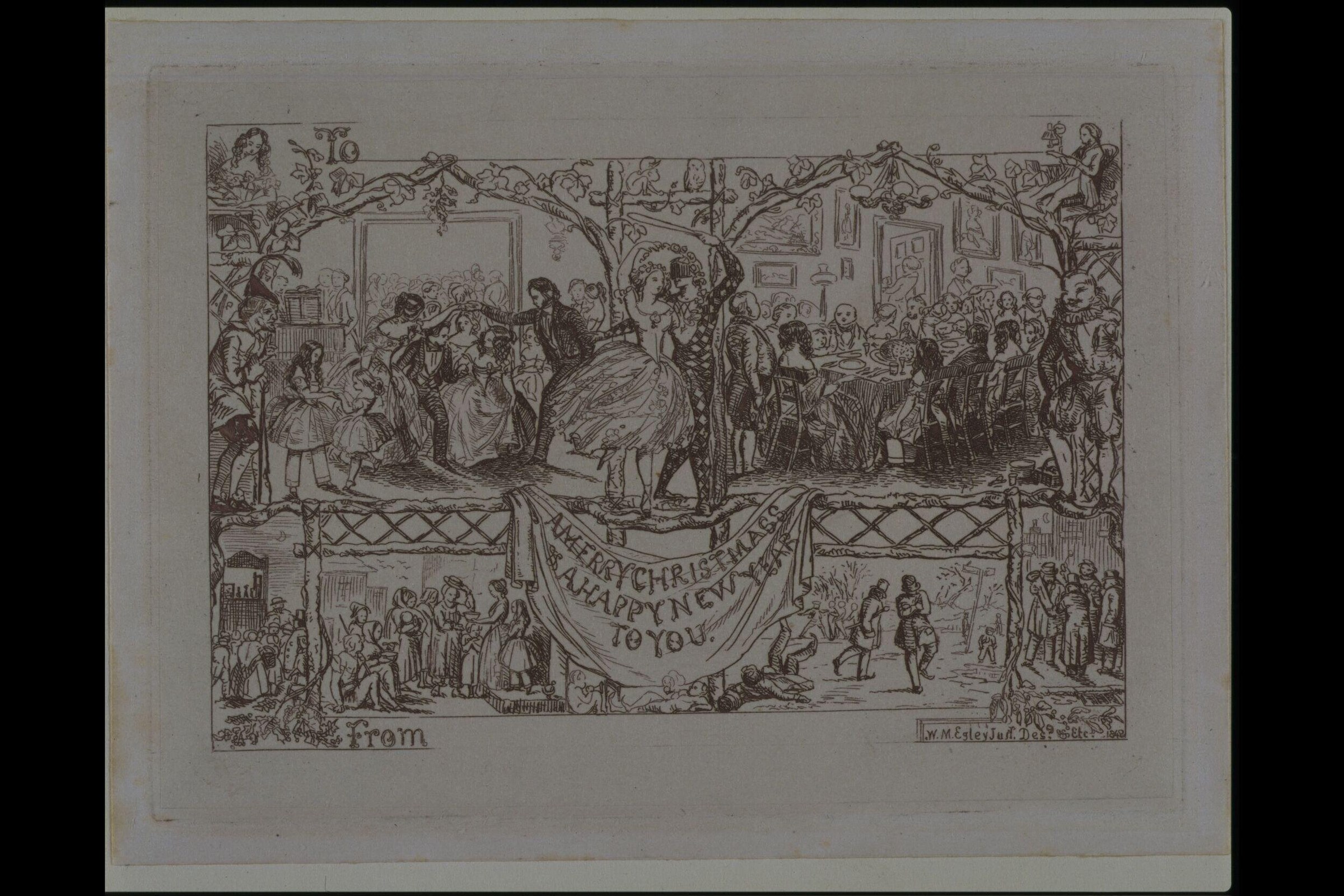
The second Christmas card
william Maw Egley
- Collection:
- Christmas card
- Source:
- Victoria and Albert Museum
- Rights:
- Rights vary by item — check the source record before reusing this image. Source record ↗
- Recorded as:
- V&A — check rights per item
This card is historically significant as an early and ambitious example of the Christmas card as an art form and a commercial medium. For dance historians, it provides rare visual documentation of the social dances—quadrilles, cotillions, and country dances—that animated middle-class drawing rooms in the 1840s, capturing the style, dress, and spatial arrangement of these performances in their everyday context rather than in theatrical representation. The work also marks a pivotal moment when printmaking became a vehicle for disseminating festive imagery and domestic ideals to a mass audience.
What you are looking at
This is a dense, multi-scene engraving structured around a central cartouche reading 'A Merry Christmas and a Happy New Year to you.' The composition is divided into two main theatrical performance scenes set within an ornate interior, with elaborate grapevine and figure-filled decorative borders above and below. The upper scenes show indoor social gatherings with figures in Victorian dress engaged in what appears to be festive celebration and dance; the left scene depicts an intimate group around a seated central figure, while the right shows a larger assembly in what seems to be a drawing room. The lower register contains additional vignettes of outdoor winter revels and celebrations. The entire composition is framed by an intricate border of entwined vines bearing fruit and flowers, with putti and cherubs positioned at intervals, typical of festive greeting card design. The work is densely populated—perhaps 60–80 figures distributed across multiple scenes—suggesting a visual catalogue of Christmas entertainments.
The dancing
The figures are rendered in fine detail typical of mid-Victorian engraving. In the central upper scenes, dancers and celebrants wear the formal dress of the 1840s: women in full skirts and fitted bodices, men in tailcoats. The poses suggest movement—some figures appear to be in active dance steps, with raised arms and turned postures; others stand in conversational clusters or sit as observers. The drawing demonstrates anatomy and drapery competently rendered, though the density of the composition and scale of the engraving limit visibility of specific footwork or technical detail. Couples and groups are positioned in attitudes of sociability rather than formal ballroom hold.
The dance depicted
The central scenes depict indoor festive dancing and socializing of the Victorian Christmas tradition, most likely quadrilles, cotillions, or country dances—the staple entertainments of polite drawing-room society in the 1840s. The presence of what appear to be musicians and the formal interior setting support this reading. This is social dance, not theatrical performance: the register is one of genteel amusement among family and friends rather than professional spectacle. The lower border scenes show outdoor winter sports—sledging, skating, and games—which were equally central to Victorian Christmas imagery but fall outside the dance category.
How it was made
This is a wood engraving or steel engraving on paper, executed with fine parallel lines and cross-hatching to create tone and texture. The technique is characteristic of commercial greeting-card production in the 1840s, when steel-faced wood blocks or steel plates allowed for long print runs and fine detail impossible in earlier copper engraving. The delicate line work and the ability to render both large compositions and small figural detail suggest a skilled hand and access to the advanced technology of the period. The complexity and finish imply this was produced for a middle-class or upper-middle-class market—Christmas cards were a novel and prestigious commodity in the 1840s.
About this work
This is William Maw Egley's 1848 Christmas card, one of the earliest known designs in the newly fashionable genre of illustrated greeting cards. It depicts the festive season as a series of overlapping scenes of Victorian domestic life and social amusement, with dancing and music prominent among the pleasures shown. The work is both a social document and a commercial design: it captures the rituals and entertainments through which the prosperous Victorian household celebrated Christmas, while its elaborate ornamental framing and densely populated composition exemplify the aesthetic ambitions of early Christmas card design. The card belongs to a moment when printmaking technology enabled mass production of complex images, and when Christmas itself was being reformulated—partly through visual media like this—into the domestic, child-centered, and commercially driven festival we recognize today.
How to look at it
Approach this work as a composition in multiple registers. Begin with the two main interior scenes in the upper half: identify which figures appear to be dancing and in what formation, and notice how the artist has conveyed motion through pose and drapery. Look at the musicians, if visible, and the arrangement of dancers relative to them. Then trace outward to the border scenes—the skating and sledging at the bottom—to understand Christmas amusement as the card's unifying theme. The ornamental border of vines and putti invites a decorative reading, but the heart of the work is its social content: a visual inventory of how the Victorian middle classes imagined themselves celebrating.
The artist
William Maw Egley (1826–1916) was a prolific Victorian painter and engraver known for historical and literary subjects as well as genre scenes of contemporary life. He was active in commercial illustration and fine art throughout the nineteenth century, and his work was widely reproduced in print form. Egley was part of the generation of artists who embraced the new technologies of wood and steel engraving to reach larger audiences. He was also involved in the early development of the Christmas card industry, which emerged as a significant commercial and artistic enterprise in Britain in the 1840s.
The period
The 1840s were a watershed for Christmas as a visual and commercial phenomenon. Prince Albert's embrace of German Christmas traditions—the decorated tree, carols, family games—helped reshape English Christmas into a domestic, sentimental celebration centered on the home and childhood. The illustrated Christmas card, pioneered by designers like John Callcott Horsley in 1843, became a vehicle for disseminating these new ideals. Egley's card, dated 1848, sits at the moment when the medium was still novel and when artists were experimenting with scale, narrative complexity, and ornamental richness. The social dances depicted—quadrilles and country dances—were themselves undergoing change during this period, as the mid-Victorian ballroom evolved and as waltz and polka began to challenge the older forms; Egley's card thus captures a moment of transition in both Christmas culture and ballroom practice.
Where it lives
Recorded as a Christmas card held in the Victoria and Albert Museum (VA) collection. As an early example of the illustrated greeting card genre, this object represents both a work of fine art and a commercial product—a distinction that is itself a defining feature of the period.
Dance in this work
Questions about this work
Who gave this card to whom?
The catalogue record does not provide information about the original recipient or sender. Like most early Christmas cards, it was likely a printed design produced in multiple copies and distributed to friends and family by the sender or the publisher.
What dances are shown?
The interior scenes most likely depict quadrilles, cotillions, or country dances—the dominant social dances of the 1840s Victorian drawing room. The formal dress, indoor setting, and grouping of figures support this reading, though the engraving's scale and density prevent identification of specific steps or formations.
Why is this card in a dance collection?
It is a primary visual source for nineteenth-century domestic social dance. Christmas cards and illustrated prints are among the most reliable evidence for how people actually danced in private contexts, as opposed to how dance was represented on the professional stage.
Is this a valuable or rare card?
Early Christmas cards are historically significant and are actively collected. The complexity and artistic ambition of Egley's design, combined with its early date (1848), make it a noteworthy example. Rarity and market value are determined by the holding institution's records, not by visual analysis.
More dance artwork





