49 works in this view — arrow keys or swipe to move between them.
Dance in Art
Touch and Go
Baker, Elizabeth
- Collection:
- Dance costume
- Source:
- Victoria and Albert Museum
- Rights:
- Rights vary by item — check the source record before reusing this image. Source record ↗
- Recorded as:
- V&A — check rights per item
Costumes are often overlooked in dance history, but they are primary documents of choreographic intention and the visual language of a piece. This object, preserved in its entirety, allows us to understand how Baker conceptualized the relationship between body, fabric, and space in 'Touch and Go,' and offers insight into the materials and construction methods available to independent choreographers in the early 2000s. The pairing of austerity and beauty in the design—the plain shift and the ornate shawl—raises questions about how meaning and affect are distributed across a costume.
What you are looking at
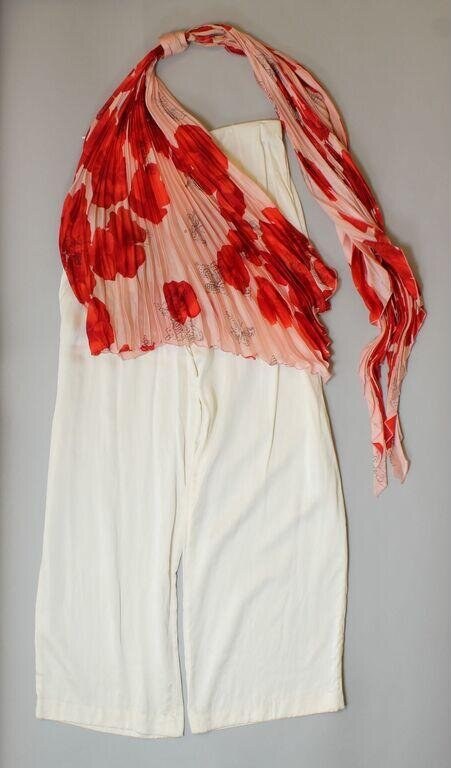
A cream-colored sleeveless garment—a tunic or shift—is displayed against a neutral ground. The dress is simply constructed and falls to mid-thigh, with a straight silhouette. Draped across the shoulders and down the figure is a diaphanous shawl or stole in shades of red and pale pink, printed with large red poppies or similar flowers. The shawl is voluminous and softly gathered, trailing loosely down one side in a way that suggests movement and flow. The contrast between the austere simplicity of the base garment and the romantic, botanical ornamentation of the wrap creates a visual tension between restraint and expressiveness. The presentation is frontal and static, showing the costume piece as an artifact rather than in performance.
The dancing
No human figure is present; this is a costume object displayed on an invisible form or dummy. The garment's proportions and cut suggest it was designed for a slender, youthful dancer. The drape of the shawl—pulled forward over one shoulder and allowed to fall with apparent casualness—implies a movement vocabulary that valued fluidity and the display of textiles in motion. The way the wrap catches and folds suggests it was meant to be manipulated and moved during performance, not merely worn.
The dance depicted
This is a dance costume, likely from early 2000s contemporary or modern dance practice. The simplicity of the base garment and the poetic ornamentation of the shawl suggest a choreography concerned with visual imagery, textile, and perhaps narrative or emotional content. The title 'Touch and Go' implies ephemeral contact or fleeting connection. The costume's design—allowing maximum visibility of the body while framing it with a beautiful, mobile textile—suggests a movement language that integrates the drape and flow of fabric as a formal element, typical of contemporary dance rather than classical ballet or ballroom forms.
How it was made
This is a conserved costume object, not a two-dimensional artwork. The garment is hand-sewn; the shawl appears to be a printed textile, probably produced industrially and then incorporated into the costume. The cream base appears to be a natural fiber—linen or cotton—while the shawl is likely a synthetic or silk blend capable of holding the printed pattern and maintaining the fluid drape visible in the photograph. The costume survives as a material archive of the choreography and the body that wore it.
About this work
This is a dance costume designed by Elizabeth Baker for a 2002 theatrical work titled 'Touch and Go.' The piece consists of a minimal cream-colored shift paired with a large, romantically printed shawl that serves as the primary visual and kinetic element. The costume embodies an aesthetic that values the interplay between bodily restraint and textile expressiveness, suggesting a choreography where fabric movement is as important as the dancer's movement. As an archival object, it preserves both a moment in early 2000s contemporary dance practice and the sensory and visual choices that shaped performance in that era.
How to look at it
Look first at the proportions: the minimal, almost clinical simplicity of the base garment, and the visual weight of the printed shawl that nearly equals it. The shawl's floral print is romantic and nostalgic; the shift beneath is contemporary and spare. Consider how a dancer moving in this costume would generate two different visual vocabularies—the containment of the body itself, and the freedom and billowing of the textile. The title 'Touch and Go' may refer to the transience of the shawl's contact with the body as it moves, or to the fleeting meeting of the two aesthetic registers (minimalist and romantic) that the costume reconciles.
The artist
Elizabeth Baker is a British artist and designer active in contemporary and experimental dance and performance since the 1990s. Her practice spans choreography, costume and set design, and installation, often employing textile, found objects, and collaborative processes. Her work frequently explores the boundary between visual art and dance, treating the body and movement as elements within a larger visual and conceptual field. The costume 'Touch and Go' exemplifies her approach to material and narrative integration.
The period
In the early 2000s, contemporary dance in Britain and internationally was increasingly integrating visual art practices and moving away from the modernist reduction of the body championed by release technique and postmodern American dance. Designers like Baker were part of a generation exploring costume not as decoration but as active collaborator in meaning-making. Simultaneously, this period saw growing institutional preservation of dance costumes as artworks, reflecting a broader recognition of costume and design as essential to dance historiography rather than subordinate to choreography.
Where it lives
The costume is held in a collection designated 'va' (likely the Victoria & Albert Museum or a related institution with dance holdings). It is catalogued as a dance costume from 2002, attributed to designer Elizabeth Baker. The object was preserved for its significance as a designed artifact rather than recovered from an archive.
Dance in this work
Questions about this work
Is this a painting or a photograph?
This is a photograph of an actual costume object—a garment made of fabric and thread—displayed against a neutral background. It is a documentation of a three-dimensional artifact, not a painted or drawn representation.
What dance is this costume from?
The costume was created for a work titled 'Touch and Go' by Elizabeth Baker, dated 2002. Without access to archival documentation of the performance, we cannot provide details of the choreography or movement vocabulary, but the costume's design suggests a contemporary dance practice valuing both bodily restraint and textile expressiveness.
Why is the shawl so important to this costume?
The printed shawl is the dominant visual and kinetic element; the base shift is almost utilitarian by comparison. This suggests that the choreography made substantial use of the shawl's movement, drape, and visual presence. The textile likely functioned as a second body or extension of the dancer's vocabulary.
Can you identify the flower printed on the shawl?
The blossoms resemble poppies or similar large-petaled flowers, but the print is stylized and somewhat abstracted. The romantic, botanical imagery contrasts sharply with the austere simplicity of the shift, creating emotional and aesthetic tension within the single costume.
More dance artwork





