49 works in this view — arrow keys or swipe to move between them.
Dance in Art
The Guards Waltz
Godfrey, Daniel
- Collection:
- Sheet Music
- Source:
- Victoria and Albert Museum
- Rights:
- Rights vary by item — check the source record before reusing this image. Source record ↗
- Recorded as:
- V&A — check rights per item
This score documents the British obsession with the waltz as a vehicle for military honor and national pageantry in the late 19th century. For dance historians, it shows how ballroom dance intersected with institutional power and how musical publication shaped access to and performance of dance across class boundaries.
What you are looking at
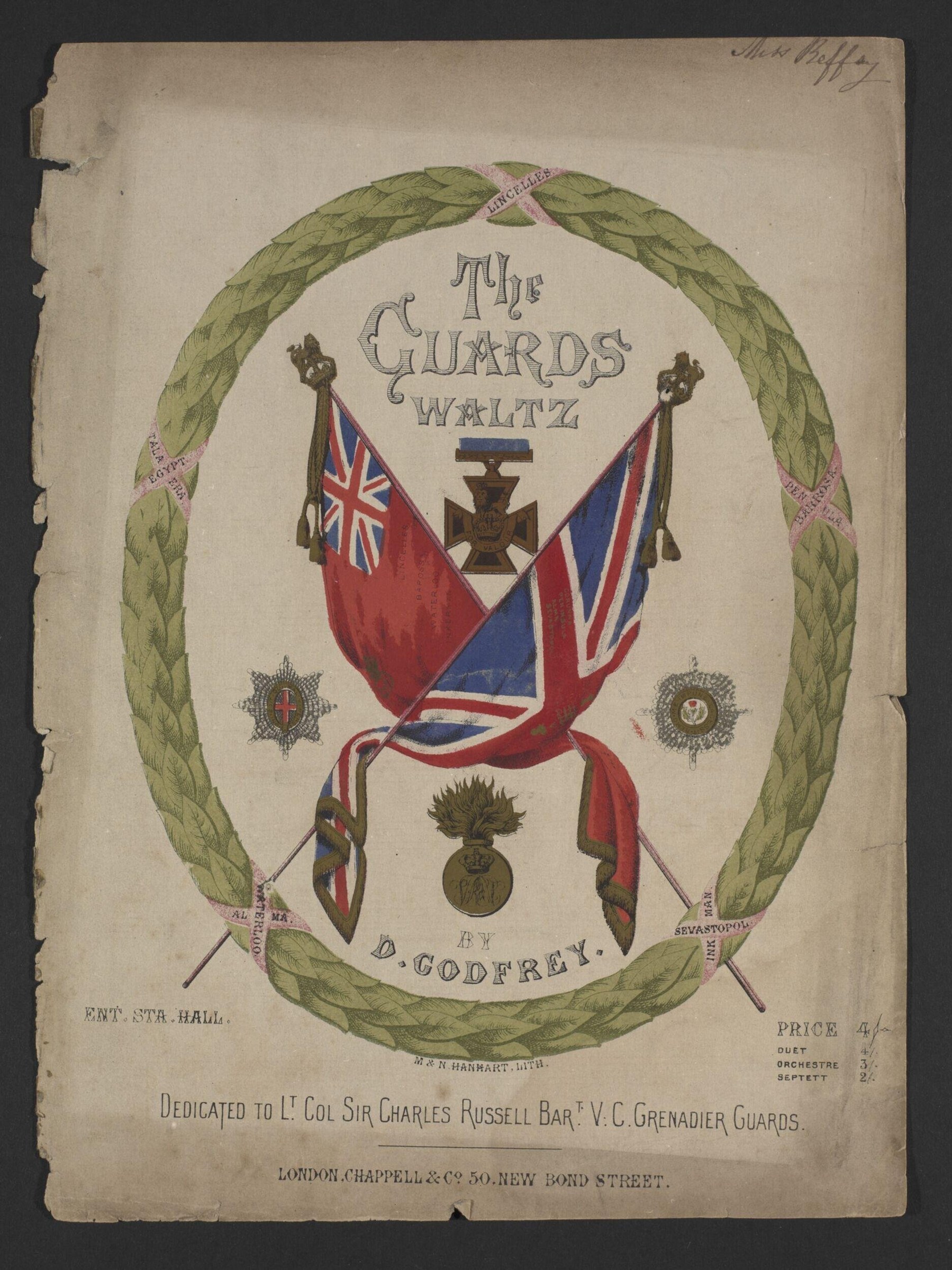
This is the title page of a musical score for a waltz dedicated to the British military. At the center sits a large oval wreath of braided green laurel, tied at top and bottom with pink ribbon bows. Within the wreath, two British flags—the Union Jack and what appears to be the Grenadier Guards regimental color—cross diagonally, their staffs topped with ornamental finials and tassels. Between the flags hangs a military decoration, likely the Victoria Cross, suspended from a bar. Below the crossed flags is a crowned regimental badge, possibly the Grenadier Guards emblem. The composition is formal and heraldic, emphasizing military honor and pageantry. The border, text, and ornamental details are printed in sepia and colored inks on aged cream paper. At the bottom, the title reads "The Guards Waltz" in ornate lettering, with the composer's name "D. Godfrey" below, and a dedication to Lt Col Sir Charles Russell, Bart, V.C., Grenadier Guards. Publication details indicate it was printed by Chappell & Co. of New Bond Street, London, with pricing for full score, duet, orchestra, and septet.
The dancing
No human figures are depicted. This is a heraldic composition using military insignia, regimental colors, and decorative elements rather than a scene of actual dancers or choreography.
The dance depicted
This is a waltz composed by Daniel Godfrey, a celebrated British bandmaster and conductor of the late 19th and early 20th centuries. The work is a ceremonial or commemorative waltz written for and dedicated to a distinguished military officer. Waltzes of this type were staple entertainment at military balls, state occasions, and ceremonial events, and their publication as sheet music—in multiple arrangements—indicates they were widely performed by military bands and in ballroom settings. The choice of waltz form signals the dance context, though the image itself contains no depiction of dancers or movement.
How it was made
This is sheet music printed by Chappell & Co., a major London music publisher, using chromolithography and letterpress printing to combine colored illustration with text. The ornate heraldic border and flags were likely hand-colored or printed in color register, while the text is typeset. The presence of multiple pricing tiers (full score 4/, duet 2/, orchestra 3/, septet 2/) indicates this was a commercially produced score circulated to military musicians, orchestras, and amateur musicians alike. The format and finish suggest mid-to-late Victorian commercial music publishing.
About this work
This is the cover page of a published military waltz by Daniel Godfrey, presented as a formal dedication to a decorated Grenadier Guards officer. It documents the intersection of ballroom dance, military ceremony, and popular music publishing in the Victorian era. The work belongs in a gallery of dance imagery because waltzes were among the most widely danced social forms of the 19th century, and this sheet music—the primary artifact through which most people encountered choreography—reveals how waltz culture was bound up with national identity, military prestige, and public commemoration. The heraldic presentation does not depict dancing, but it contextualizes the social and ceremonial world in which this waltz was danced.
How to look at it
Read this as a historical document of how institutions—in this case, the British military—used the waltz to broadcast power and prestige. The formality of the presentation, the emphasis on medals and regimental colors, and the commercial printing all tell you that this waltz was not a folk or experimental form but an establishment art, performed in ballrooms and at state ceremonies. The multiple arrangements (full score, duet, orchestra, septet) show the breadth of performance contexts—from intimate home music-making to full military band. The Chappell imprint and London address mark this as a product of the professional music publishing industry that shaped taste and accessibility.
The artist
Daniel Godfrey (1831–1897) was a prominent British bandmaster and conductor, best known as conductor of the Coldstream Guards Band and later the Brighton Promenade Orchestra. He was a prolific composer and arranger of dance music, marches, and light orchestral works, many of which were published during the height of the Victorian waltz craze. His works were performed at state occasions, military ceremonies, and public entertainment venues, making him a major figure in disseminating ballroom music to British audiences.
The period
The waltz reached its cultural peak in 19th-century Britain as the dominant social dance form, particularly among the upper and middle classes. By the 1870s–1890s, when this score was likely published, the waltz had moved from scandalous novelty (with its close hold and rotating movement) to respectable institution, regularly performed at court, at military balls, and in public dance halls. The dedication to a Victoria Cross–decorated officer reflects how waltz culture became intertwined with military identity and national pride. Sheet music publication was the primary medium through which dance music reached amateur musicians and dance enthusiasts, making published dance scores a window into what and how people actually danced.
Where it lives
This object is sheet music held in a collection identified only as 'va' in the catalogue record, which appears to be a library or archive, likely in the United States. The printed publication details indicate it was published by Chappell & Co. of 50 New Bond Street, London, a major Victorian music publisher. The notation 'M.S. Duffey' in manuscript at the top of the page suggests individual ownership at some point in the work's circulation.
Dance in this work
Questions about this work
Who was Daniel Godfrey?
Daniel Godfrey (1831–1897) was a leading British bandmaster and conductor, famous for directing the Coldstream Guards Band and the Brighton Promenade Orchestra. He composed hundreds of dance pieces, marches, and orchestral works that were widely performed at military ceremonies, public concerts, and private balls. His popularity rested on his ability to write accessible, elegant music in the prevailing fashions of the Victorian era.
What is a waltz?
A waltz is a couple dance in triple meter (3/4 time) characterized by a rotating motion and a closed hold in which partners face each other and move in lockstep around the ballroom. It emerged in Austria in the late 18th century and became the dominant social dance form of the 19th century across Europe and North America, particularly among the upper and middle classes.
Why dedicate a waltz to a military officer?
Waltzes were prominent entertainment at military balls and state ceremonies, and dedicating a work to a distinguished officer was a form of honor and commemoration. This particular dedication to a Victoria Cross recipient (the highest British military decoration) suggests the waltz was meant for performance at military social events, and the printed dedication served both as tribute and as marketing to military audiences.
What does the pricing tell us?
The multiple price points (full score, duet, orchestra, septet arrangements) show that waltz publishing was a commercial enterprise designed to reach different markets: professional musicians, amateur duet players, orchestras, and chamber ensembles. This range of formats was essential to the popularity and economic viability of dance music publishing.
More dance artwork





