49 works in this view — arrow keys or swipe to move between them.
Dance in Art
The May Waltz
Mellon, Alfred
- Collection:
- Sheet Music
- Source:
- Victoria and Albert Museum
- Rights:
- Rights vary by item — check the source record before reusing this image. Source record ↗
- Recorded as:
- V&A — check rights per item
This object documents the intersection of dance, music commerce, and visual culture in the nineteenth century. For historians of ballroom dance, it shows how waltz repertoire moved between concert hall and ballroom, and how composers of serious music engaged with dance forms. The cover design itself reveals what aesthetic conventions governed how dance music was sold to its audiences.
What you are looking at
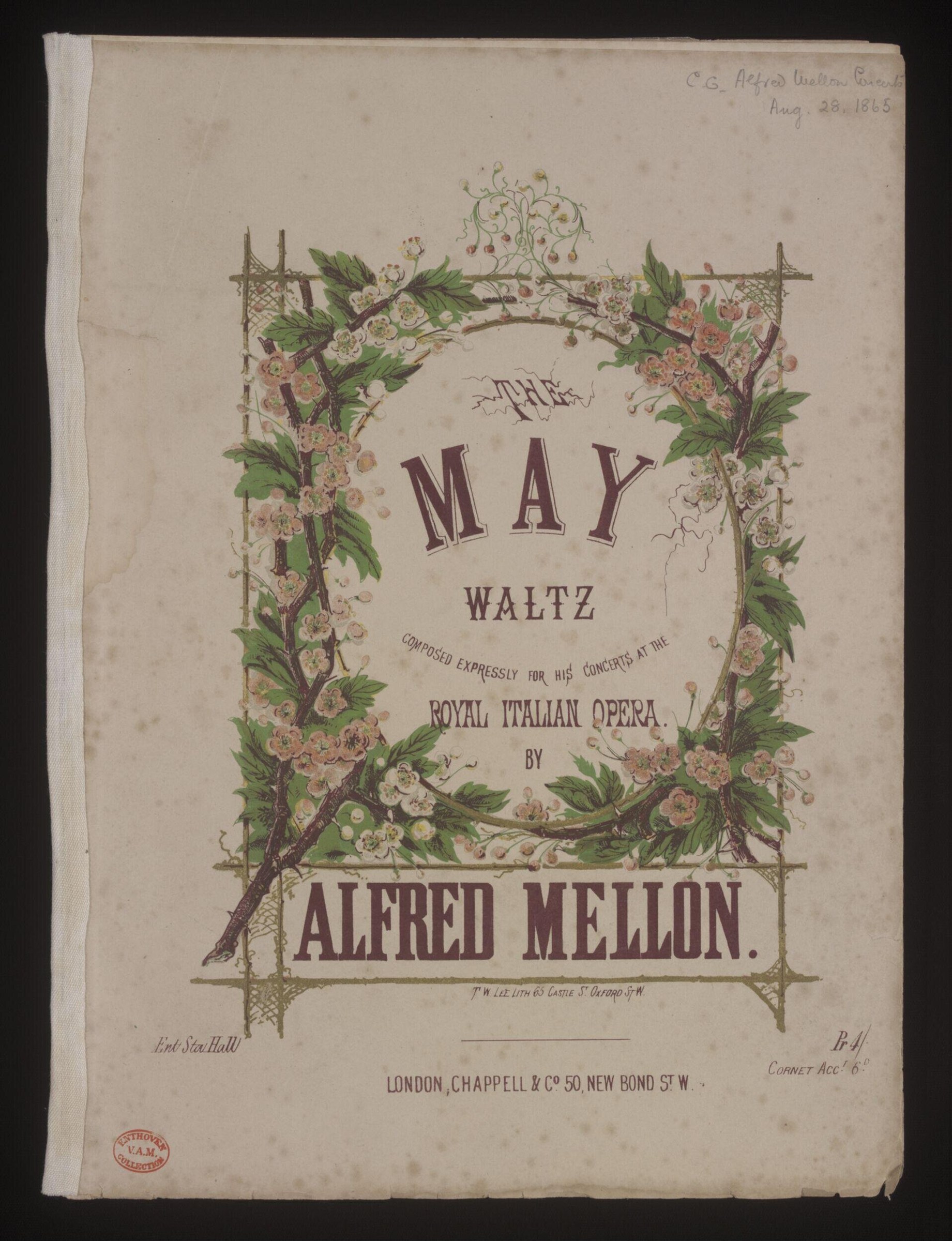
This is a decorative cover to a printed waltz composition published by Chappell & Co., a major London music publisher of the nineteenth century. The design frames the title and attribution within an elaborate trellis structure adorned with flowering vines—white blossoms with pink centers on green foliage cascade around all four sides. The frame itself is rendered in soft brown ink and has a delicate, latticed appearance, as though woven from wooden strips. Within it, large serif capitals announce "THE MAY WALTZ" centered on the page, with the subtitle "COMPOSED EXPRESSLY FOR HIS CONCERTS AT THE / ROYAL ITALIAN OPERA" beneath, and the composer's name "ALFRED MELLON" in even larger capitals at the foot. The floral border is printed in color—green, pink, and sepia—against a cream background that shows age and handling. This is a commercially produced sheet music cover, the kind found in nineteenth-century drawing rooms and concert halls, designed to advertise both the composition and the occasion of its premiere.
The dancing
No human figures appear in this image. The work is purely decorative and typographic, using botanicals as ornament rather than depicting any dancers or performers. The waltz itself would have been danced by couples in closed ballroom position, but that action is not represented here—only named and contextualized.
The dance depicted
This is sheet music for a waltz, a couples' dance in triple meter that dominated nineteenth-century ballroom culture. The waltz emerged in Vienna and spread across Europe through the early 1800s as the defining social dance of the middle and upper classes. Mellon composed this piece for the Royal Italian Opera's concert season, suggesting it was performed as an orchestral or chamber work at a formal venue rather than as dance music for a ball, though waltzes were equally at home in both concert halls and ballrooms. The title "The May" and the floral decoration suggest a seasonal or romantic theme appropriate to the waltz's association with courtship and elegance.
How it was made
This is a color-printed sheet music cover, most likely a lithograph or chromolithograph—the medium that made affordable, colorful commercial music printing possible from the 1830s onward. The technique allowed printers to produce decorative covers that were both visually attractive and economically viable for mass distribution. The delicate floral design and the careful registration of multiple color passes is characteristic of mid-to-late nineteenth-century commercial lithography. Such covers were marketing devices as much as functional objects; they made sheet music a display item in the home and advertised the publisher's taste and the composer's status.
About this work
This is a published waltz composition by Alfred Mellon, a conductor and composer of the mid-nineteenth century, whose work was prominent in London concert life. The cover announces a piece written for the Royal Italian Opera's concert series—a venue of considerable prestige. The decoration is entirely typical of Victorian-era commercial sheet music: florals, delicate typography, and an overall air of genteel refinement. As an object, it represents both a musical score and a cultural artifact—evidence of how waltzing was integrated into concert life, how it was marketed to middle-class households, and what visual language signaled musical and social respectability in that era.
How to look at it
This is not a representation of dance in action, but an advertisement for it. The floral frame—with its allusions to spring, May, and romance—creates a symbolic context for the waltz without depicting one. Notice how the ornamental frame contains and celebrates the text; the design makes the title the focal point while the botanical decoration appeals to domestic elegance and femininity. The careful typography and color registration signal that this is a product of significant commercial investment; this cover design was meant to make the piece attractive enough to purchase and display. For a dancer, the interest lies in what the cover claims: that a respected conductor composed this waltz for a major opera house, and that it was considered worthy of concert performance as well as ballroom use.
The artist
Alfred Mellon (1821–1867) was a British conductor and composer active in London's musical establishment. He was conductor of the Royal Italian Opera at Covent Garden and composed extensively for opera, concert, and domestic music—waltzes, galops, and other salon pieces designed for amateur performance in the home. His works were popular and widely published; this piece exemplifies the prolific output of mid-century composers who wrote for both professional concert venues and the domestic music market.
The period
The waltz was at the height of its cultural authority in the 1860s, when this piece was composed. It had moved from disreputable novelty (in the 1810s, when conservative critics objected to the closed hold) to the dominant form of respectable social dancing and concert music. Composers from Strauss to Mellon created waltzes by the hundreds, and they appeared equally in ballrooms and concert halls. The sheet music cover as a decorated art object was itself a Victorian innovation; publishers competed for domestic shelf space through attractive design. The Royal Italian Opera's commission of a new waltz for its concert season reflects the mixing of genres and venues that characterize nineteenth-century musical life.
Where it lives
This sheet music cover is held in a collection of dance-related materials (source: VA). The archive inscription "C.G. Alfred Mellon, from Aug. 28. 1865" suggests it may have been acquired or annotated on that date, though the meaning of "C.G." is unclear from the evidence shown.
Dance in this work
Questions about this work
Was this waltz meant for dancing or for concert listening?
Both. It was composed for the Royal Italian Opera's concert series, suggesting a professional orchestral premiere in a concert hall. But waltzes of this era existed in multiple versions—orchestral, for piano, for small ensemble—and could be adapted for dancing. Mellon's waltz likely circulated both as a concert piece and in arrangements for home and ballroom use.
What does the "Royal Italian Opera" refer to?
The Royal Italian Opera was a major opera house in Covent Garden, London. Mellon was its conductor and a respected figure in mid-Victorian musical life. A commission from this venue would have enhanced the waltz's prestige and marketability.
Why is the cover decorated with spring flowers?
The title "The May Waltz" invited floral ornament. May evokes youth, courtship, and renewal—themes central to the waltz's cultural meaning. The flowers also appealed to domestic taste and made the sheet music an object suitable for display in a Victorian drawing room.
What does the cover tell us about how waltzes were sold?
Sheet music covers were visual marketing devices, competing for attention on the parlor piano. The investment in color printing, delicate ornament, and elegant typography shows that publishers understood sheet music as both functional score and decorative object. The cover's design sold the waltz as both a musical composition and a marker of refined taste.
More dance artwork





