49 works in this view — arrow keys or swipe to move between them.
Dance in Art
Faust Waltz
Coote, Charles
- Collection:
- Sheet Music
- Source:
- Victoria and Albert Museum
- Rights:
- Rights vary by item — check the source record before reusing this image. Source record ↗
- Recorded as:
- V&A — check rights per item
This work shows how 19th-century popular culture understood the waltz not as technical steps but as social theatre—a charged moment of intimate proximity and romantic negotiation between men and women. For historians of dance and gender, it documents the visual language used to represent ballroom culture at the height of the waltz's cultural dominance and controversy.
What you are looking at
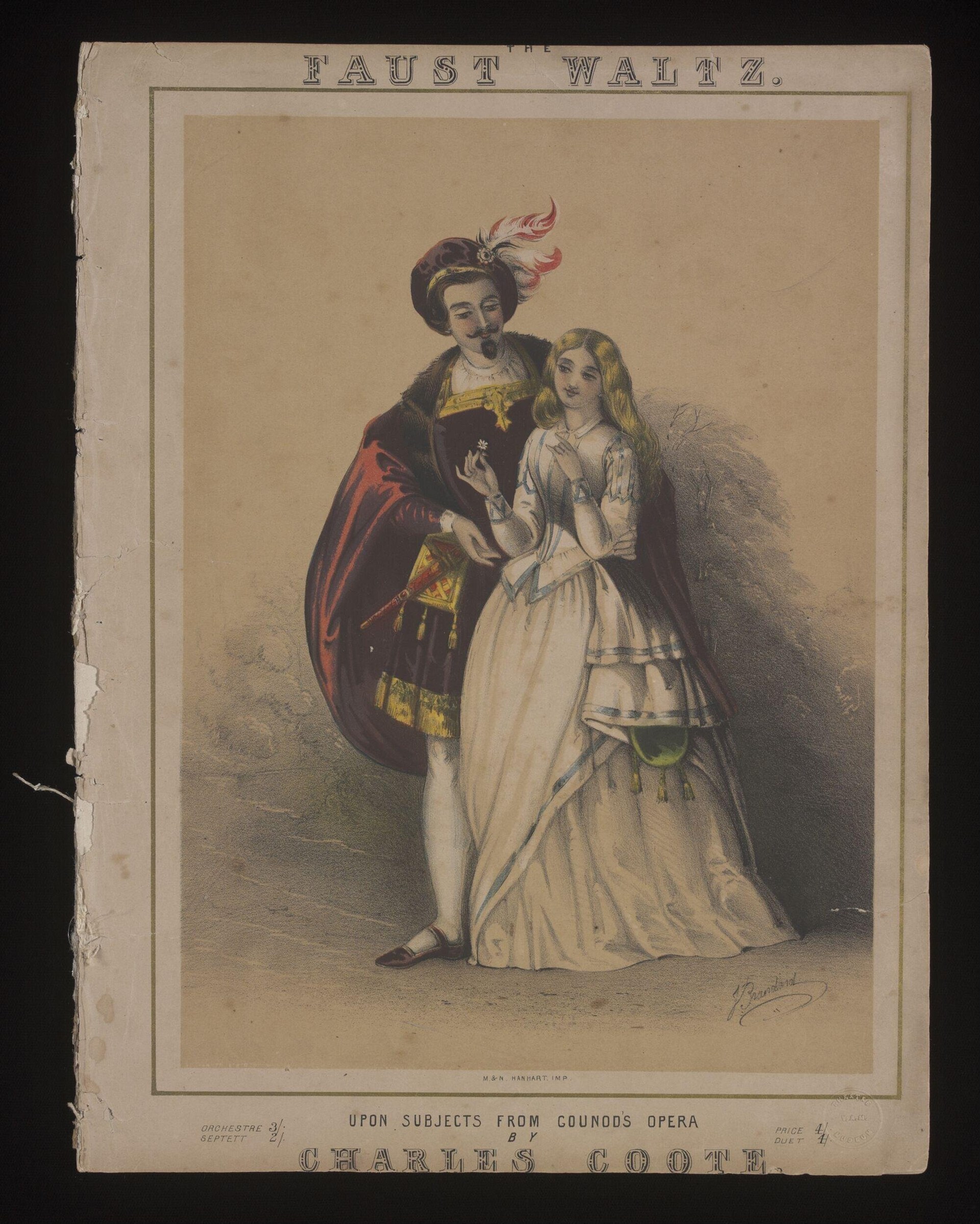
A man and woman are shown in an elegant interior, posed in a moment of social interaction during what appears to be a formal dance or ball. The man wears a dark coat with a red-lined cape and gold trim, topped by a distinctive feathered hat; he leans toward the woman with an animated expression, his posture suggesting courtship or flirtation. The woman stands in a flowing white gown with blue-grey trim and ribbons at the hem, her body angled away slightly as she gazes downward in a pose of modest reserve or coquettish interest. The composition captures a freeze-frame of social dance conversation rather than active movement—the two figures occupy the shallow foreground against a neutral, atmospheric background rendered in soft grey wash. The hand-colored lithograph technique has preserved delicate gradations in the fabrics and subtle modeling in their faces, creating an intimate, conversational mood.
The dancing
The man's weight is forward and his frame is open, his gesture expansive and his gaze directed at his partner with evident interest. The woman holds an upright posture with a reserved arm position, her long skirt flowing to the ground. They are not in a closed dance hold; instead, they stand apart in the formal proximity appropriate to a ball or promenade. The distance and angles of their bodies suggest a moment of verbal or gestural courtship rather than partner dance steps.
The dance depicted
This is not a depiction of active waltz steps, despite the title. Instead, it represents the social theatre of the waltz era—the moment of invitation, flirtation, or conversation that surrounds ballroom dancing. The 19th-century waltz was as much a social occasion as a dance, and this image captures that social dimension. The man's animated courtship and the woman's demure response are characteristic of how waltz culture was understood: as a coded exchange of attention and interest. The image tells us that the aesthetic and narrative appeal of the waltz lay not only in the turning and holds, but in the romantic drama of approach and acceptance.
How it was made
This is a hand-colored lithograph, a medium perfectly suited to theatrical and popular culture imagery of the 1840s–1850s. Lithography allowed rapid production and distribution of sheet music covers and theatrical prints; the artist drew on stone, and hand coloring was applied afterward, giving each impression subtle variation. The technique was ideal for capturing costume detail and facial expression for a mass audience, and the soft tonal qualities of lithographic stone allowed for the atmospheric grey washes and delicate skin tones visible here. This work's survival as sheet music suggests it was issued as a cover illustration or advertisement, reaching homes and music rooms across Europe.
About this work
The *Faust Waltz* is a hand-colored lithographic cover or illustration for sheet music, depicting not the dance itself but the social ritual surrounding it. The image captures a moment of romantic courtship at a ball, showing the visual codes of waltz-era flirtation: the man's confident advance, the woman's modest reserve, their elegant dress, and the formal proximity that was both the rule and the transgression of 19th-century ballroom culture. Charles Coote's contribution—whether as artist, publisher, or engraver—placed this work in the vast popular culture of waltz imagery that flooded Europe after the dance's rise to dominance in the 1820s and 1830s. The title's reference to Gounod's opera *Faust* (or its literary source) suggests the image was part of a broader phenomenon in which waltz music and waltz imagery borrowed from theatrical narratives of seduction, fate, and moral ambiguity.
How to look at it
Notice the carefully calibrated distance and angles between the two figures: they are close enough to suggest intimacy, but not yet in a dance hold. The woman's downward gaze and the man's forward lean create a narrative of approach and hesitation. The artist has chosen a moment of stillness rather than movement, emphasizing the social psychology of the waltz—the ritual of invitation and acceptance—over the technical choreography. Observe how the feathered hat and elaborate cape costume the man as a figure of theatrical interest, aligning him with the Romantic hero rather than a simple gentleman.
The artist
Charles Coote is recorded as an engraver and lithographer active in mid-19th-century London and associated with theatrical and popular music publishing. Little is known of his biography beyond his work as a commercial artist producing sheet music covers, theatrical prints, and popular illustrations. His name appears on numerous prints from the 1840s–1860s, many of which drew on operatic and ballroom culture.
The period
The waltz rose to dominance in European ballrooms after 1815, but faced sustained moral and social criticism for its close hold and the speed of its turning. By the 1840s, waltz imagery had become ubiquitous in popular prints, sheet music covers, and theatrical contexts. The simultaneous rise of grand opera (Gounod's *Faust* premiered in 1859) created a crossover market in which operatic narratives of seduction and transgression were mapped onto ballroom imagery. Lithography, developed in the 1790s, had become the dominant medium for affordable color prints by mid-century, making images like this accessible to the growing middle-class market for music and entertainment.
Where it lives
This work is catalogued as sheet music and held as part of a collection (VA) of musical scores and theatrical ephemera. It was almost certainly issued as a cover illustration or advertisement for the waltz composition, making it a product of the commercial music publishing industry that flourished in the 19th century.
Dance in this work
Questions about this work
Is this image depicting an actual dance step or movement?
No. The figures are in a conversational pose, not executing waltz steps. The artist has captured the social moment that surrounds the waltz—the invitation, the negotiation of proximity, the flirtation—rather than the technical choreography of the dance itself. This reflects how waltz culture was understood: as much a social and moral event as a physical skill.
Why is the title 'Faust Waltz'?
The reference is almost certainly to Gounod's opera *Faust* (1859) or its literary sources, which explore themes of seduction, transgression, and temptation. By mid-century, the waltz had become strongly associated with Romantic narratives of desire and moral ambiguity. The title links this dance image to operatic drama, suggesting that the social theatre of the ballroom and the theatrical stage were understood as parallel spaces of seduction.
What does the woman's body language tell us?
Her downward gaze, slight angle away from the man, and reserved arm position convey a pose of modest interest or demure acceptance. This visual language was a convention of 19th-century courtship imagery, allowing the woman to appear receptive without being forward. It reflects the codes of gender and propriety that governed ballroom interaction.
Why was the waltz so controversial?
The waltz brought dancers into a closed hold and rapid turning that was unprecedented in European ballroom culture. Moralists objected to the closeness and the speed, and the dance was frequently attacked as indecent or corrupting. Popular imagery like this both responded to and amplified the waltz's association with transgression and romance.
More dance artwork





