49 works in this view — arrow keys or swipe to move between them.
Dance in Art
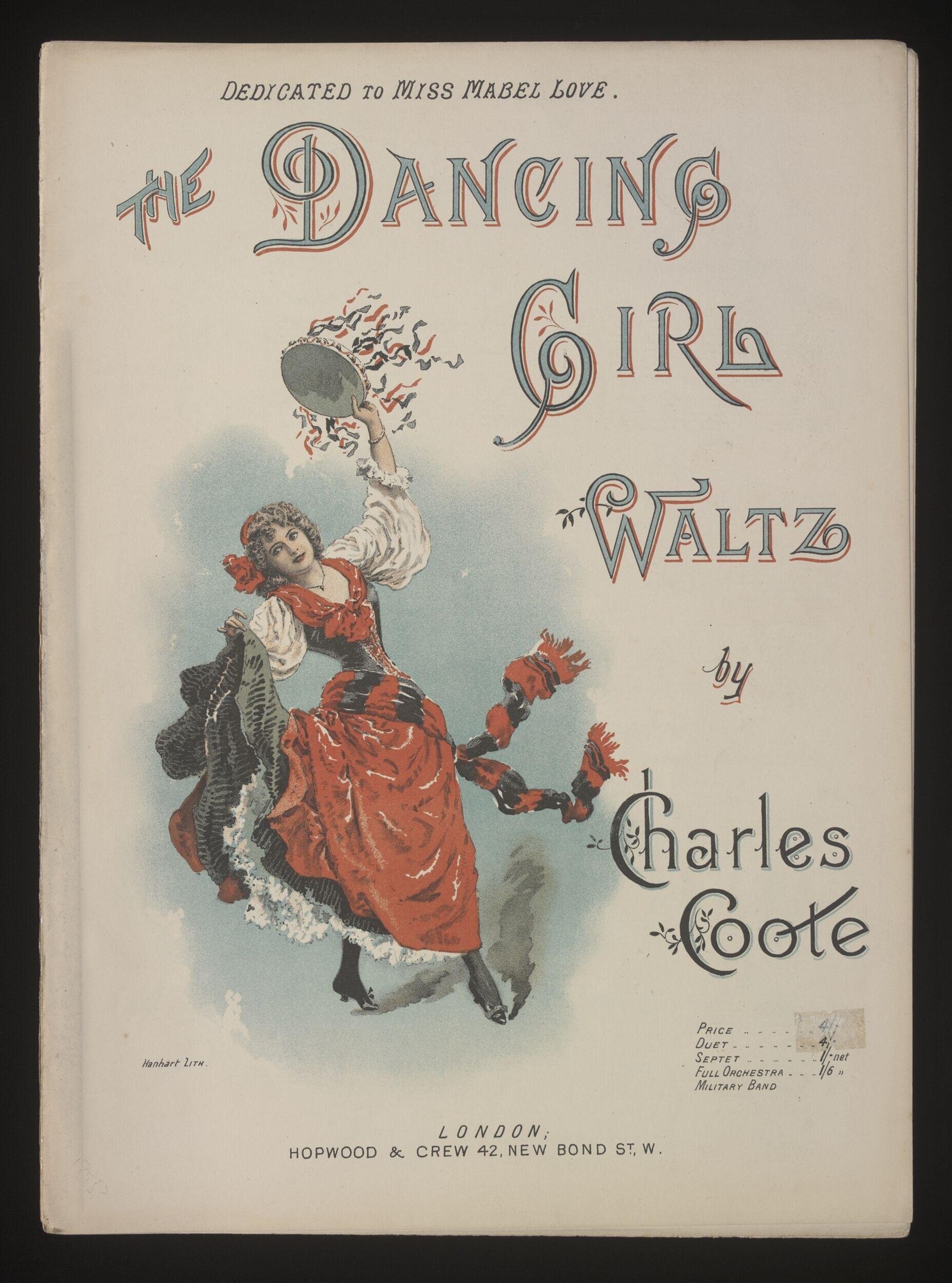
The Dancing Girl Waltz
Coote, Charles
- Collection:
- Sheet Music
- Source:
- Victoria and Albert Museum
- Rights:
- Rights vary by item — check the source record before reusing this image. Source record ↗
- Recorded as:
- V&A — check rights per item
This image shows the waltz not as a technical achievement but as a marker of social identity and feminine grace in Victorian culture. For anyone studying nineteenth-century ballroom culture, gender performance, or the visual marketing of dance, this cover is a primary source—it reveals what the dance was understood to mean and whom it was made for.
What you are looking at
This is the cover of a vocal waltz published by Hopwood & Crew in London. A young woman in an elaborate crimson ball gown dominates the composition, caught mid-twirl with one arm raised overhead holding a fan, her body angled dynamically across the page. She wears the dress of the 1870s–80s: a fitted bodice with a red silk skirt trimmed with black velvet bands and white lace at the hem, paired with a black jacket or bolero. Her blonde hair is styled up with a red feather or ribbon. The background is a soft blue-grey wash, creating depth without distraction. The composition is elegant and energetic, capturing the moment of a solo dancer in full rotation—a moment of lightness and social accomplishment rather than technical difficulty. The work celebrates the figure of the dancing girl as a subject of popular entertainment and commercial culture.
The dancing
A single young woman is shown in a three-quarter turn, with her raised arm holding a fan aloft and her body angled into the spiral of the waltz. Her weight appears to be on one leg, supporting the dynamic lean required by the turn. The other leg trails behind, supporting the sense of motion. Her face is upturned and animated, not looking down at her feet. No partner is visible, though the gestures and posture are entirely consistent with a ballroom waltz hold—she is posed as though dancing with an unseen partner who would be facing her across a closed frame.
The dance depicted
This is a waltz, one of the most fashionable couple dances of the nineteenth century. The title *The Dancing Girl Waltz* positions the work as a piece of Victorian popular music designed for drawing rooms and public dance halls. The image shows not a technical feat but a moment of social poise—the waltz as a display of elegance and femininity within the strict conventions of Victorian courtship and public dancing. The woman's upturned face and raised arm suggest the gaiety and lightness associated with the waltz in this era, a dance that had moved from aristocratic ballrooms into middle-class domestic performance.
How it was made
This is a colour-printed sheet music cover, a lithographic or chromolithographic work (not specified in the record, but standard for commercial music publishing of this date). The technique allowed the publisher to combine typography with hand-drawn illustration and colour, producing an affordable, attractive object that could be displayed in a music seller's window or in a home. The image is signed 'Haybert Irvin' in the lower left, likely the commercial illustrator. Sheet music covers were crucial marketing objects for the music industry, and the quality of the illustration directly affected sales—this one invests in both figure drawing and colour to make the piece visually appealing to potential buyers.
About this work
This is a commercial ballroom dance cover from the Victorian era, a lithographed sheet music cover for a waltz attributed to Charles Coote. The work documents the waltz as a middle-class social practice in the late nineteenth century, presented as a graceful and feminine performance. The image is neither a record of actual dancers nor a serious artistic study, but a marketing object designed to appeal to amateur musicians and dancers—it promises the pleasure of gaiety and accomplishment within respectable bounds. It belongs in a dance gallery as evidence of how the waltz was visualized, sold, and imagined during its period of greatest cultural dominance.
How to look at it
Notice the moment chosen: the dancer at the peak of a turn, her body and dress in full extension, her face joyful and upturned. This is the moment of the waltz that audiences and participants wanted to see and remember—not the footwork or technical difficulty, but the sense of gliding, turning, and feminine display. The absence of a male partner is striking: she is shown alone, as though the pleasure of the dance and the accomplishment of the turn are hers alone to claim. The richness of the dress—the deep red silk, the black velvet trim, the white lace—shows that this is an image of respectability and status, not of working dancers.
The artist
Charles Coote was a prolific composer of ballroom and light orchestral music in the late nineteenth century, working within the commercial tradition of British music publishing. His works were designed for amateur performance—for the piano at home or the dance band at public assemblies. The illustrator, credited as Haybert Irvin, was a commercial artist producing sheet music covers for the London publishing industry; his name appears on many covers of this period. Both were part of a vast machinery of popular cultural production that made dance music and dance imagery widely accessible.
The period
The waltz reached the peak of its fashionability in the 1870s and 1880s, especially as a drawing-room and public assembly dance. It had arrived in Britain from Vienna earlier in the century amid some moral anxiety (the closed hold was considered daring), but by the time this cover was printed, it was thoroughly respectable and ubiquitous. Sheet music publishing was a major industry; Hopwood & Crew was one of many London firms producing thousands of pieces annually. The image reflects the Victorian idealization of femininity—the upturned face, the graceful arm, the rich dress—within a dance that was actually performed by couples and governed by strict rules of propriety.
Where it lives
This is a sheet music cover held in the Virginia collection (based on the source attribution 'va'). Sheet music covers of this period are typically held in music libraries, university collections, and historical societies rather than art museums, and they are usually catalogued as music rather than as visual art. This work sits at the boundary between the two disciplines.
Dance in this work
Questions about this work
Is this a painting or a print?
This is a printed sheet music cover, most likely produced by chromolithography—a colour printing process that used separate stones for each colour. Chromolithography was the standard method for commercial music covers in the 1870s–90s. The image was designed for mass production, not as a unique artwork.
Who was the dancer modelled on?
The record does not name a model, and the image does not identify one. This is a generic figure of 'the dancing girl'—an idealized type rather than a portrait of an actual performer. Many sheet music covers featured unnamed women posed as types: the prima donna, the dancing girl, the society belle.
What does 'Dedicated to Miss Mabel Love' mean?
The dedication likely indicates that the piece was written for or promoted by Mabel Love, who may have been a known performer or patron of the music. Dedications on sheet music were common and served both as compliments and as marketing: they connected the music to a recognizable name that buyers might wish to emulate.
Would people have actually danced a waltz this way?
No. The waltz was a partner dance, performed in a closed hold (man and woman facing each other, his right hand on her waist, her left hand on his shoulder). This image shows a solo figure posed as though dancing, which was not how the waltz was performed. The image is artistic idealization, not documentation of actual practice.
More dance artwork





