49 works in this view — arrow keys or swipe to move between them.
Dance in Art
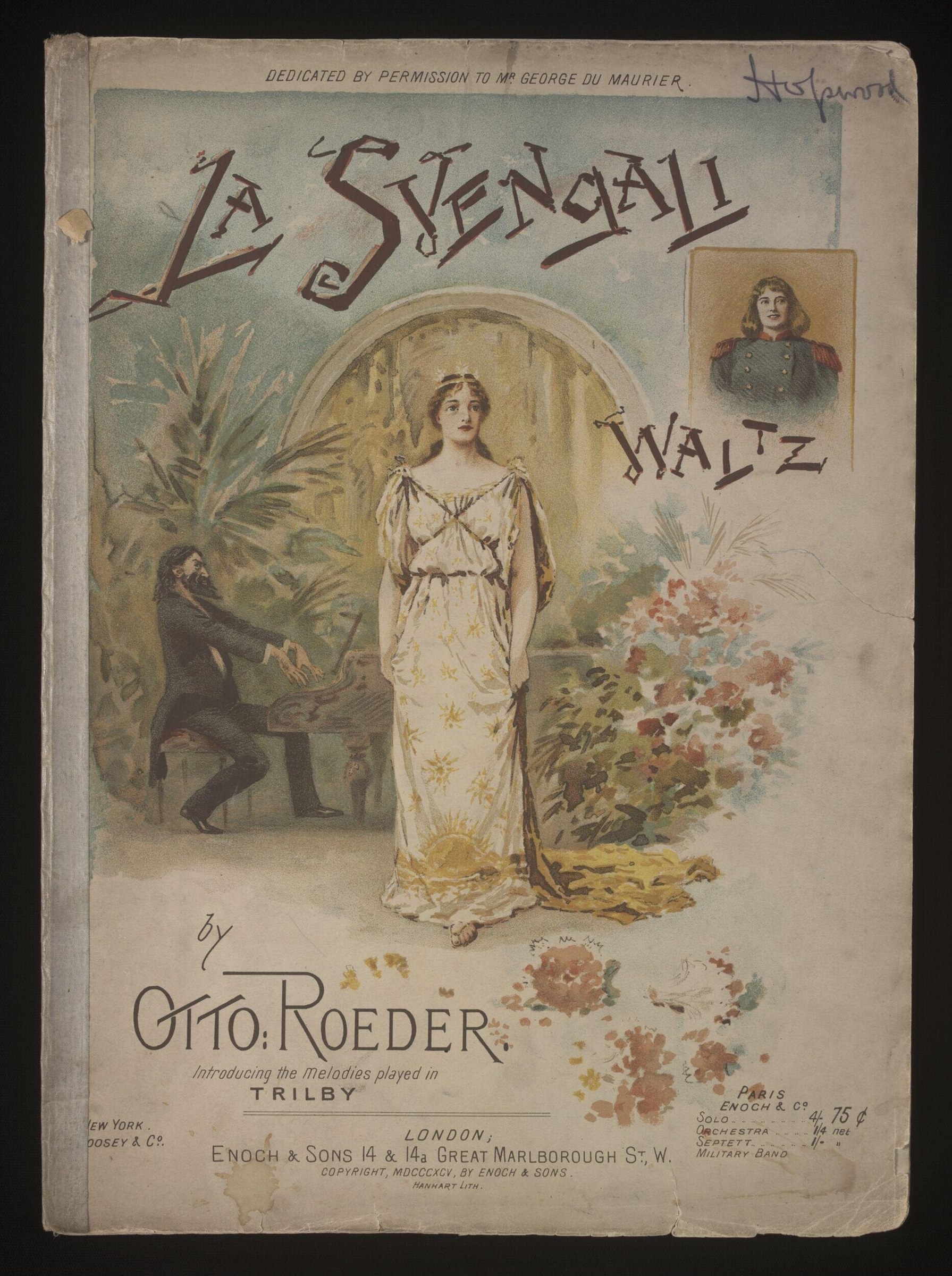
La Svengali Waltz
Roeder, Otto
- Collection:
- Sheet Music
- Source:
- Victoria and Albert Museum
- Rights:
- Rights vary by item — check the source record before reusing this image. Source record ↗
- Recorded as:
- V&A — check rights per item
This work documents the intersection of ballroom dance culture, theatrical narrative, and commercial mass reproduction in the 1890s. It reveals that sheet music covers were not neutral documents but active participants in theatrical promotion and narrative interpretation—they made stories legible and marketable through dance imagery. For historians of dance, it shows how the waltz functioned as a cultural symbol of feminine refinement and susceptibility, and how that symbolism was exploited in literature and visual culture.
What you are looking at
This is the cover of a sheet music publication for a waltz titled "La Svengali." The composition by Otto Roeder was introduced through melodies played in the theatrical production *Trilby*. The central figure is a woman in a flowing, pale classical or neoclassical gown, standing in a graceful, contemplative pose. She is positioned in an interior space with potted palms and flowering plants—details that evoke late 19th-century drawing room aesthetics. To her left, in shadow, a dark figure sits at what appears to be a piano or musical instrument, hunched forward in an attitude of intense focus or manipulation. The woman's gaze is distant, her body language passive and statuesque, creating a visual metaphor for the narrative of *Trilby*: the domination of the passive heroine by the controlling musician Svengali. A portrait inset in the upper right shows the same woman in period dress, reinforcing her identity as the subject of the work. The entire composition is rendered in soft watercolor tones—pale blues, greens, ochres, and reds—giving it the character of theatrical promotional art.
The dancing
The central female figure stands in an upright, almost rigid posture with arms held before her body in a pose of classical restraint. Her weight appears to be evenly distributed, and her stance suggests formal presentation rather than active movement. The seated male figure to her left is rendered in darker tones and appears hunched, creating visual contrast and suggesting psychological dominance. The composition implies a relationship of control and submission through spatial positioning and body language rather than through an actual dance encounter. There is no visible dance hold or partnership frame; instead, the woman's isolation within the space reinforces her status as observed rather than active participant.
The dance depicted
Though titled as a waltz and published as sheet music for a ballroom dance, this cover does not depict an actual waltz in progress. Instead, it visualizes the literary narrative of *Trilby*—specifically the famous episode in which the musician Svengali hypnotizes the heroine into becoming his instrument. The composition uses the waltz as a cultural reference point (waltzing was the dominant ballroom dance of the 1890s and a marker of social refinement) while depicting a moment of psychological rather than physical dance. If waltz was performed as part of the theatrical production, this cover captures not the dance itself but the dramatic power dynamic the music accompanied. The work is thus more accurately understood as theatrical or literary illustration that uses dance culture as its subject.
How it was made
This is a chromolithograph, a color printing technique that allowed for the production of affordable, multi-colored theatrical and commercial art in the 1890s. The soft, blended tones and the ability to layer transparent colors are characteristic of lithographic process. The technique made this cover reproducible in quantities suitable for sheet music distribution—this would have been sold alongside the printed score in music shops and theaters. Chromolithography was the dominant commercial printing method for theatrical promotion, sheet music covers, and advertising in this period, reaching a broad audience including amateur musicians and theater audiences. The technique's aesthetic—the painterly, slightly soft focus and ability to render atmospheric effects—was ideally suited to conveying the dreamlike, supernatural qualities of the *Trilby* narrative.
About this work
This is a chromolithographed sheet music cover for Otto Roeder's waltz *La Svengali*, published circa 1895 by Enoch & Sons in London and Dosey & Co. in New York. The cover illustrates a scene from the theatrical production *Trilby*, one of the most famous works of the 1890s, translating the narrative into visual form for commercial distribution. Rather than depicting the waltz itself in action, the cover stages the dramatic moment central to the story: the psychological domination of the heroine by the musician-villain Svengali. The work belongs in a gallery of dance in art because it reveals how dance culture—particularly the waltz as a symbol of refined society—was appropriated into theatrical narrative and commercial promotion. It shows dance not as an actual practice but as a trope through which power, gender, and artistic control were visualized and sold to a mass audience.
How to look at it
Attend to the radical spatial separation of the two figures and the way the woman's passivity contrasts with the man's focused intensity. Notice how the artist has chosen a moment not of dance movement but of stasis—the woman is not turning or responding to music, but standing as if suspended. Observe the use of light and shadow: the woman is brightly lit and clearly rendered, while Svengali is darkened and obscured, yet his presence dominates the composition through its off-center placement and psychological weight. The flowering plants and palatial interior are conventions of theatrical set design rendered in two dimensions, signaling that this is a theatrical scene rather than a ballroom. The portrait inset functions as authentication—the woman's face is repeated to confirm her identity as the heroine, a common device in theatrical promotion.
The artist
Otto Roeder (fl. 1890s–1910s) was a composer and musician active in London during the late 19th and early 20th centuries. He is known principally for theatrical compositions and orchestral arrangements. *La Svengali* appears to be his most commercially successful work, likely because it capitalized on the enormous popularity of *Trilby* in theaters across Europe and America. Little else is documented about his biography or broader practice.
The period
The 1890s witnessed the zenith of the Victorian waltz and its dominance in ballroom culture, yet simultaneously saw the waltz begin to be challenged by newer imported dances (Cuban contradanzas, Argentine tango). The decade also saw the rise of theatrical spectacle as a mass medium, with plays and musical theater reaching unprecedented audiences. George Du Maurier's novel *Trilby* (1894) became a publishing phenomenon and was rapidly adapted for the stage, spawning multiple theatrical productions, musical settings, and commercial products. The novel's central metaphor—the artist's control over the seemingly passive female muse—resonated powerfully with fin-de-siècle anxieties about artistic genius, female will, and mass culture. Sheet music covers of this period were not merely functional but were conceived as promotional art and collected objects. Chromolithography made possible the production of these covers in quantities that ensured wide distribution, making theatrical imagery available to amateur musicians and middle-class households.
Where it lives
This sheet music cover is held in the collection identified as "va" in the catalogue record. It was published by Enoch & Sons (London) and Dosey & Co. (New York) circa 1895. The dedication reads "Dedicated by permission to Mr George du Maurier," acknowledging the author of the original novel and his copyright. This object is a commercial music publication and would have been widely distributed through music shops, theaters, and private sale.
Dance in this work
Questions about this work
Is this depicting an actual waltz?
Not in the conventional sense. While titled as a waltz and published as a musical score, the cover illustration shows a theatrical scene rather than dancers in a waltz hold. It stages the dramatic moment from the play *Trilby*, capturing the psychological domination of the heroine rather than the physical mechanics of the dance. The waltz is invoked as a cultural symbol—a marker of refinement, susceptibility, and the society in which power operates—rather than as a choreographic practice.
Who was Svengali and why was this story so famous?
Svengali is the antagonist of George Du Maurier's 1894 novel *Trilby*, a manipulative musician who hypnotizes an innocent woman into becoming his artistic instrument. The character became iconic in late Victorian culture as an embodiment of predatory artistic genius and foreign (Jewish) otherness. The novel was adapted for stage almost immediately and became one of the most commercially successful theatrical productions of the 1890s, spawning merchandise, music, and visual imagery throughout Europe and America.
What is chromolithography?
Chromolithography is a color printing process that uses multiple stone or metal plates, each inked with a different color, to create layered, multi-colored prints. Developed in the early 19th century, it became the dominant commercial printing technique by the 1890s for theatrical posters, sheet music covers, advertising, and other promotional materials. It allowed for affordable mass production of colorful, detailed images without hand-coloring, making theatrical imagery widely available to middle-class consumers.
Why would a waltz be published with this narrative imagery?
Sheet music covers in the 1890s served as both functional labels and promotional art. Publishers used theatrical imagery to market instrumental music and to capitalize on the success of stage productions. A waltz could be performed at home or in the ballroom, and the cover's connection to a famous play made it more desirable and collectible. This cover essentially advertises both the music and the theatrical production, encouraging amateur musicians to purchase and perform the piece.
More dance artwork





