49 works in this view — arrow keys or swipe to move between them.
Dance in Art
When You're Waltzing With A Girl
Collins, Henry Wilfred
- Collection:
- Sheet Music
- Source:
- Victoria and Albert Museum
- Rights:
- Rights vary by item — check the source record before reusing this image. Source record ↗
- Recorded as:
- V&A — check rights per item
Sheet music covers are underrepresented in dance history collections but are vital evidence of how popular dances were marketed, imagined, and consumed in their own time. This small object tells us what a 1912 London publisher assumed dancers and song-buyers wanted to see: a romantic, heterosexual couple in a timeless waltz pose, suitable for home performance and social dancing. It is a direct artifact of the dance economy and the culture industry that sustained and shaped ballroom practice.
What you are looking at
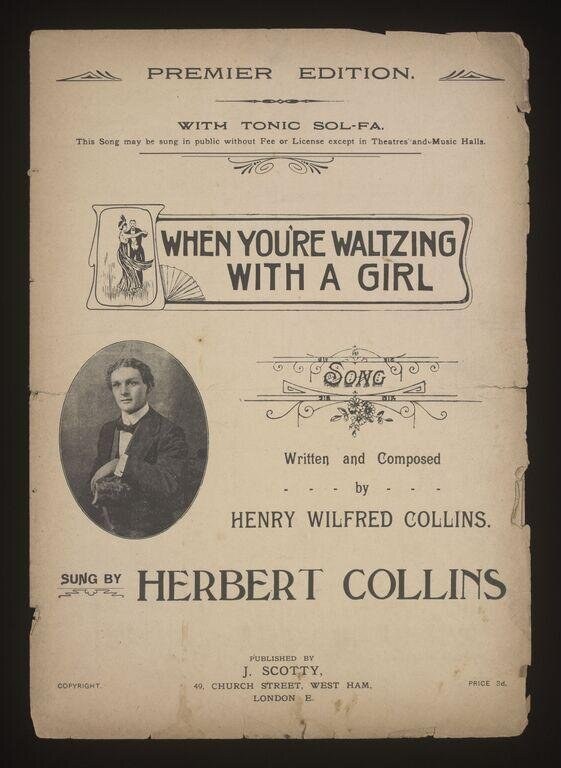
This is the cover of a printed song sheet, a mass-market publication of the early 20th century. The title 'When You're Waltzing With A Girl' appears in large block letters above a decorative cartouche containing a silhouette of a dancing couple. Below the title sits a photographic portrait of a young man in dark formal dress—identified as Herbert Collins, the singer—rendered as a halftone oval inset. The credits read 'Written and Composed by Henry Wilfred Collins' and 'Sung by Herbert Collins.' The publication details state it was published by J. Scotty of Church Street, West Ham, London, priced at 3d. The sheet announces itself as a 'Premier Edition' and notes it may be sung in public venues without fee or license. The overall design is typical of affordable popular songs sold to domestic music-makers in Britain during the Edwardian era—functional, cheerful, and designed for wide circulation.
The dancing
The image contains a single silhouette of a couple in a closed ballroom position, seen in profile. The figures are small and schematic—rendered as a dark outline rather than a naturalistic drawing—which limits detail about hold, frame, or footwork. The male figure stands to the left, the female to the right, and their bodies angle toward one another in the characteristic enclosed frame of the waltz. The woman's arm appears raised, consistent with a ballroom frame, though the scale and medium preclude certainty about the specific arm and hand position. The posture suggests forward momentum and upright carriage typical of early 20th-century ballroom style.
The dance depicted
The title and the silhouette together identify this as a waltz. The waltz was the dominant couple dance in ballroom contexts across the English-speaking world in 1912, and a sentimental love song paired with waltzing was a standard commercial formula. The song was written to be performed and danced socially—the verso would contain lyrics and a melody line for home musicians. The title's romantic premise ('with a girl') and the decorative treatment of the dancing silhouette as an ornamental vignette reflect the waltz's association with courtship and middle-class courtship rituals in the early 20th century. Nothing in the image distinguishes between the Viennese waltz, the standard waltz, or regional variants; the generic silhouette represents the ballroom waltz as a social form rather than a competition or theatrical genre.
How it was made
This is a printed song sheet, produced by offset lithography or letterpress—the standard methods for affordable popular music publication in Britain in 1912. The halftone portrait of Herbert Collins was integrated into the design via photolithography, allowing a photographic likeness to be combined with typography and ornamental borders. Sheet music of this kind was sold for a few pence through music shops, stationers, and department stores, and was designed for amateur musicians and singers to purchase, bring home, and perform. The cheap production and mass circulation made this a major vector for teaching dance fashions and popular songs to the middle and working classes. The 'Premier Edition' designation suggests this was the first issue of this particular arrangement or recording.
About this work
This is a song sheet cover for a popular ballroom waltz published in Edwardian Britain. The work documents both the commercial music industry of the period and the waltz's central place in early 20th-century courtship and social dancing. The image is primarily a design artifact and publishing record rather than a representation of an actual performance; the dancing couple exists as a decorative motif to signal the song's subject to prospective buyers. Yet it is precisely this formulaic quality that makes it historically significant—the standardization of the waltz silhouette in commercial print reflects its normalization as the standard couple dance of English-speaking ballrooms in this era. The sheet music industry was one of the primary means by which dance styles were disseminated to amateur performers and social dancers.
How to look at it
Note the silhouette technique: it conveys the essentials of the ballroom frame without anatomical detail, suggesting that by 1912 the closed waltz position was so familiar that a simple outline would be immediately recognized. The decorative cartouche treats the dancing couple as an ornament—not a narrative moment or a dramatic scene, but a symbol. Contrast this with theatrical dance imagery of the same period, which typically shows costume, character, and a specific dramatic pose. Here, the dance is abstracted into a pure formal shape, suggesting that the waltz had become almost invisible as a particular set of movements and had instead become a cultural code for 'romance' and 'social dancing.' The portrait of the singer is the more prominent visual element, indicating that celebrity and the voice were being marketed as equal to or greater than the dance itself.
The artist
Henry Wilfred Collins is credited as both composer and writer of the song. He is otherwise unidentified in available records. Herbert Collins, the credited singer, is also not documented in standard references. Both may have been semi-professional musicians working in the London music halls or amateur performers whose work appeared in the popular sheet music market; the credited 'performer' was often a publisher's invention or a featured artist in a minor venue, used to add credibility to a new release. The publisher J. Scotty of West Ham appears to have been a small regional or local music publisher, not one of the London majors.
The period
In 1912, the waltz was at the height of its popularity in English ballrooms and was beginning to face competition from newer dances like the foxtrot (introduced in 1912–13). The sentimental parlor song coupled with the waltz was a staple genre; music halls and ballrooms in Britain featured both live performance and sheet music sales. The early 20th-century sheet music industry was highly productive and competitive, with hundreds of songs published annually aimed at amateur performers. Sheet music was a major consumer good and a primary medium of musical and choreographic education for people without formal training. The photographic portrait of the performer on the cover was a newer marketing strategy, reflecting the rise of celebrity and image reproduction in mass media.
Where it lives
This is a song sheet held in a collection of printed ephemera. It is a product of the commercial music publishing industry and was never intended as a unique or precious object; it was a consumable commodity, mass-produced and distributed through retail channels. Its survival depends on accidental preservation by collectors or libraries rather than curatorial intent.
Dance in this work
Questions about this work
Why is the couple shown as a silhouette?
Silhouettes were economical to produce and immediately readable in small reproduction on a song cover. They conveyed the essential ballroom position without anatomical detail. The technique also gave the design a timeless, classical quality—silhouettes evoked elegant simplicity and were associated with refined entertainment.
Could you actually waltz to this song?
Yes. Song sheets were sold with melody lines and chord indications on the verso, allowing amateur pianists and singers at home to perform the song. The music would be written in waltz meter (3/4 time) and tempo. Couples would dance while someone played the sheet music, or it would be performed in social venues like dance halls or at home entertainments.
What does 'Premier Edition' mean?
It indicates this was the first published version of this arrangement. Popular songs might be published in multiple versions (different singers, different instrumental arrangements, different publishers), so 'Premier Edition' distinguished the original or the first widely distributed release.
Why was it so cheap to publish?
Lithography allowed relatively low-cost mass production compared to engraving. Simple designs with typography and minimal illustration could be run off quickly and in large quantities, keeping the unit cost low. This made sheet music accessible to middle and working-class households.
More dance artwork





