49 works in this view — arrow keys or swipe to move between them.
Dance in Art
Adoration Waltz
Fabian Rose
- Collection:
- Music
- Source:
- Victoria and Albert Museum
- Rights:
- Rights vary by item — check the source record before reusing this image. Source record ↗
- Recorded as:
- V&A — check rights per item
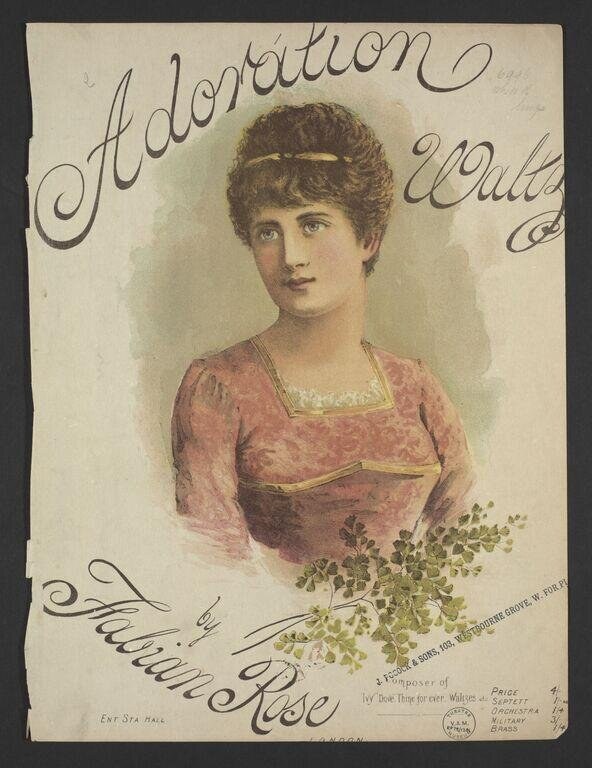
This cover illustrates how the waltz was marketed and imagined in popular culture: not as athletic or technical, but as an expression of romantic sentiment and feminine grace. It shows the centrality of visual and musical marketing to the social dance economy of the early 20th century, and how the image of dance—rather than its actual movement—shaped cultural desire.
What you are looking at
A young woman with upswept dark hair, wearing a rose-pink dress with white lace trim at the neckline, faces the viewer in a three-quarter pose against a soft, neutral background. She holds a delicate spray of fern fronds in her right hand at waist level. The composition is intimate and frontal, suggesting a moment of stillness rather than motion. Decorative script reading "A adoration" curves across the upper left of the image, while "Waltz" appears in script on the lower left. The woman's gaze is direct but contemplative, and her posture is upright and composed, her shoulders relaxed. The soft watercolor or chromolithographic technique creates a hazy, romantic quality typical of turn-of-the-century sentimental imagery. A credit line at the bottom right indicates this is sheet music cover art.
The dancing
A single female figure is depicted in a standing pose, her weight evenly distributed, her body aligned toward the viewer. Her right arm is extended downward in a gentle curve to hold the fern spray; her left arm hangs naturally at her side. The posture is upright but not rigid—the carriage of the head and the softness of the arm position suggest elegance without tension. There is no active dance movement captured; the figure is stationary and posed for portraiture rather than frozen mid-gesture.
The dance depicted
This is a cover illustration for a waltz, one of the most popular ballroom dances of the late 19th and early 20th centuries. The title 'Adoration Waltz' suggests a romantic or sentimental number, likely for social dance rather than theatrical performance. The image presents the waltz not through depiction of movement but through the figure of an idealized woman—the implicit partner in the dance—in a moment of repose. The fern and the woman's refined dress and bearing encode the gentility and sentimentality associated with ballroom culture of the period. The work advertises the music rather than illustrating the dance itself.
How it was made
This is a chromolithographic print, a color printing technique that allowed mass production of sheet music covers in vivid, softly blended hues. Chromolithography created layers of color through successive stone plates, enabling the subtle gradations and romantic soft focus visible here. The technique was ideal for commercial sheet music distribution, reaching middle-class households with affordable reproductions of fine art. The painterly quality—the warm peachy tones, the atmospheric background, the delicate rendering of lace and fabric—suggests the work was created for wide circulation as popular music cover art.
About this work
This is a chromolithographic sheet music cover for a waltz composed or arranged by Fabian Rose, likely published in the early 1900s. The work exemplifies the marriage of dance, music, and visual art in turn-of-the-century ballroom culture. Rather than depicting couples in motion, the cover presents an idealized feminine figure as the emotional anchor of the waltz—a convention of romantic, sentimental dance music of the era. The image encodes the values of refinement, grace, and genteel courtship associated with the waltz in polite society.
The work belongs to the history of ballroom culture at the moment when the waltz had become the dominant couple dance of European and American high society. Sheet music covers such as this served as both advertisements and cultural artifacts, disseminating idealized images of dance and femininity to a broad audience. The softness of the chromolithographic technique, the pale palette, and the romantic composition all worked to make the waltz and the music desirable to consumers.
How to look at it
Note that the artist has chosen not to depict the waltz itself—no couple, no swirling skirts, no movement—but instead presents a single idealized woman in repose. This was a common convention for sentimental waltz covers of the period: the woman is the object of adoration (as the title suggests), and her stillness and grace imply the emotional and physical qualities a dancer should embody in the dance. The fern frond is a carefully chosen detail: ferns were symbols of delicacy, fecundity, and refined taste in Victorian and Edwardian visual culture. Attend to the softness of the chromolithographic technique, which allows no hard edges and creates an almost dreamlike quality—this technical choice reinforces the romantic, sentimental mood the music and the title promise.
The artist
Fabian Rose is credited as the composer or arranger of this waltz. Little is known of Rose from the catalogue record, but the work suggests he was one of many composers working in the popular waltz idiom for middle-class domestic and social consumption in the early 20th century. Waltz composition was a competitive commercial field, and covers such as this were crucial to the marketability of new pieces.
The period
The waltz reached the height of its popularity in European and American ballroom culture in the late 19th and early 20th centuries, though it had been dominant since the early 1800s. By the time this cover was created, the waltz was the standard couple dance of formal balls and middle-class social dancing. The chromolithographic technique allowed cheap, beautiful color reproductions of art, making sentimental imagery of dance and femininity widely accessible. This period saw intense competition among composers for the attention of amateur musicians and dancers; elaborate, romantic sheet music covers were a key marketing tool.
Where it lives
This is a sheet music cover held in a music collection (catalogued as source 'va'). The catalogue record provides no accession number, date, or imprint information. The work is a commercial music publication, likely produced in multiple copies and distributed through music retailers.
Dance in this work
Questions about this work
Is this a painting or a print?
This is a chromolithograph, a color print made by layering inks on stone plates. Unlike a painting (one-of-a-kind), a chromolithograph could be reproduced in hundreds or thousands of copies, making it an ideal medium for commercial sheet music covers. The soft, blended colors and painterly quality are characteristic of the technique, which was expensive to produce but affordable for end consumers.
Why is there only one person if this is a dance?
Sentimental ballroom music covers often featured a single idealized woman rather than a dancing couple. The woman represented the emotional and aesthetic ideal of the dance, and the cover implicitly positioned the viewer (or the purchaser of the sheet music, usually a young woman) as the dancer. The title 'Adoration Waltz' emphasizes the emotional sentiment, not the physical steps.
What was the waltz in 1900?
By this period, the waltz was the dominant social couple dance across Europe and America, danced at balls, formal social events, and in middle-class drawing rooms. It was considered elegant, romantic, and quintessentially modern—having shocked earlier generations for its close hold and speed, it was now the sign of refined society. Waltz music was endlessly produced and consumed; thousands of new waltzes were published each year.
More dance artwork





