49 works in this view — arrow keys or swipe to move between them.
Dance in Art
The Ravenswood Waltzes
Donizetti, Gaetano
- Collection:
- Sheet Music
- Source:
- Victoria and Albert Museum
- Rights:
- Rights vary by item — check the source record before reusing this image. Source record ↗
- Recorded as:
- V&A — check rights per item
The waltz was the first modern ballroom dance to achieve global popularity and commercial saturation; the flood of waltz sheet music with idealized cover imagery shaped how millions of people imagined the dance long before they ever performed it. This single image captures the intersection of music publishing, ballroom culture, and romantic ideology in the Victorian era, showing us what composers and printers thought would sell music and what dancers and their families aspired to embody.
What you are looking at
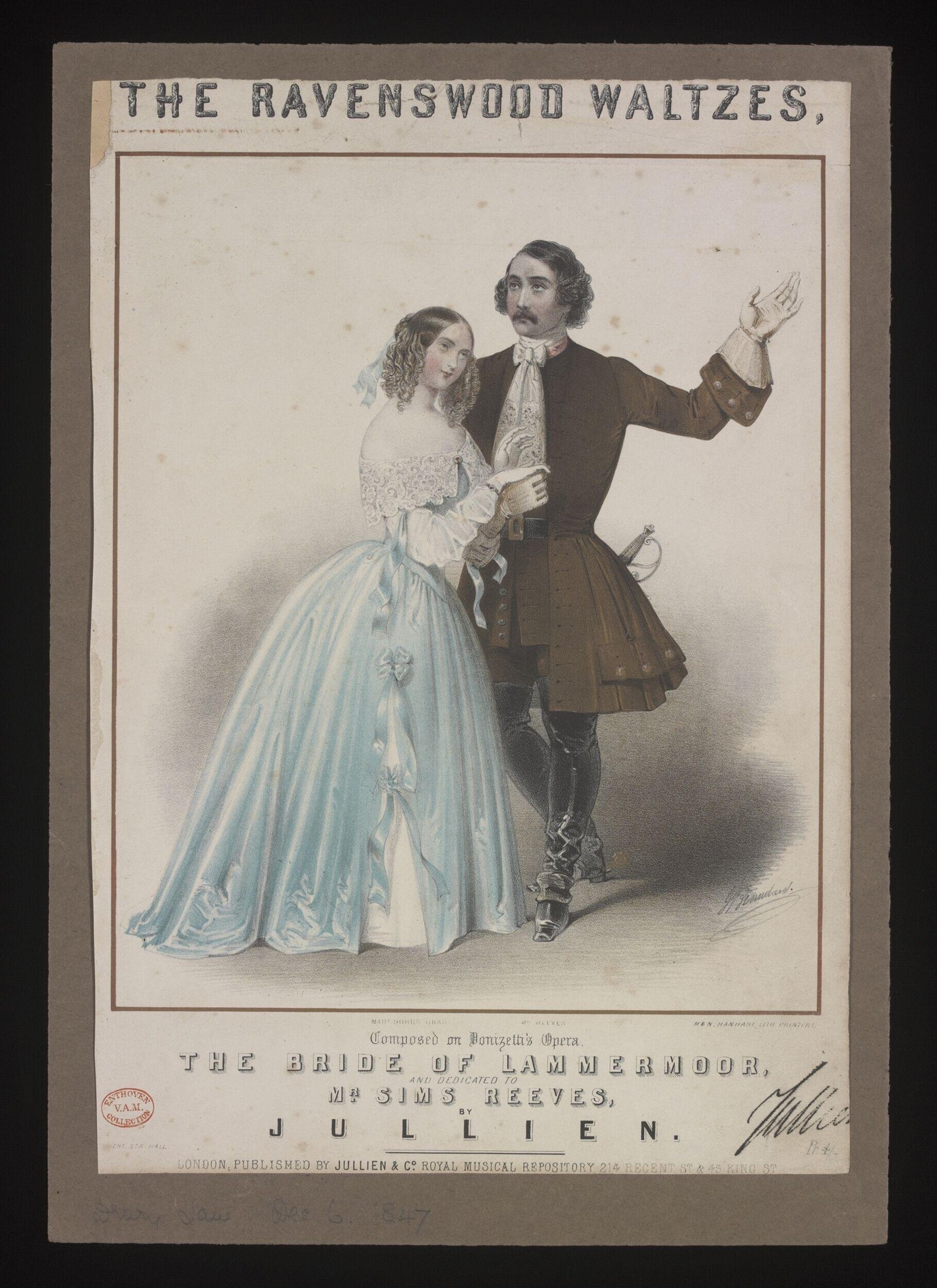
A young couple in formal nineteenth-century dress stand together in a ballroom or theatrical setting against a neutral background. The woman wears an elegant white or cream lace bodice with a voluminous skirt of pale blue silk or satin, gathered with ribbon bows down its length and sweeping into a long train. She wears a delicate veil or lace head covering. The man, in dark formal coat with decorative braid or lacing at the front, stands beside her with his right arm raised in an expressive gesture—his hand held aloft with fingers extended, as if conducting or presenting. His left arm is extended toward his partner. The composition captures an intimate moment between the pair, with the woman's gaze directed toward him and her body angled to engage with his gesture. The image has the quality of a hand-colored lithograph or engraving, with soft shading that gives the figures dimensionality against the plain background.
The dancing
The couple are positioned side-by-side in a formal ballroom stance rather than a closed dance hold. The man's right arm is raised high with an open, presentational gesture—fingers relaxed and arm curved—while his left arm reaches toward his partner in an invitational or supportive manner. The woman stands with proper posture, her weight balanced, her skirts arranged to display their volume. There is no visible footwork or the tensile grip characteristic of standard ballroom dance technique; instead, the pose suggests a moment of promenade or courtship gesture rather than active partnered dancing.
The dance depicted
This is a waltz, as confirmed by the title 'The Ravenswood Waltzes,' and likely represents the Viennese waltz of the mid-nineteenth century during the romantic era when the form dominated ballroom culture. The image does not capture a moment of active turning or typical closed-position waltz technique, but rather a posed presentation of a couple in formal dress suitable for the title page of sheet music. The man's raised arm and the woman's receptive posture suggest a theatrical interpretation or stylized presentation rather than instructional dance documentation. The work belongs to the wave of waltz-derived musical compositions and their iconography that flooded Europe in the 1840s–1860s.
How it was made
This is a hand-colored lithograph or chromolithograph, as evidenced by the soft tonal transitions, the delicate color work (particularly in the woman's blue skirt and the man's brown coat), and the printing marks visible at the sheet edges. The technique allowed for wide circulation and affordable production of sheet music covers, making this accessible to amateur musicians and the growing middle-class domestic market. The colored form suggests a more expensive or prestigious edition than a plain print, indicating this was marketed to a relatively affluent audience. The publication credit to 'Julien & Cº Royal Musical Repository' in London places this within the Victorian-era sheet music trade.
About this work
This is the title page or cover image of a waltz composition, lithographically reproduced and hand-colored for commercial sheet music distribution in Victorian London. It depicts an idealized scene of courtship and ballroom romance rather than a documentary record of dance technique—a convention of the period that used dance imagery to sell music to amateur performers. The work sits within the vast tradition of nineteenth-century waltz culture, when the dance dominated social life and generated enormous quantities of composed music and related visual materials. It belongs in a dance gallery not as evidence of how waltzes were actually danced, but as testimony to how nineteenth-century society understood and visualized the dance: as elegant, intimate, theatrical, and aspirational.
How to look at it
Observe the man's raised arm and open gesture: this is not the closed partnering position of an active waltz turn, but a presentational moment—the kind of courtship pose that would have appeared in operatic scenes or ballroom tableaux. Notice how the artist has arranged the couple to display both figures fully to the viewer rather than in the three-quarter view that would occur if they were actually turning together. The woman's gaze toward her partner and her relaxed posture suggest consent and admiration rather than the focused concentration of active dance. This is an idealized image designed to sell music to aspiring dancers, not to document technique.
The artist
The work is attributed to Donizetti (Gaetano Donizetti, 1797–1848), the celebrated Italian operatic composer, though the credit may refer to composition rather than visual art. The lithographic illustration is unsigned in the visible portion of this image, and the artist's name does not appear in the provided record. Donizetti composed numerous operas and standalone works for ballroom use; the 'Ravenswood' title likely references his opera *La Lucia di Lammermoor* or a related work, which was extremely popular in England during the 1840s. The sheet music was published through the London house of Julien & Cº, a major Victorian music publisher.
The period
The 1840s–1860s witnessed an explosion of waltz composition and publication in Britain and Europe. The waltz, originating in Central Europe decades earlier, had become the dominant ballroom dance by the 1830s, displacing earlier forms like the cotillion and quadrille in fashionable society. Simultaneously, ballroom dancing was becoming increasingly commercialized: dancing masters published instructional materials, composers produced thousands of named waltzes (often tied to operas, current events, or fashionable locations), and print publishers issued cover images that standardized the visual language of ballroom romance. The woman's Romantic-era dress, with its high waistline and full skirt, and the theatrical presentation of the scene reflect the taste of the 1840s–1850s.
Where it lives
This is sheet music from the Victorian era, part of a collection held as music rather than visual art. The catalogue record identifies it as being sourced from 'va' (likely Virginia) and held as sheet music, suggesting it was once part of a domestic music library. It is now catalogued in a dance-focused collection, recognizing that sheet music covers constitute an important genre of dance iconography.
Dance in this work
Questions about this work
Is this an instructional dance manual?
No. This is a sheet music cover designed to appeal to amateur musicians and dancers in the home. It presents an idealized, theatrical image of ballroom romance rather than a guide to waltz technique. The posed, stiff positioning and raised arm gesture are artistic choices meant to convey elegance and emotion, not to show how couples actually danced waltzes.
What is the connection to Donizetti?
Gaetano Donizetti composed the waltz or collection of waltzes, likely drawing on themes from one of his operas (possibly *Lucia di Lammermoor*). The music was then published with this lithographic cover, which may or may not have involved the composer's input on the visual design.
How do we know this is a waltz?
The title clearly states 'The Ravenswood Waltzes,' and the work was published as sheet music through a commercial London house. The couple's formal ballroom dress and the intimate, turning-focused composition are consistent with waltz iconography of the 1840s–1850s, though the pose is too static to demonstrate actual waltz technique.
Why are their hands positioned that way?
In actual waltz technique, couples maintained a closed hold: the man's right hand on the woman's back, their left and right hands joined. This image shows a different moment—more theatrical and presentational. The raised arm and open gesture suggest the man is presenting or inviting his partner, a romantic convention of ballroom imagery rather than active dance.
More dance artwork





