49 works in this view — arrow keys or swipe to move between them.
Dance in Art
Mc. Fadden Learning to Waltz
Carey, M.F.
- Collection:
- Sheet Music
- Source:
- Victoria and Albert Museum
- Rights:
- Rights vary by item — check the source record before reusing this image. Source record ↗
- Recorded as:
- V&A — check rights per item
This image reveals the waltz not as an abstract ideal of elegance, but as a lived social practice that audiences found genuinely difficult and worthy of ridicule. It documents how dance was commodified and performed in Victorian music halls, and shows that the gap between the aspiration and the execution of ballroom dance was itself recognized, performed, and sold as entertainment. For dance historians, this is evidence of how the waltz was taught, valued, and experienced outside the formal ballroom—and how central dance remained to popular culture and working-class entertainment.
What you are looking at
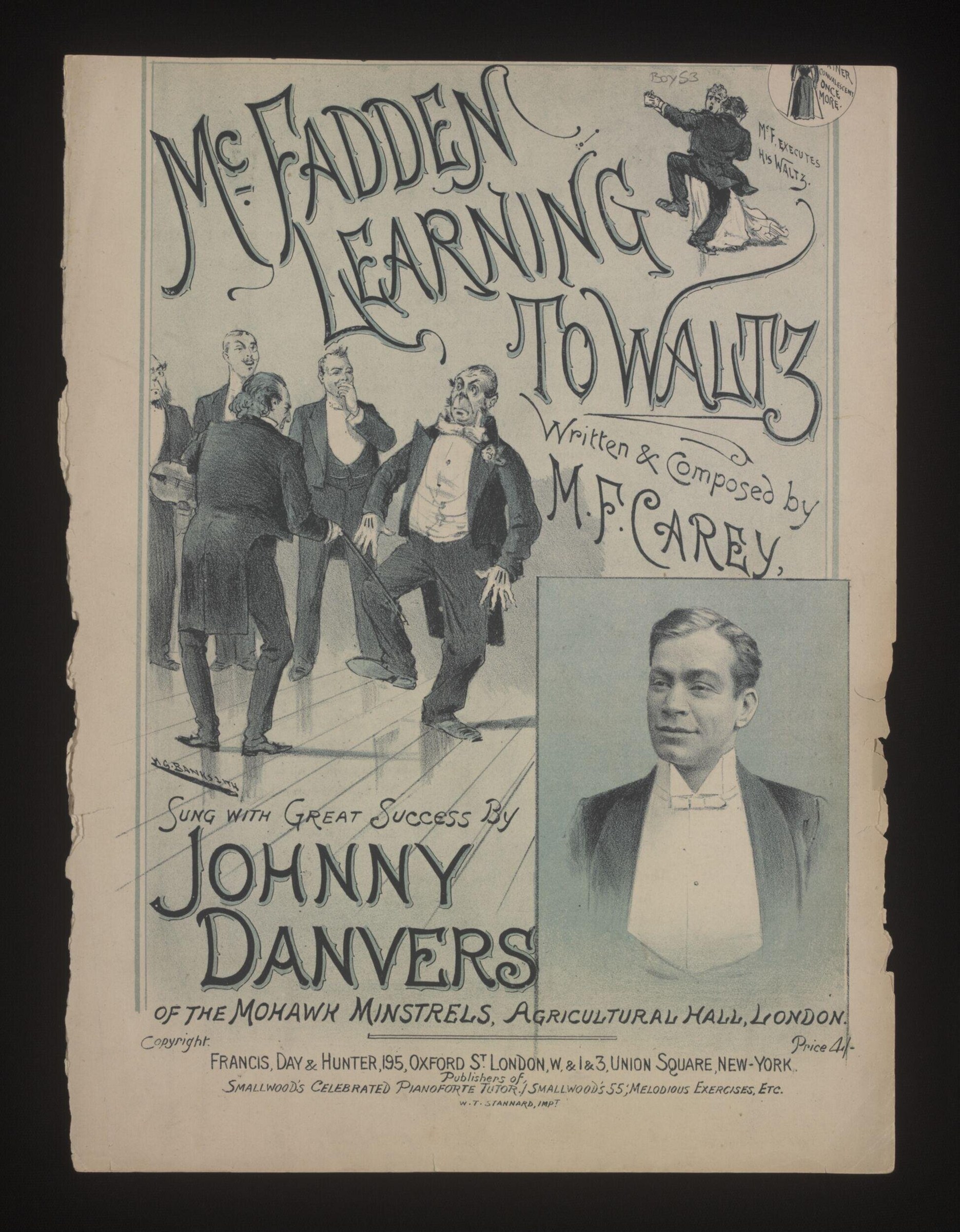
This is the cover of a piece of sheet music titled *Mc. Fadden Learning to Waltz*, composed by M.F. Carey. The central illustration depicts a ballroom comedy: a stout man in formal dress—dark coat, white shirt front, and bow tie—stands in the center, arms raised in an awkward, uncertain posture as he learns to waltz. He is surrounded by four other figures in evening wear: a dancing master or instructor appears to be demonstrating or correcting his position, while three other men watch with expressions of amusement or concern. The setting is a polished ballroom floor, rendered in perspective lines that recede toward the background. In the upper right, a small vignette shows another figure executing an exaggerated, comedic dancing pose. The composition emphasizes the humor of an adult beginner grappling with the formality and coordination required by the waltz. At the bottom of the cover, a photographic portrait of Johnny Danvers is printed, identified as "of the Mohawk Minstrels, Agricultural Hall, London"—suggesting he was the performer who popularized this comic song. The typography is ornate and flowing, characteristic of late-Victorian sheet music design.
The dancing
The central figure displays the posture of an uncertain beginner: his torso is stiff and upright, his arms held high and spread—not in the proper waltz frame but in an exaggerated, flailing position suggesting loss of balance or confusion. His weight appears unstable. The instructor or guide figure leans toward him in an attitude of correction or demonstration, his own carriage more assured. The three onlookers maintain formal posture but their body language suggests they are reacting with humor to the scene. None of the figures show the relaxed confidence of experienced waltzers; instead, the composition captures a moment of social awkwardness, the physical comedy of ballroom instruction gone awry.
The dance depicted
This is a waltz, as stated in the title and confirmed by the ballroom setting and formal dress. However, this is not a depiction of the waltz as a serious or elegant pursuit. Rather, it is a comic novelty song—a popular form of entertainment in the 1890s—in which the humor arises from watching an unprepared or ungainly man attempt to master a dance that was itself still relatively modern and formal in social protocol. The image documents the waltz as a marker of social class and propriety, with humor generated from the failure to achieve grace. The attribution to Johnny Danvers and the Mohawk Minstrels confirms this was entertainment music, likely performed with spoken dialogue and exaggerated physical comedy. The waltz here is not the dance itself, but the occasion for satire of social aspiration and physical clumsiness.
How it was made
This is a lithographed sheet music cover, a standard commercial format of the late nineteenth century. The illustration is rendered in black line with gray tone work, allowing for both crisp typography and detailed figuration within the constraints of the print process. Sheet music covers of this period were designed for visibility and appeal at music sellers' windows and served as advertising as well as packaging; the photographic portrait of the performer at the bottom was a common marketing device to connect the published music with a known entertainer and draw audiences to hear the song performed. The technique allowed for rapid, affordable production and wide circulation.
About this work
This sheet music cover documents a popular comic song of the 1890s that used the waltz—then a marker of formal social dance and Continental sophistication—as the vehicle for music-hall humor. The waltz was among the most prestigious ballroom dances of the Victorian era, yet this composition celebrates the failure to master it, turning the dance into a site of slapstick and social satire. The work is evidence of how dance functioned in popular entertainment: not only as a physical practice but as a cultural reference point that audiences recognized and found comedic. It also shows the intimate connection between music and dance in the period—the waltz could not be separated from the specific piece of music that drove it, and the title alone would have evoked both musical and choreographic expectations in the listener-viewer.
How to look at it
Look first at the central figure's posture and arms—the artist has exaggerated the stiffness and uncertainty in the body to create comedy. Compare this to the straighter, more confident bearing of the instructor: the difference in carriage tells the whole story. Notice too the onlookers' expressions: their eyes and mouths are animated, registering amusement at the scene unfolding. The ballroom setting—the polished floor, the formal dress, the contained interior space—is rendered with enough specificity to place this firmly in the world of respectable dance, which makes the physical disaster happening within it all the more comic. The title alone promises instruction; the image delivers humiliation.
The artist
M.F. Carey was a composer of popular and novelty songs in the late nineteenth century. Little is recorded of his broader practice, but his work as represented here was directed toward the music-hall and commercial entertainment market. Carey's piece was sufficiently successful to be published by Francis, Day & Hunter, a leading London music publisher, and to feature a known performer (Johnny Danvers) on the cover, suggesting it reached a substantial audience. His compositional approach was typical of the period: setting topical or comic situations to melody in a form designed for theatrical performance and domestic reproduction.
The period
The 1890s was the height of the waltz's dominance in European ballroom culture. The dance had been fashionable since the early nineteenth century, but by the 1890s it had become deeply codified—formal, rule-bound, and exclusive to the educated and propertied classes. Simultaneously, music hall and popular entertainment were at a peak of production and cultural influence in Britain. The tension between the waltz as a marker of respectability and the music hall's irreverent, comedy-driven ethos created space for parodies like this one. The Mohawk Minstrels, mentioned as Danvers's ensemble, were a professional group performing in the minstrel tradition of the period, often featuring comedic and satirical numbers. This sheet music is a product of the high demand for popular songs that could be performed on stage and also sold to amateur musicians and singers for home performance.
Where it lives
This is a piece of sheet music held in the Virginia collection (indicated by the holding code 'va' in the catalogue record). Sheet music of this era survives widely in public and private collections; it was produced in thousands of copies for commercial sale and domestic use. This particular item represents the material culture of entertainment consumption in the 1890s.
Dance in this work
Questions about this work
Was the waltz really so difficult to learn?
In the context of formal ballroom dance, yes. The waltz required a closed hold (unfamiliar to many), a specific three-beat rhythm (different from earlier country dances), and the ability to move across the floor in a turning pattern without collision. For audiences from outside the educated middle class, it was genuinely foreign. The humor of this song depends on that difficulty being real and recognized.
What is the Mohawk Minstrels?
A professional entertainment ensemble performing in the minstrel tradition of the late nineteenth century. Despite their name, they were not a blackface minstrel show but rather a variety performance group that included comedy, music, and dance. Johnny Danvers was one of their performers, and the company was established enough to perform at Agricultural Hall, a major London venue.
Why would people buy sheet music of a song about failure?
The comedy was relatable. Not everyone in the audience could waltz successfully; indeed, most working-class people had little access to formal instruction. The song offered both satire of the pretensions of ballroom culture and a kind of revenge fantasy—laughing at the waltz itself for being difficult and exclusive. The melody was probably catchy, and Danvers's performance made it memorable.
What does the photographic portrait at the bottom tell us?
It is a marketing device. By the 1890s, photographs of performers were standard on sheet music covers. They created a direct link between the published song, the performer audiences knew from live performance, and the music they could play at home. Johnny Danvers's face was recognizable in London theaters; seeing it on the cover would have encouraged people to buy the music to recreate his performance.
More dance artwork





