49 works in this view — arrow keys or swipe to move between them.
Dance in Art
The Bellow of the West Waltzes
John Pridham
- Collection:
- Sheet Music
- Source:
- Victoria and Albert Museum
- Rights:
- Rights vary by item — check the source record before reusing this image. Source record ↗
- Recorded as:
- V&A — check rights per item
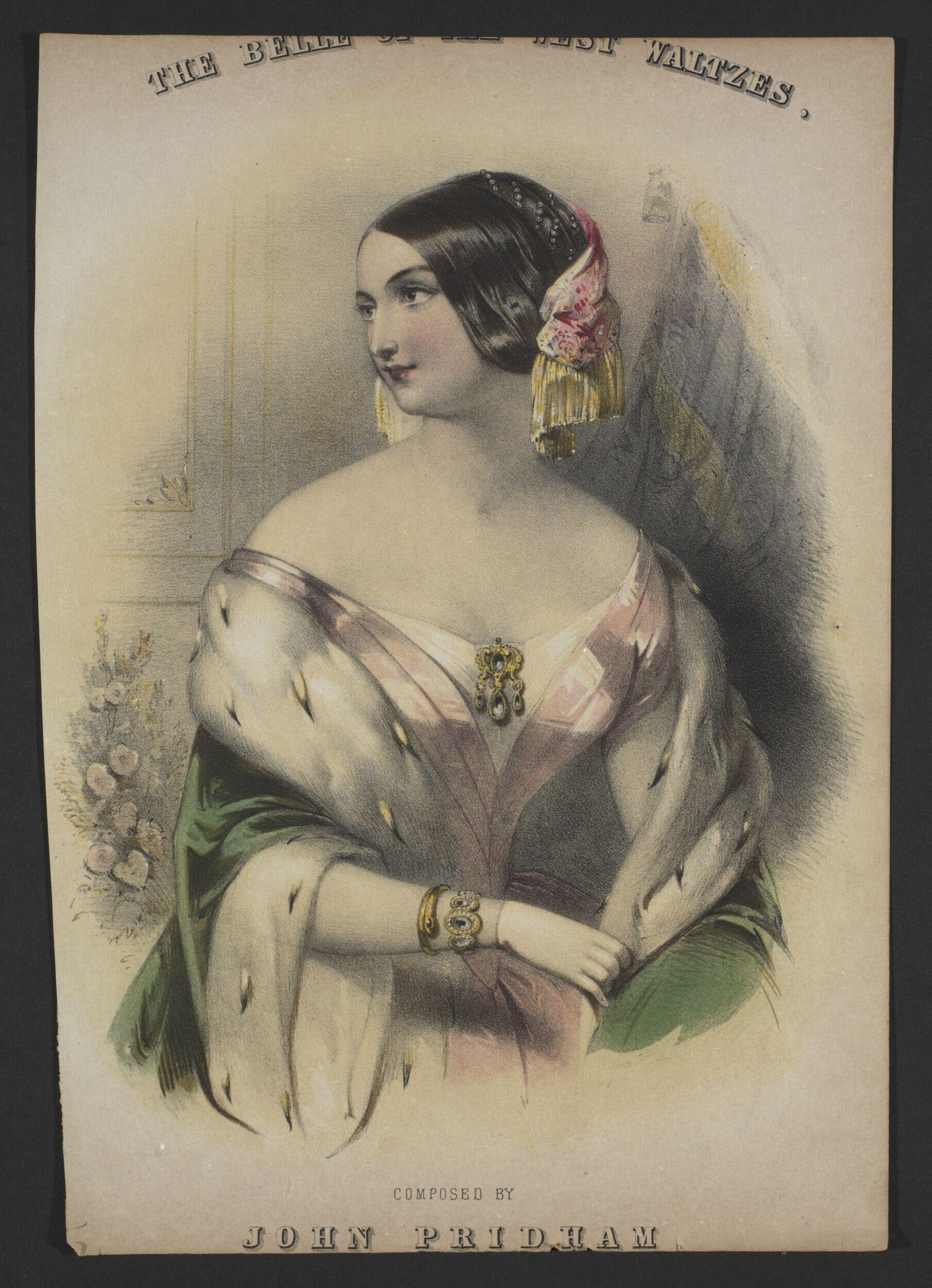
This image documents the visual culture of waltz in its commercial and domestic context—not as a work of fine art, but as an everyday object that shaped how dancers, particularly women, understood their own dancing. The specificity of the costume, the idealization of the female waltz dancer's posture and bearing, and the direct link to music and commerce reveal how dance was consumed and imagined in 19th-century popular culture.
What you are looking at
A young woman in full waltz regalia stands in three-quarter profile facing left, her body poised as if mid-turn or prepared for the dance. She wears a pale pink ball gown with a low, off-shoulder neckline and fitted bodice, the skirt voluminous and gathered. A white fur stole or shawl drapes across her shoulders and extends down her back. Her dark hair is styled in a fashionable middle parting and pulled back; she wears an elaborate headdress combining pink ribbons or silk with golden tassels that frame her face and fall past her shoulders. Gold bracelets ornament both wrists, and a brooch or jewelled ornament fastens her bodice. The background is neutral and soft, with barely suggested architectural elements—a draped curtain or fabric on the left, and muted greative tones on the right. The lighting is soft and diffuse, emphasizing the pale skin and the shimmer of the fabrics. The overall impression is of elegance and refinement characteristic of mid-19th-century ballroom portraiture.
The dancing
The woman's posture is upright and graceful, with her weight apparently centred and her body aligned in the classic ballroom frame, though no partner is visible. Her shoulders are relaxed and open; her head is held high with a slight forward inclination typical of Romantic-era waltz deportment. The positioning of her body and the tilt of her head suggest she is at rest or poised at a preparatory moment rather than captured mid-step, allowing the viewer full appreciation of her costume and bearing.
The dance depicted
This is a waltz, as confirmed by the title and the dress code. The Waltz, which had become the dominant social dance of the European ballroom by the 1830s-1860s, is the 3/4-time turning dance that defined an era. The image presents the dancer—or more likely, the ideal waltz dancer—in formal dress as she would appear at a ball. The work does not attempt to capture the rotational movement or partner work that define waltz technique; instead it presents a portrait of the waltz dancer as a figure of refinement and fashionable display.
How it was made
This is a hand-coloured lithograph, a reproductive print technique that allowed wide distribution of fashionable dance imagery in the mid-19th century. Lithography permitted soft tonal gradation and the painterly effects visible in the drapery and flesh tones, while allowing for efficient hand-colouring of the costumes afterwards. The delicate colouring of the gown, the gold leaf or gold pigment used for the tassel ornament, and the careful handling of light and shadow suggest a print of some quality intended for a middle-class or affluent domestic audience. As sheet music cover art, this would have been a commercially produced object circulating among piano players and dancers.
About this work
Sheet music cover art for 'The Bellow of the West Waltzes,' composed by John Pridham, this is a mid-19th-century hand-coloured lithograph depicting an elegant young woman in full ballroom dress. The title references the waltz, and the figure's pose and deportment embody the grace and refinement associated with this dominant social dance of the era. The work belongs to a large vernacular tradition of dance-specific sheet music covers that served simultaneously as fashion plates, marketing images, and representations of dance culture for the drawing room.
How to look at it
Attend to the costume first: the ball gown with its pale satin, the fur stole, the elaborate headdress with its golden tassels, the jewelled ornaments. These are not incidental; they are the content of the image, advertising both the composition's fashionable currency and the status of the waltz dancer. Note the figure's posture and the suggested lightness of her frame—the image presents the waltz not as athletic but as an expression of taste and grace. The neutral background and soft lighting isolate the figure and costume, making this as much a fashion plate as a dance image.
The artist
John Pridham is documented as a composer of dance music, particularly waltzes, in mid-19th-century Britain. No substantial biographical record survives, but the attribution to him suggests he was a working musician whose compositions were commercially published and distributed through the popular sheet music market. This work represents the common practice of commissioning or producing illustrated covers for published dances.
The period
The Waltz had scandalized Europe a generation earlier (early 1800s) for its close partner embrace and turning motion, but by the 1840s-1860s it had become the primary social dance of respectable society across Europe and Britain. The Romantic era in visual art emphasized refined femininity, soft drapery, and the idealization of women's bodies, and this image draws on those conventions. Sheet music covers had become a major medium for dance imagery, advertising both the music and the fashionable world in which it circulated. The lithographic print industry was at its peak for hand-coloured popular graphics.
Where it lives
This work is held as part of a sheet music collection, indicating it was originally produced as the printed cover or frontispiece for a published musical score of 'The Bellow of the West Waltzes.' The source catalogue notes it as sheet music, confirming its status as a commercial music publication rather than a fine art print.
Dance in this work
Questions about this work
What is the waltz, and why does it matter in dance history?
The waltz is a 3/4-time turning dance for couples in closed ballroom hold, which became the dominant social dance of the 19th century. It scandalized Europe initially for its close partnership and continuous turning, but had become respectable by the era this image was created. The waltz defined ballroom dancing for over a century and established conventions of partner work, posture, and musical form that persist in modern competitive ballroom dance.
Who was John Pridham?
John Pridham was a 19th-century composer of dance music, particularly waltzes. He worked during the period when the waltz was at peak popularity and when sheet music publication was a major commercial industry. Very little biographical detail survives, but his published compositions indicate he was an active and presumably successful participant in the music trade.
What does the costume tell us?
The pale pink satin ball gown, low neckline, fitted bodice, voluminous skirt, fur stole, and elaborate headdress with gold tassels represent the height of fashionable ballroom dress of the 1840s-1860s. The costume indicates this is a woman of means and taste—the waltz was a dance for the respectable middle and upper classes. The specificity of the dress suggests the image was as much about circulating fashionable dress codes as about the dance itself.
Why is this a lithograph, and what does that mean?
Lithography was the dominant technology for colour printing and popular graphics in the 19th century. It allowed for soft tonal effects and efficient hand-colouring, making it the standard for sheet music covers, fashion plates, and other domestic visual culture. The technique was economical enough for mass distribution but refined enough for quality hand-colouring, making lithographed sheet music covers affordable prestige objects for the drawing room.
More dance artwork





