49 works in this view — arrow keys or swipe to move between them.
Dance in Art
H Beard Print Collection
Donowell, John
- Collection:
- Source:
- Victoria and Albert Museum
- Rights:
- Rights vary by item — check the source record before reusing this image. Source record ↗
- Recorded as:
- V&A — check rights per item
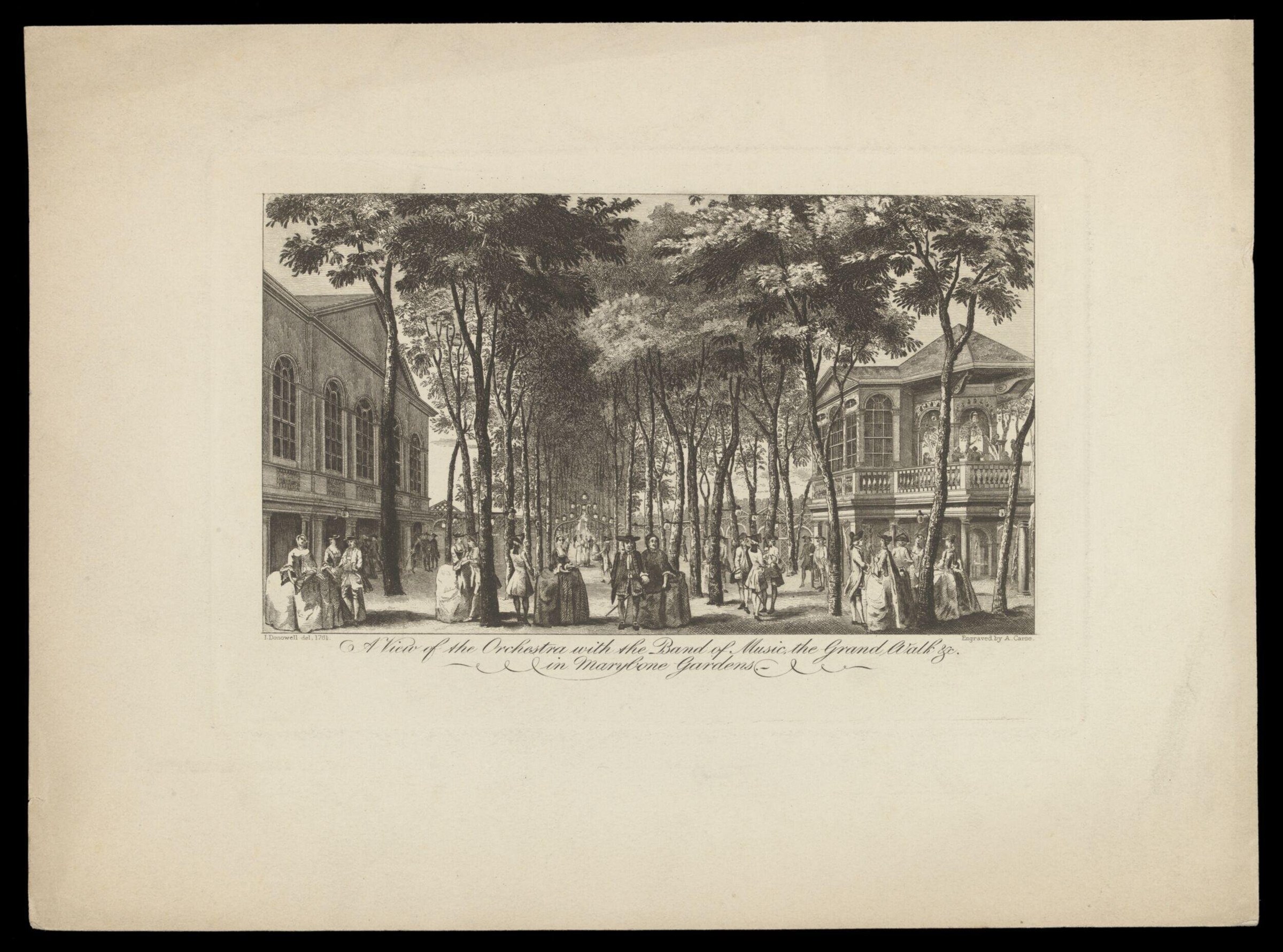
The engraving documents the physical and social context of elite 18th-century entertainment, showing the orchestra, venue, and ceremonial promenade that framed dance performances. It is evidence of how outdoor music and the 'grand walk'—a structured social performance in itself—functioned as courtship, display, and social regulation in the period.
What you are looking at
This engraving depicts a formal outdoor orchestra performance in a tree-lined courtyard or garden setting flanked by ornate buildings. The scene is animated with dozens of fashionably dressed figures—men in coats and breeches, women in full skirts and elaborate dress—arranged loosely across the space. Musicians occupy the foreground and center, instruments raised, while attendees stroll, converse, and listen throughout the grounds. The tall trees create a deep perspectival avenue receding toward the background; architectural details suggest an aristocratic venue. The whole conveys the leisurely, promenade-like atmosphere of a social music event rather than a concert hall performance. The engraver has captured the interplay of sound, spectacle, and social display characteristic of open-air entertainment in the period.
The dancing
The figures are rendered in the formal upright posture of 18th-century dress, with little active dancing visible in the traditional sense. Musicians stand with instruments in performance attitude. The broader crowd displays the genteel bearing and restrained movement expected of polite society—standing, walking, pairing off in conversation. No closed ballroom holds or energetic partnering is evident. Instead, the image emphasizes the social choreography of mingling and attending, with bodies deployed across the landscape to create compositional rhythm and depth.
The dance depicted
The engraving does not depict an active dance but rather documents the social and musical context in which dance performances or dances would have occurred—an outdoor concert in an aristocratic garden or courtyard setting. This is the setting for music and dance together, a 'grand walk' or promenade that was itself a form of social performance. The presence of orchestral musicians suggests this was a venue where dances to live music would have been performed, though the static nature of the figures here speaks more to the ceremonial display and social mingling that framed such events.
How it was made
This is an engraving, likely etched or line-engraved, characteristic of the 18th century. The fine hatching, clear linear detail, and formal compositional structure are typical of reproductive prints made for circulation in aristocratic and educated households. The technique allowed for the precise rendering of architectural elements and the intricate articulation of dress fabrics. Engravings of this type served both as documentary records of notable venues and events and as luxury prints for display, reaching a broader audience than the events themselves.
About this work
This engraving records a performance venue rather than a dance itself—an outdoor orchestra with the Grand Walk, a formal promenade where attendees assembled to hear music and see society. The title identifies it as a scene 'with the Band at' a specific gardens, anchoring it to a real place and occasion. It is one of a long tradition of 18th-century prints documenting aristocratic gardens, pleasure grounds, and the social rituals of performance that took place within them. For dance historians, it reveals the setting, scale, and social organisation of the occasions where formal dance and music intersected in elite culture.
How to look at it
Attend to the carefully arranged distribution of figures across the deep space—the engraver has composed the scene to suggest both the grandeur of the venue and the leisurely, ritualistic quality of the gathering. Notice the musicians in the foreground and the looser assembly of attendees throughout the courtyard; the emphasis is on costume, posture, and spatial arrangement rather than movement. The use of the tall trees to frame and structure the composition creates a sense of theatrical depth, as if the viewer is watching a living picture arranged for display.
The artist
John Donowell was an 18th-century printmaker active in England, likely specialising in architectural and topographical engravings that recorded notable buildings and public spaces. The H Beard Print Collection suggests the work entered a notable private accumulation of prints. Little else is recorded of Donowell's practice or output.
The period
This engraving dates to the height of the pleasure garden and promenade culture of the 18th century, when elaborate outdoor venues such as Vauxhall and Ranelagh in London became sites of orchestral performance, dancing, and fashionable display. The 'grand walk' or formal promenade was both a social necessity and an entertainment in itself—an opportunity for courtship, the display of dress and position, and the performance of gentility. The engraving tradition reached its peak in this period as a means of documenting and circulating images of these venues to those who visited them and to those who aspired to know them.
Where it lives
The work is part of the H Beard Print Collection, housed in Virginia. It is a historical print documenting a specific venue or event in 18th-century English gardens and entertainment.
Dance in this work
Questions about this work
Is there actual dancing in this image?
Not active dancing in the traditional sense. The image documents the social and musical context—the orchestra, the courtyard venue, and the promenade gathering—in which dancing would occur, but the figures shown are mostly standing or walking in formal posture. The 'grand walk' itself was a structured social performance.
What is a 'grand walk'?
In 18th-century polite society, the grand walk or promenade was a ceremonial, leisurely movement through a venue where people dressed in their finest, conversed, and displayed their position and taste. It was both a social ritual and a form of entertainment in itself, and it typically accompanied musical performance.
Where was this performance?
The caption names a specific gardens, though the exact location cannot be confirmed without additional research. It was likely one of the major London pleasure gardens such as Vauxhall or Ranelagh, which were famous for orchestral concerts and promenades in the 18th century.
How was this image used?
As a fine engraving, this was a luxury print likely sold or distributed to those who attended such venues or who aspired to knowledge of fashionable life. It served as both a record of a specific place and a mode of circulating images of aristocratic entertainment and dress.
More dance artwork





