49 works in this view — arrow keys or swipe to move between them.
Dance in Art
H Beard Print Collection
Brandard, John
- Collection:
- Source:
- Victoria and Albert Museum
- Rights:
- Rights vary by item — check the source record before reusing this image. Source record ↗
- Recorded as:
- V&A — check rights per item
This image is one of thousands of Victorian-era dance prints, yet it is precisely such commercial, widely distributed imagery that shaped how ordinary people understood dance and dress. For historians of social dance, ballroom culture, and nineteenth-century costume, it is invaluable: it fixes the precise appearance of the waltz in a particular moment and place, and it shows the waltz not as an isolated technical accomplishment but as a social ritual embedded in fashion, theatre, and courtship. The link to a theatrical work also demonstrates how stage dances permeated popular culture and fed back into social practice.
What you are looking at
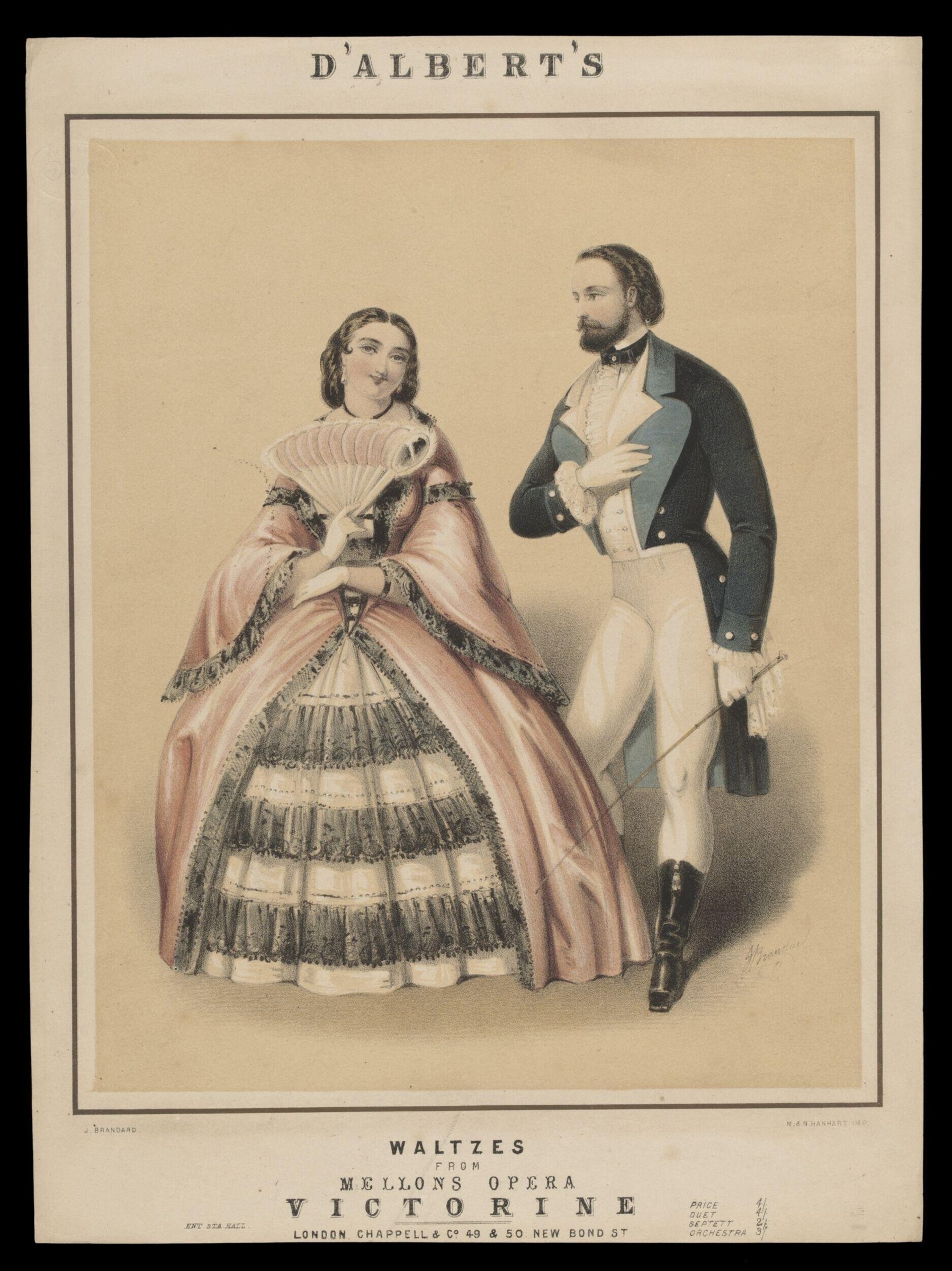
A fashionably dressed couple stands together in an elegant interior setting. The woman wears an elaborate mid-nineteenth-century ball gown with a massively full skirt composed of multiple tiers of fabric decorated with black lace trim, pale silk or satin underskirts, and a draped rose-pink outer cape or shawl that falls from her shoulders. She holds a large fan in one hand and gazes toward her male partner with a composed, flirtatious expression. The man is dressed in formal evening attire: a black tailcoat with white shirt front and bow tie, light-colored breeches, and black boots. He stands in profile or three-quarter view, one arm folded across his torso in a posture that suggests either the beginning of a dance frame or a moment of courtly regard. The background is plain and neutral, allowing the figures and their dress to dominate the composition. The print is hand-colored, with soft shading that gives the figures volume and presence.
The dancing
The two figures are positioned close but not yet in closed ballroom hold. The man's arm position—folded across his body—is typical of the moment before engagement in a formal dance, and his posture is upright and attentive. The woman's stance is graceful and balanced, her full weight supported by her legs beneath the voluminous skirt; her fan is held as both an accessory and a tool for managing her presence in the dance space. Both figures exhibit the composed bearing and elongated posture expected in mid-Victorian social dance, with no exaggeration of movement or gesture. The composition suggests the instant before the first steps, a moment of mutual acknowledgment between partners.
The dance depicted
This is a waltz, the title of the print confirms it: 'Waltzes from Mellons Opera Victorine.' The waltz was the dominant couple dance of the nineteenth century, performed at balls, assemblies, and in the theatre, and this image documents its formal presentation in a fashionable setting around mid-century. The dress of both figures—the woman's extreme skirt volume, the man's formal tailcoat, the careful positioning—is consistent with the ballroom waltzes that dominated European and American social dancing from the 1830s onward. The print appears to be promotional material or a souvenir image associated with a theatrical work (Mellons' opera *Victorine*), suggesting that this waltz was either performed on stage or popular in the fashionable society circles that attended such productions.
How it was made
This is a hand-colored lithograph or engraving, likely produced by the London printer Chapell & Co., whose imprint appears at the bottom of the sheet. The medium allows for fine detail in the costume and faces, and the hand-coloring (visible in the soft pinks, flesh tones, and grays) gives the work an appealing, finished quality suited to circulation as a popular print. The artist's signature visible in the lower right suggests this is the work of a practiced illustrator, likely John Brandard, whose name appears in the attribution. The technique and distribution method—a sheet print sold through a music publisher's retail location—indicates this was a commercial product aimed at a middle-class audience, people who danced waltzes themselves and wanted to own fashionable dance imagery.
About this work
This hand-colored lithograph documents the formal waltz as it was performed and understood in Victorian theatrical and ballroom culture, circa 1850s. The print serves as a souvenir or promotional image linked to a theatrical production, and it records not only the steps or style of the dance but the full visual and social context in which the waltz was experienced: the costume, the formality, the gendered roles and courtship dynamics, the interior setting. As a commercial print, it circulated widely and functioned as both a record of fashion and a guide to aspiration for people learning or practicing the dance themselves. The work sits at the intersection of stage and society, theatre and everyday social life, showing how the waltz moved between these contexts in the nineteenth century.
How to look at it
Look first at the postures and the distance between the partners: this is not a moment of dynamic movement but of formal preparation, the instant of mutual acknowledgment that precedes the first step. Notice how the man's folded arm and the woman's poised stance create a sense of restrained energy—the waltz is about to begin, but has not yet. The dress is as much the subject here as the dance: the woman's skirt is so vast that the figure exists almost as a landscape of fabric, and that landscape is the context in which the waltz happened. The print is a document of fashion, social ritual, and theatre all at once; to read it fully, attend to all three.
The artist
John Brandard was a nineteenth-century English lithographer and illustrator who produced numerous fashion plates and theatrical prints, many of them hand-colored. He worked during the height of the Victorian print industry and was associated with theatrical and musical souvenir publications distributed through London music sellers. His style is consistent with the mid-century commercial illustrative tradition: carefully observed costume and posture, pleasing hand-coloring, and an emphasis on fashionable elegance rather than dynamic movement. Little else is known of his individual biography, but his work exemplifies the large class of professional illustrators who documented Victorian social and theatrical life for mass consumption.
The period
The waltz was at the height of its social dominance in the 1850s. It had been controversial in earlier decades—critics objected to the closed hold and the speed—but by mid-century it was fully established as the premier couple dance of European and American ballrooms. In the theatre, the waltz appeared frequently in comic operas and ballets, and theatrical performances of waltzes influenced social dancing in return. The dress visible here—the woman's extraordinarily full skirt supported by multiple petticoats—is characteristic of the late 1840s and 1850s, the decade before the crinoline became the dominant support structure. This print thus captures the waltz at a moment of peak fashionability and social prestige, when it was the subject of theatrical entertainment and the measure of a person's social accomplishment.
Where it lives
This print is held in the H Beard Print Collection and was published by London Chapell & Co., a music publisher and print seller on New Bond Street. The print includes performance price information (suggestive of a piece for retail distribution) and is catalogued as part of a broader holding of nineteenth-century dance and theatrical prints.
Dance in this work
Questions about this work
What is the 'Mellons Opera Victorine' and why is it on this waltz print?
Mellons' opera *Victorine* was a theatrical work performed in mid-nineteenth-century London, and this waltz was either featured in the production or became popular in fashionable circles as a result of it. Theatre and ballroom dancing were closely linked in this period: stage dances influenced social practice, and popular theatrical pieces generated commercial spin-off prints like this one, sold as souvenirs or as models for home dancing.
Why is the woman's skirt so enormously full?
The extreme fullness is characteristic of late-1840s to early-1850s fashion, before the crinoline cage was invented. Multiple layers of stiff petticoats, often made of horsehair, created this silhouette. The full skirt was desirable both for fashion and for the waltz, because it created a visual spectacle as the dancer turned, and the weight and swing of the fabric were part of the aesthetic experience of the dance.
How do we know this is a lithograph or engraving and not a painting?
The publication information at the bottom (Chapell & Co., London), the hand-coloring technique visible in the soft gradations, the printing marks, and the commercial scale all indicate this is a lithograph or engraving, likely lithograph. The medium allowed for affordable mass production and distribution, which is why so many copies could have circulated. A painting would be a unique object; this print was made to be seen by many.
What does the man's folded arm position tell us about how the waltz was danced?
The folded arm is the 'ready' position before engaging in the closed hold of the waltz. It suggests formality, mutual respect, and a moment of courtly ritual before the dance begins. The closed hold itself—which became standard for the waltz—is not yet visible here, but the print documents the social and physical transition into the dance.
More dance artwork





