49 works in this view — arrow keys or swipe to move between them.
Dance in Art
The Ravenswood Waltzes
Brandard, John
- Collection:
- Music sheet cover
- Source:
- Victoria and Albert Museum
- Rights:
- Rights vary by item — check the source record before reusing this image. Source record ↗
- Recorded as:
- V&A — check rights per item
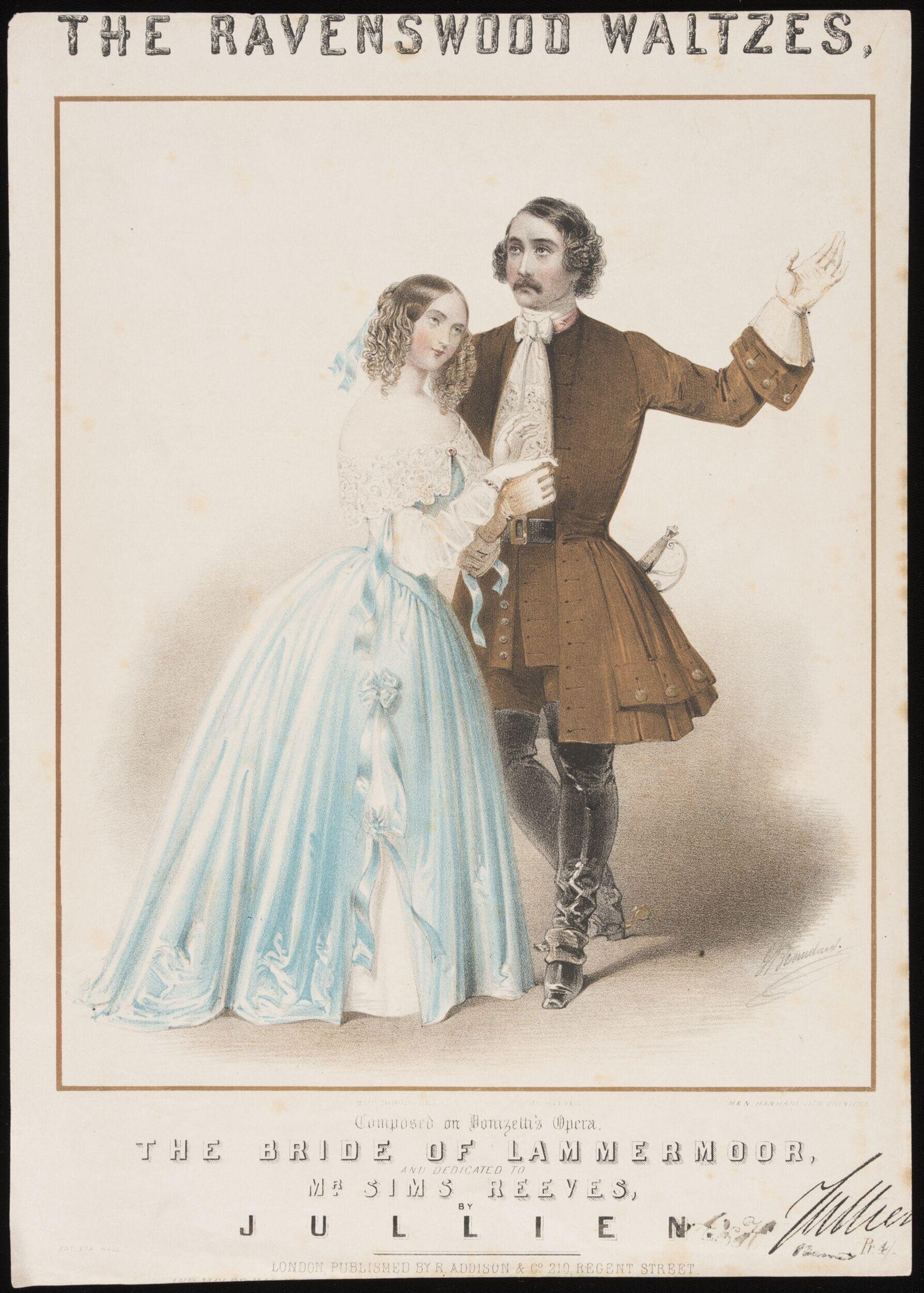
This image provides visual evidence of how the waltz was performed and understood in the mid-nineteenth century—not a document of a moment in motion, but of the formal, controlled preparation that preceded it. For dancers and historians, it shows the posture, frame, and costume conventions that defined elite ballroom practice in this period. The survival of such covers indicates that dance imagery was a commodity, produced and consumed by the dancing public itself, making this both a primary source for dance history and a window into how dance was commercialized and fashionized.
What you are looking at
A hand-colored engraving presents a couple in ballroom dress positioned center-frame against a neutral background. The man, in a dark brown coat with white ruffled collar and cuffs, stands with his weight forward and right arm extended outward in a gesture of invitation or presentation. His left arm holds his partner's hand. The woman wears an elaborate white gown with a pale blue taffeta underskirt visible in deep vertical pleats that dominate the lower half of the composition; her white lace bodice and blue ribbon trim are delicate and refined. She wears a blue ribbon or veil in her curled hair. Both figures display the posture and precision expected of ballroom dancers, with an upright carriage and controlled positioning. The engraving's fine lines and delicate hand-coloring suggest a work of professional theatrical or dance documentation, likely created for circulation among dancers, dance masters, or the fashionable public.
The dancing
The pair stand in what appears to be a preparation or opening position for a formal dance rather than mid-movement. The man's extended right arm and forward stance suggest he is leading or inviting his partner into motion. The woman's posture is erect and attentive, her body angled slightly toward her partner while remaining poised. Both figures maintain the closed or semi-closed positioning characteristic of nineteenth-century ballroom dance. Their relative heights, the precise positioning of limbs, and the formal nature of their stance suggest the artist had direct knowledge of how trained dancers held themselves.
The dance depicted
This is a waltz, as indicated by the title and the costumes and deportment shown. The Ravenswood Waltzes were composed on Ronzelli's Opera (as noted on the cover), and the image depicts the opening moment of such a dance—the man presenting his hand to his partner before beginning the rotational movement characteristic of the waltz. The waltz, by this date in the nineteenth century, was a highly formalized ballroom dance performed by couples in closed position, with a three-beat rotational pattern. The elegance of dress and the precision of posture suggest this was a dance of the social elite, performed at balls and formal occasions.
How it was made
This is a hand-colored engraving or lithograph, printed and then carefully tinted by hand with watercolor or similar pigment. The medium is characteristic of 1840s–1860s sheet music covers and theatrical dance documentation. The printing process allowed for wide distribution among music publishers, dance instructors, and the fashionable public, while the hand-coloring gave each copy a delicate, finished quality suitable for framing or display. The technique required skilled engraving to capture the precision of ballroom pose and costume detail, and skilled hand-coloring to render the fabrics convincingly. This was a commercial product designed for a middle to upper-class audience interested in current dance fashions and music.
About this work
The Ravenswood Waltzes cover presents a formal ballroom couple at the threshold of the dance—an image designed to accompany the sheet music for piano and to serve as a visual instruction in correct deportment and dress for this fashionable dance. The waltz was the dominant couple dance of the nineteenth-century ballroom, and images like this one circulated widely to teach both the form and the fashion associated with it. As a hand-colored engraving produced for commercial publication, it documents not only the movement vocabulary of the waltz but also the precise, elevated aesthetic that ballroom dance embodied for the social classes who practiced it. The image belongs in a dance gallery because it is both a historical document of ballroom technique and an artifact of how dance was taught, promoted, and imagined in the nineteenth century.
How to look at it
Attend to the exact positioning of the hands, the angle of the bodies, and the distribution of weight—these details would have been what a dancer consulting this cover would study to learn the correct opening position. Notice that neither figure is in motion; the artist has chosen a moment of readiness and presentation rather than a captured step. The woman's elaborate skirts and the man's extended arm are carefully rendered to show the silhouette and proportion that characterized fashionable ballroom dress of the period. The formality and precision of the pose reflects the dancing master's concern with deportment and correctness.
The artist
John Brandard (c. 1812–1863) was a prolific lithographer and engraver active in London during the mid-nineteenth century. He was known for theatrical and dance-related imagery, including sheet music covers, playbills, and portraits of performers. His work is characterized by careful attention to costume and pose, suggesting either direct observation of dancers or close collaboration with choreographers and dance masters. Brandard's commercial output—sheet music covers, theatrical prints, and fashion plates—placed him at the intersection of dance, music, and visual culture.
The period
The waltz dominated European and American ballroom culture from approximately 1815 onward, though it remained controversial in conservative circles for much of the nineteenth century because of its close partnering. By the 1850s, when this cover was likely produced, the waltz had achieved full respectability and was the primary couple dance of fashionable society. Sheet music covers like this one were a major vehicle for promoting both the music and the correct visual image of ballroom dancing. The period saw an explosion of published ballroom instruction books, etiquette guides, and visual documentation of dance forms—a sign of the codification and democratization of what had once been the province of hired dancing masters.
Where it lives
This is a music sheet cover, held in the Virginia collection (coded 'va'). It is a commercial printed product, originally bound with or accompanying the published score of the Ravenswood Waltzes.
Dance in this work
Questions about this work
What is a waltz and who danced it?
The waltz is a couple dance in triple meter (three beats) characterized by rotational movement. By the mid-nineteenth century, it was the dominant dance of European and American ballrooms, performed by the middle and upper classes at balls, soirées, and formal social occasions. It required partners to stand in close proximity while executing smooth, turning steps—a positioning that was considered daring or even improper earlier in the nineteenth century but which became fully conventional by mid-century.
Why was the waltz controversial?
Earlier in the nineteenth century, critics and conservative moralists objected to the waltz because the partners stood close together and the man held the woman's waist directly—a degree of physical contact considered inappropriate or even scandalous. By the 1850s, these objections had largely subsided, and the waltz was fully respectable. This cover, with its elegant and decorous presentation, reflects the waltz in its fully accepted form.
Who was Ma Sims Reeves?
Ma Sims Reeves was a singer and performer active in the mid-nineteenth century. Her name appears on this cover, indicating that either she performed this waltz, that it was dedicated to her, or that her name was used to help promote the sheet music. Many published waltzes bore the names of famous performers or were dedicated to patrons.
What is a sheet music cover?
Sheet music covers were illustrated wraps or first pages printed with the music, serving as advertisement, instruction, and collectible art. Dancers, musicians, and the fashionable public bought them for the music, but the visual image—showing correct costume, pose, or a scene from a ballet or opera—served to promote the dance or performance and to guide performers in how the dance was understood and executed.
More dance artwork





