49 works in this view — arrow keys or swipe to move between them.
Dance in Art
Sheet music
Stannard
- Collection:
- Sheet music
- Source:
- Victoria and Albert Museum
- Rights:
- Rights vary by item — check the source record before reusing this image. Source record ↗
- Recorded as:
- V&A — check rights per item
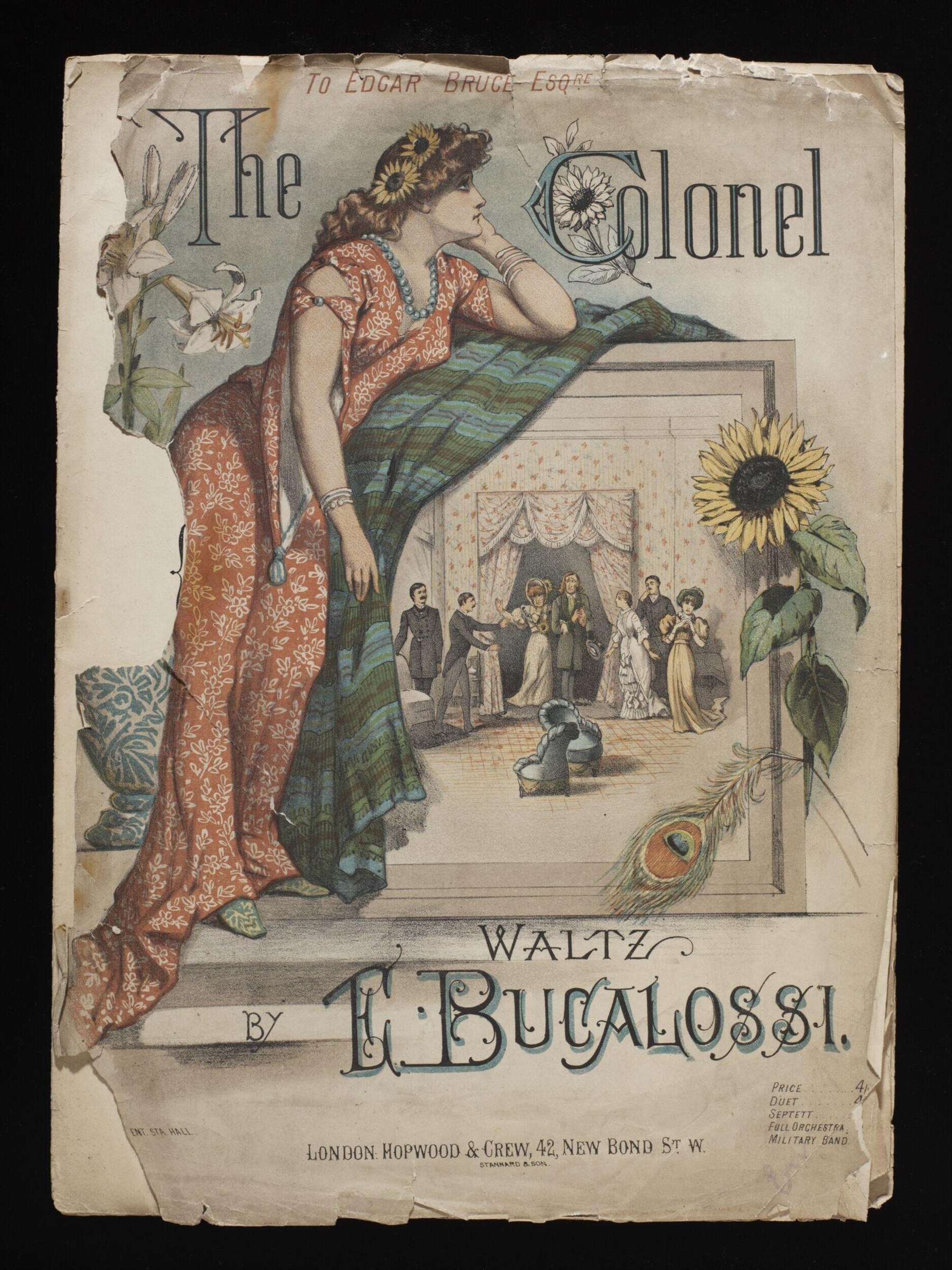
This cover reveals the aesthetic and commercial language through which the waltz was marketed to amateur musicians and dancers in the Victorian home—a dance that had moved from aristocratic courts to the domestic drawing room and public ballroom. It shows how sheet music covers used allegorical imagery to invest the dance with romance and aspiration, shaping how people imagined the emotional and social experience of dancing.
What you are looking at
Sheet music cover for a waltz titled *The Colonel*, composed by L. Bugaloss and published by London Hopwood & Crew in 1881. The cover presents an allegorical composition in which a life-size woman in an elaborate rust-red patterned dress reclines across the upper half of the page, gazing downward with a contemplative expression. Her dress, rendered in rich detail with ornate embroidery and a draped plaid shawl, displays the opulent fashion of the 1870s–80s. She wears bracelets and a beaded necklace; her dark hair is styled with a golden feathered ornament. Framing her head is a decorative daisy. Below her, a vignette shows an indoor dance scene—a formal ball or social gathering where couples and groups in evening dress stand and interact beneath a draped, decorated ceiling. The scale contrast between the dreaming woman and the tiny ballroom below creates a dreamlike quality, as if the dance scene represents her imagination or reverie. The illustration is hand-colored, with delicate botanical details (white flowers and sunflowers with green stems) adorning the left and right margins. The title and composer's name are set in ornate typography characteristic of Victorian sheet music design.
The dancing
The principal figure is a reclining woman, her body elongated in a pose of leisure or reverie, propped on one elbow with her head resting on her hand in an attitude of pensiveness or romantic daydreaming. This pose—half-reclining, introspective, adorned—is not a dance posture but a narrative device positioning her as observer or dreamer. The ballroom figures in the vignette below are too small to assess in detail, but they appear to stand in pairs and groups in formal evening dress, suggesting the closed holds and upright carriage typical of social ballroom dancing. No pointe work, turnout, or balletic vocabulary is visible; the setting is plainly a society dance floor, not a stage.
The dance depicted
The image depicts a waltz, as stated in the title and confirmed by the publisher's notation on the cover ("WALTZ"). The vignette shows an interior ballroom scene typical of Victorian social dancing—the setting in which the Waltz dominated from the 1810s onward as the signature couple dance of the middle and upper classes. The waltz by 1881 was established as the foundational ballroom dance for mixed social gatherings, and this cover uses the ballroom as a symbol of courtship, romance, and refined society. The woman's dreaming posture suggests the emotional register in which the waltz was understood: romantic, intimate, and aspirational. The Waltz in this era was danced in closed hold, three-quarter time, with a rising and falling motion and a rotational figure—none of which can be confirmed from the small vignette, but all of which are consistent with standard practice.
How it was made
This is a chromolithograph, a color printing process that allowed mass production of illustrated sheet music covers. The technique involved multiple stone plates, each carrying one color layer, which were printed in sequence to build the full palette. From the image alone, the characteristic soft gradations, the registration of multiple colors, and the delicate hand-finishing visible in the details suggest chromolithography. The process was ideally suited to sheet music, which needed to reach a broad, literate, middle-class audience: the cover was both advertisement and object of display. The theatrical quality of the allegorical composition—the reclining beauty, the dreamwork—was typical of the genre, designed to catch the eye of shoppers and to convey the emotional tenor of the music within. Publication by Hopwood & Crew, a major London music publisher, confirms the work was intended for commercial distribution among amateur musicians in middle-class homes.
About this work
This is a Victorian sheet music cover that frames a waltz composition through the language of romantic reverie. Rather than depicting dancers in motion, the cover presents a dreaming woman whose gaze and posture draw the viewer into an imagined ballroom scene below—a compositional strategy that merges the private, emotional world of the listener with the public social world of the dance itself. The waltz in 1881 was at the height of its cultural dominance as the emblem of respectable courtship and refined leisure. The cover's allegorical structure—beauty dreaming of the dance, rather than dancing—suggests the psychological and emotional pull the waltz held over Victorian culture. It is a record of how the waltz was sold, imagined, and consumed by the urban middle class at the close of the nineteenth century.
How to look at it
Attend first to the scale and spatial relationship between the woman and the ballroom scene: the cover asks you to follow her gaze into the tiny ballroom below, to understand the dance not as action unfolding before you but as the object of yearning and imagination. Note the contrast between her stillness and introspection and the activity (though minute) of the dancers beneath. The decorative botanical frames—the flowers and stems—and the ornate typography signal the visual register of the sheet music market: this is a product designed to sit on a piano, to be admired, and to communicate taste and refinement. The waltz itself does not appear as bodily technique but as a social and emotional experience.
The artist
L. Bugaloss is credited as composer; the artist/illustrator of the cover is not named. Chromolithographed sheet music covers of this period were often produced by workshop teams rather than individual named artists, and Hopwood & Crew maintained in-house design and production capacity. The illustrative style—decorative, narrative, and saturated with period fashion detail—is typical of the highest-end Victorian sheet music production, aimed at middle and upper-middle-class consumers.
The period
By 1881, the waltz had been the dominant social dance across Europe and North America for seven decades. It had evolved from a scandalous court novelty (its close hold and rotational motion were considered improper in the early 1800s) to the essential ritual of respectable courtship and social mixing. The 1870s and 80s saw the peak of Victorian ballroom culture: formal dances, public assembly rooms, and the domestic piano were central to social life and marriage markets. Sheet music was a major domestic commodity, and illustrated covers functioned as both instruction and fantasy. The aesthetic of the cover—the reclining beauty, the ornate dress, the emphasis on reverie—reflects the late Victorian fascination with beauty, psychology, and the inner life.
Where it lives
Published by London Hopwood & Crew, 42 New Bond Street, London, a major commercial music publisher of the Victorian era. The cover is inscribed "To Edgar Bruce Esq"—indicating it was a presentation copy or gift to an individual patron or musician. The work survives in the Virginia collection (catalogued as sheet music), confirming its circulation and preservation within the private domestic collections of the era.
Dance in this work
Questions about this work
Is this waltz still danced today?
The waltz depicted here—the Victorian parlor waltz—remains a fundamental ballroom dance and is taught and performed in both competitive and social contexts. Modern ballroom waltz has evolved in frame, rise-and-fall, and technique, but the three-quarter time signature, closed position, and rotational movement stem directly from the tradition of which this 1881 composition was a part. The piece itself may have fallen from circulation, but the dance form survives as a core repertory of ballroom culture.
Why does the cover show a woman dreaming rather than couples dancing?
The allegory serves multiple purposes. It conveys the emotional and romantic appeal of the waltz—the sense that the dance was the culmination of courtship and desire. It also addresses the cover's primary audience: sheet music was often purchased by amateur women pianists, and the image of a beautiful, fashionable woman in a state of romantic reverie was both aspirational and commercially appealing. The tiny ballroom scene invites the pianist to imagine herself as both observer and participant in the elegant social world depicted.
What can you tell about the waltz from the tiny ballroom scene?
Very little detail of the dance itself is discernible at the scale shown. The figures appear to stand in pairs in an indoor, formally decorated space, consistent with the Victorian ballroom environment. The formal evening dress and the architectural setting confirm that this is a respectable social dance of the middle and upper classes, not a theatrical or folk performance. The vignette functions more as a symbol of the waltz's social context than as a record of its technique.
More dance artwork





