49 works in this view — arrow keys or swipe to move between them.
Dance in Art
Hypathia Waltz
Ostlere
- Collection:
- Sheet Music
- Source:
- Victoria and Albert Museum
- Rights:
- Rights vary by item — check the source record before reusing this image. Source record ↗
- Recorded as:
- V&A — check rights per item
This object reveals how waltz compositions were marketed and understood in the 1880s: through allegorical reference and classical allusion rather than depiction of actual ballroom practice. The choice of Hypatia as subject suggests the period's complex attitudes toward women's education, intellectualism, and participation in refined social practice. For historians of graphic design and commercial music culture, the cover demonstrates the visual conventions used to sell sheet music to middle-class households.
What you are looking at
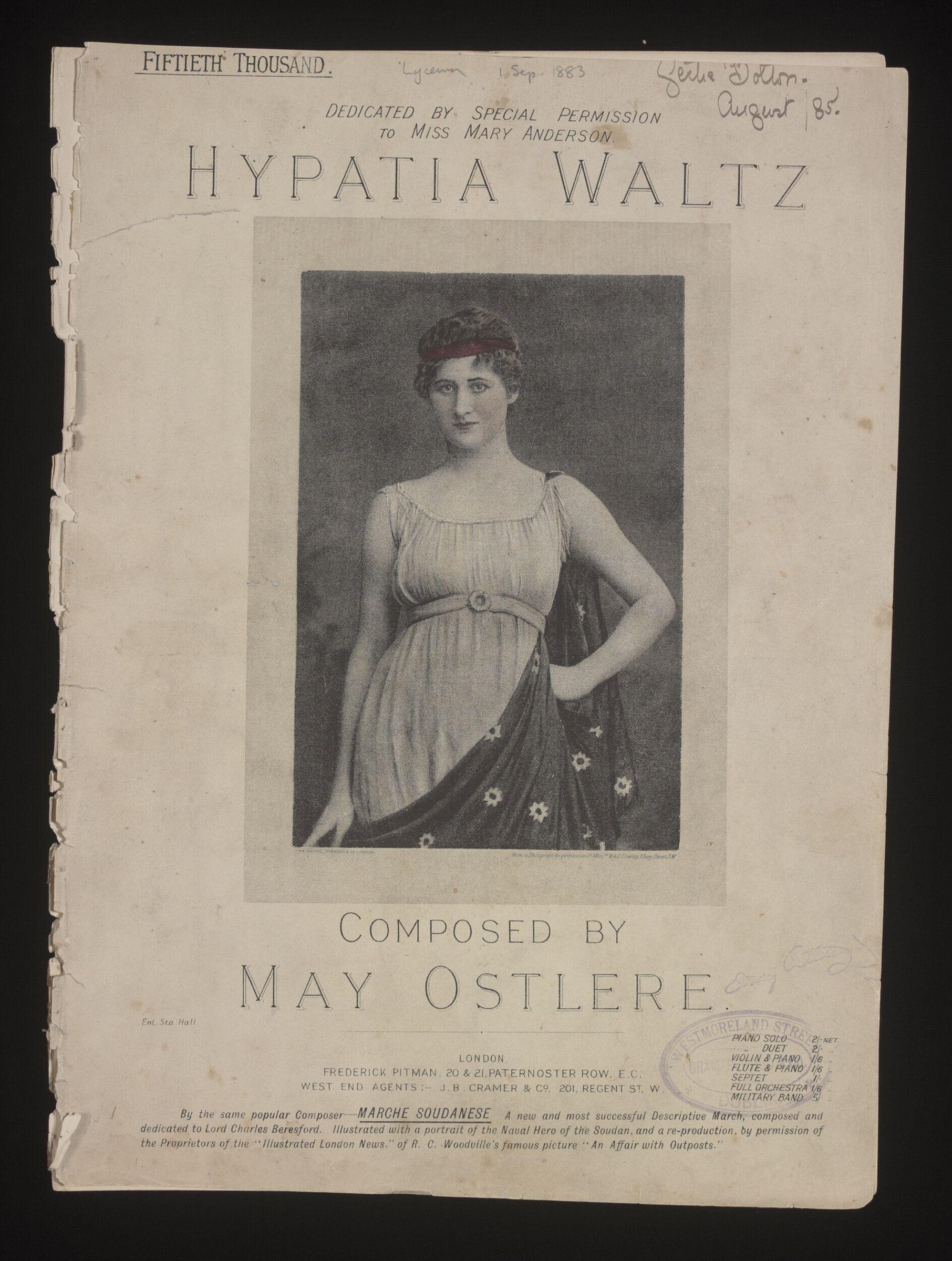
Sheet music cover for a waltz titled "Hypatia Waltz," composed by May Ostlere and dedicated to Mary Anderson. The cover features a classical female figure in Greco-Roman dress: a high-waisted, draped white linen chiton with short sleeves, cinched beneath the bust with a decorative button. The woman stands in a three-quarter pose against a dark background, her weight shifted slightly to one side. A dark draped fabric—possibly a himation or cloak—falls from one shoulder, decorated with what appear to be white floral or star motifs. Her hair is bound up in a Grecian style with a decorative band or wreath. The figure's pose is statuesque and formal rather than active; she stands quietly, with one arm at her side and the other relaxed. The composition is a portrait study rather than a depiction of movement, positioned centrally on the page.
The dancing
A single female figure in classical dress, posed stationary and dignified. The body weight rests evenly; there is no suggestion of motion, weight transfer, or dance frame. The arms are relaxed and not engaged in any hold or gesture specific to waltz dancing. The posture is that of a classical sculpture or historical portrait rather than an active dancer mid-movement. The costume is the primary visual statement, not the body's action.
The dance depicted
This is sheet music for a waltz, a ballroom dance of the 19th century. The cover illustration does not depict the actual dance in progress. Instead, it presents an allegorical or thematic image: a woman in Greco-Roman costume suggests the classical subject matter (Hypatia, the 4th-5th century philosopher) that inspired the composition's title. The waltz itself—a turning, three-beat partnered dance—would not be visible in a single figure standing still. The cover uses costume and classical reference to appeal to the purchaser and performer, but provides no visual information about how the waltz was actually danced.
How it was made
This is a printed sheet music cover, likely a photogravure or halftone reproduction of a painted or photographic portrait. The technique allows for fine tonal gradation and subtle detail in the drapery and facial features. Sheet music covers of this period were often illustrated with classical or allegorical figures to enhance their commercial appeal and suggest refinement and artistic aspiration. The printed format and dedication to a named performer (Mary Anderson, likely the American actress) indicate this was a commercial publication aimed at amateur musicians and music buyers in the late 19th century.
About this work
This sheet music cover for May Ostlere's "Hypatia Waltz" uses classical iconography rather than choreographic documentation to frame a ballroom dance composition. The figure in Greco-Roman dress evokes the philosopher-mathematician for whom the piece is named, creating a visual metaphor for intellectual and artistic refinement. Sheet music covers of this era rarely depicted the actual dance in motion; instead, they employed costume, allegory, and portraiture to suggest the music's character and aspirations. The work sits at the intersection of dance history, musical commerce, and classical revival aesthetics that defined late Victorian leisure culture.
How to look at it
Observe the stillness of the figure and the absence of any suggestion of turning or partnered movement. Notice how the artist has chosen a portrait stance—frontal, dignified, classical—rather than capturing a moment of waltz choreography. The decorative drapery and floral motifs invite appreciation of costume and design rather than scrutiny of dance technique. The cover's effect depends entirely on the viewer's recognition of classical dress and artistic allusion; it does not ask the viewer to understand or evaluate dance itself.
The artist
May Ostlere was a late Victorian composer of dance music and light orchestral works. The composition's dedication to Mary Anderson (1859–1940), the acclaimed American actress, indicates Ostlere moved in theatrical and musical circles. The piece exemplifies the commercialization of dance composition in the late 19th century, when waltzes, galops, and other ballroom dances were staple entertainment and profitable publishing ventures for composers. The use of a classical female portrait on the cover reflects broader Victorian artistic practice of using historical and allegorical female figures to frame commercial cultural products.
The period
The waltz was the dominant ballroom dance of the 19th century, and by the 1880s, printed dance music was a major commercial enterprise. Publishers commissioned illustrated covers to attract buyers; classical and mythological references were fashionable in the visual arts and appealed to middle-class aspirations toward cultural refinement. The adoption of Greco-Roman costume and portraiture reflects the period's neoclassical revival in both fine art and decorative design. Mary Anderson's prominence as an actress and her theatrical celebrity made her an ideal dedicatee for a work intended for amateur performance in genteel households.
Where it lives
This is a printed sheet music cover from the Fiftieth Thousand edition, indicating multiple printings and popular demand. The handwritten inscription on the cover ("Lyceum 1 Sep. 1883" and what appears to be a performer's name) suggests it belonged to a musician or performer, possibly associated with the Lyceum Theatre in London. The object is held as part of the Sheet Music collection in the LODance archive.
Dance in this work
Questions about this work
Who was Hypatia, and why would a waltz be named after her?
Hypatia (c. 350–415 CE) was a Neoplatonist philosopher and mathematician in Alexandria, renowned for her learning. In the Victorian period, her figure became a symbol of intellectual achievement and classical wisdom. Naming a musical composition after her suggests aspirations toward learning and refinement. The classical costume on the cover reinforces this allegorical reading.
Was Mary Anderson a dancer?
Mary Anderson was an American actress of considerable prominence in the 1880s–1890s, celebrated for Shakespearean roles and dramatic performance. She was not primarily a dancer, but her fame and cultural standing made her an ideal dedicatee for a published composition. The dedication was likely a commercial strategy to enhance the work's prestige and sales appeal.
Does this cover show how the waltz was actually danced?
No. The figure is posed statically in portrait fashion, not in any recognizable waltz position or frame. The cover uses costume and allegorical reference instead of choreographic documentation. To understand how this waltz was danced, one would need to study the musical notation itself and period dance manuals, not this illustration.
Why use classical dress for a Victorian ballroom dance?
Victorian commercial culture frequently employed classical and historical costume as a marker of artistic pretension and refinement. Classical references suggested timelessness and elevated taste. The choice also created a visual distinctiveness that made the cover memorable and appealing to purchasers.
More dance artwork





