49 works in this view — arrow keys or swipe to move between them.
Dance in Art
John Strauss! John Strauss! The Girls are All Mad
Klitz, Philip
- Collection:
- Sheet Music
- Source:
- Victoria and Albert Museum
- Rights:
- Rights vary by item — check the source record before reusing this image. Source record ↗
- Recorded as:
- V&A — check rights per item
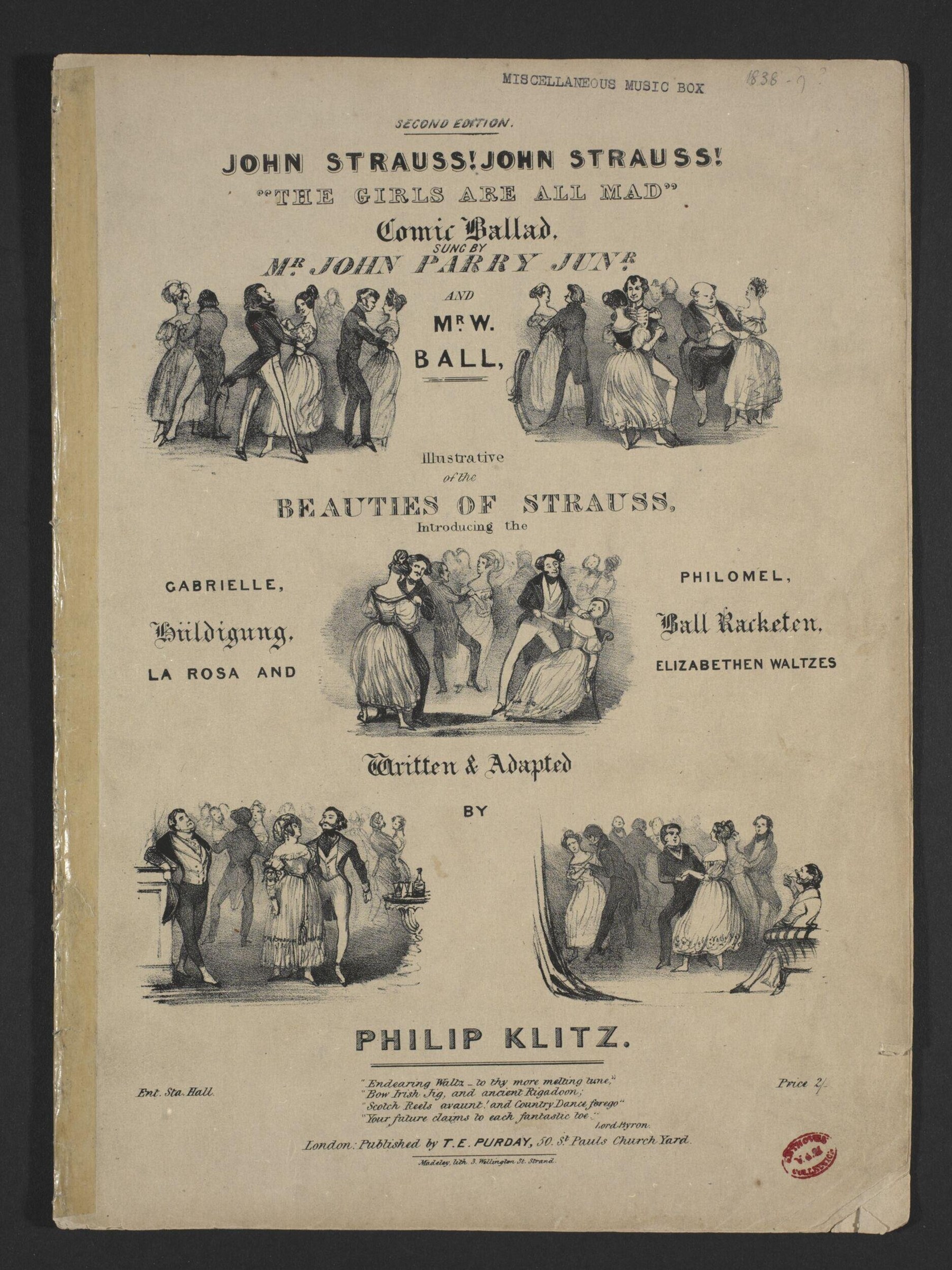
This object shows how dance entered mass culture through the Victorian music trade. It is direct evidence of how Strauss's waltzes were adapted, repackaged, and sold to amateur performers in England, and how the waltz itself—once controversial as too intimate—had become respectable, cheerful, and commercial by 1850. For dance historians, it is a rare survival of the social context in which millions of people actually danced.
What you are looking at
This is a sheet music cover for a comic ballad based on John Strauss's waltz "The Girls Are All Mad," adapted by Philip Klitz. The cover is densely illustrated with small vignettes in a Victorian engraving style, showing lively social scenes of men and women in mid-19th-century dress. The central image features couples and groups in animated conversation and dance, while the decorative panels around the title introduce what Klitz calls "the beauties of Strauss"—named characters including Gabrielle, La Rosa, Philomel, and Elizabethen Waltz. The figures wear the bell-skirted dresses and formal coats typical of the 1850s. The composition is crowded and narrative-driven, with multiple small scenes stacked vertically to tell a story of courtship, flirtation, and social dancing. The overall effect is of a bustling ballroom or assembly room captured in multiple moments, rendered in fine lines characteristic of wood engraving or steel engraving.
The dancing
The figures are depicted in pairs and small groups, many in closed ballroom hold with the man's arm around the woman's waist and their free hands joined or extended—the standard posture for mid-19th-century waltz and quadrille. The women's full skirts dominate visually, suggesting the flare and swing of turning movement. Several figures are captured mid-stride or mid-turn, with their bodies tilted and skirts flying, conveying motion and gaiety. The men wear dark coats and stand upright, supporting and leading. The scale is small and the execution fine, prioritizing narrative charm over anatomical precision, which is typical of popular sheet music graphics of the period.
The dance depicted
This is a waltz—specifically a Viennese waltz or Strauss-style waltz, one of the most fashionable ballroom dances of the 1850s. The title credits the Strauss orchestra's composition, and the cover celebrates the social craze around Strauss's music in Vienna and London. The depicted hold, paired figures, and emphasis on turning movement all confirm the waltz genre. The ballad format (comic verses by Parry and Ball) suggests this was entertainment for drawing-room performance or amateur singing, piggybacking on Strauss's instrumental popularity. The female characters named on the cover personify the waltz's romantic allure—a marketing strategy to sell both the music and the idea of social dancing as courtship.
How it was made
This is a wood engraving or steel engraving, a reproductive print technique that allowed sharp detail and fine cross-hatching. The even black line and the ability to render tiny figures across the full page with precision are hallmarks of engraved sheet music covers of the 1850s. This technique was ideal for mass production and circulation among the middle classes who could afford bound vocal scores. The cover's decorative density and narrative storytelling were typical of popular music ephemera, which treated the cover as entertainment in itself, not merely a label. As a 'Second Edition,' this sheet survives from what was clearly a commercial success.
About this work
This is a Victorian sheet music cover—a comic ballad adaptation of a Strauss waltz, dated 1850 and published in London. It is not a depiction of professional theatrical dance but rather an illustration of social ballroom dancing as a leisure activity and romantic occasion. The work captures a crucial moment in dance history: the mainstreaming of the waltz among the English middle classes, enabled by the international fame of Johann Strauss's orchestra and the commodification of dance through printed music. The cover's crowded, intimate vignettes celebrate the waltz not as a spectacle but as a social practice—something amateurs did in drawing rooms and assembly rooms. It belongs in a gallery of dance in art because it documents both how the waltz was danced (the hold, the turning, the costume) and how it was marketed and consumed as a cultural product.
How to look at it
Look at how the engraver has staged multiple moments of the dance—couples in different stages of turning and promenade, some just meeting, some mid-spin. The consistency of the ballroom hold across all figures tells you this is a danced social form, not theatrical spectacle. Notice the women's skirts: the artist has worked hard to show the outward flare of the full skirt during turning, a key visual signature of the waltz. Attend to the faces—smiling, animated, flirtatious—which emphasize the waltz as social occasion and courtship ritual, not exercise or competition. The small scale and accumulation of detail are typical of wood-engraved sheet music, made to be studied closely in the home.
The artist
Philip Klitz was an active London music publisher and adapter of operatic and orchestral works for vocal and amateur ensemble performance in the mid-19th century. His practice was to take popular compositions (often from Continental composers like Strauss) and repackage them with English lyrics and theatrical adaptations for the domestic market. This comic ballad shows Klitz's commercial acumen: he recognized that Strauss's waltzes sold well and that adding narrative comedy and named characters would increase appeal. He likely worked with engravers rather than creating the artwork himself; his role was editorial and entrepreneurial.
The period
The 1850s saw the Viennese waltz at the height of its fashion in England and across Europe. Johann Strauss the Younger had just begun his ascendancy (though the Strauss dynasty's popularity was already strong), and his music was being rapidly transcribed, arranged, and pirated by London publishers. At the same time, the social waltz was still relatively new to English ballrooms—it had faced moral objections for its close hold and rapid rotation, but by mid-century it was becoming standard in genteel society. This cover dates to a moment when the waltz was being domesticated, trivialized, and made funny through adaptation. The comic ballad format reflects a broader Victorian phenomenon: the appropriation of serious Continental art into entertaining domestic performances by amateurs.
Where it lives
This is a sheet music cover from a commercial print edition, held as part of a miscellaneous music collection. It is catalogued as a 'Second Edition,' indicating it was a successful enough publication to warrant reprinting. Sheet music survives in far smaller quantities than bound books, making any complete copy a valued historical artifact.
Dance in this work
Questions about this work
Is this the same Strauss who wrote 'The Blue Danube'?
Almost certainly his father or the broader Strauss orchestra ensemble. The Strauss family dominated Viennese waltz composition in the mid-19th century, and their work was immediately imported to London and adapted. The title credits 'John Strauss' (often Anglicized), which could refer to either Strauss the Elder or the Younger; the 1850 date and the popularity of the music suggest this was already a known composition, possibly by the Elder.
What was a 'comic ballad' in this context?
A narrative song with comic or satirical verses, usually set to a well-known tune (in this case, Strauss's waltz). The ballad tradition allowed amateurs to perform dramatic or humorous scenes through singing. This one clearly uses the waltz as a pretext for romantic comedy, with named female characters who embody different aspects of the waltz's charm or madness.
Would people have actually danced while singing this ballad?
Unlikely. This was probably performed as a novelty song in a drawing room or concert setting, sung by an amateur vocalist to amuse guests. The connection to Strauss's waltz was commercial and cultural rather than purely functional—it sold better because the waltz was already fashionable, and the comic lyrics exploited that enthusiasm.
How does this show what the waltz actually looked like in 1850?
The consistently depicted closed hold, the female partner's position across the man's body, the emphasis on turning, and the absence of any other formation (no lines, no sets) all confirm that this was a partner dance in the modern ballroom style. The full skirts and upright posture are also accurate to the period. The engraver was documenting a social practice he or she knew well.
More dance artwork





