49 works in this view — arrow keys or swipe to move between them.
Dance in Art
The Circus Girl
Kieffert, Carl
- Collection:
- Sheet Music
- Source:
- Victoria and Albert Museum
- Rights:
- Rights vary by item — check the source record before reusing this image. Source record ↗
- Recorded as:
- V&A — check rights per item
It documents the theatrical and vaudeville dimension of late-Victorian dance culture—not the refined ballroom but the circus and music hall. For historians of popular entertainment and commercial design, it illustrates how dance and movement were packaged and sold to domestic consumers through sheet music, and how circus spectacle and novelty were marketed alongside ballroom music.
What you are looking at
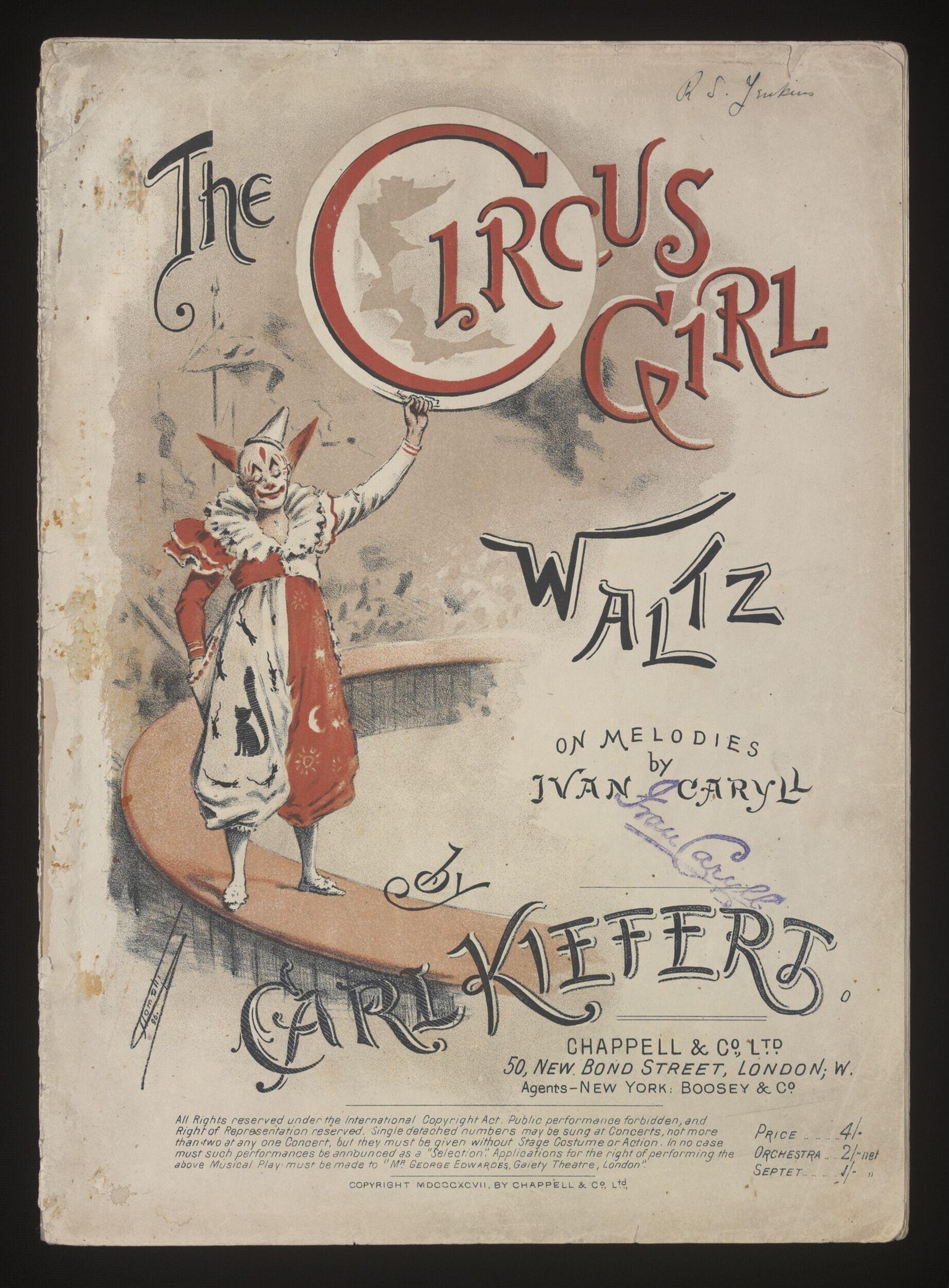
This is the cover of a waltz composition for piano, published by Chappell & Co. in London around 1897. The cover art shows a circus performer—a clown or acrobat in white and red costume—captured mid-leap or mid-performance on what appears to be a circus ring or platform. The figure wears a pointed hat with upturned points, a white clown suit with red accents and polka dots, and holds aloft a large circular hoop or ring bearing the title 'The Circus Girl' in red letters. The composition is sketched with loose, energetic charcoal or pencil lines against a cream-coloured ground, with watercolour washes suggesting atmosphere and shadow. The performer's pose conveys dynamic energy—one arm raised high holding the hoop, the body in a diagonal leap or stride. The setting is minimal, suggesting the interior of a circus tent or performance space with hints of canvas or structure. The artistic style is period-appropriate commercial cover art: illustrative, lightly coloured, designed to appeal to amateur pianists who would purchase sheet music.
The dancing
The central figure is a single performer in a grotesque or comic pose—the body arched and extended, with weight clearly on one foot while the other leg is lifted or extended. The free arm rises dramatically to hold and present the title hoop, while the other is positioned lower, contributing to the asymmetrical, energetic composition. The clown's exaggerated costume—loose, baggy, with bold colour and pattern—emphasizes the comic or acrobatic character rather than ballroom poise. There is no suggestion of ballroom hold, line, or formation. The artist understood this as a solo comedic performer rather than a social dancer.
The dance depicted
This is not primarily a dance image, though it depicts a performer in motion. The figure is a circus clown or acrobat, not a trained dancer, and the 'dance' here is vaudeville or circus performance—the athletic, comedic movement of popular entertainment. The waltz was a fashionable ballroom form in the 1890s, but the visual content emphasizes circus spectacle and comedy rather than ballroom elegance. The work is a commercial cover design meant to attract purchasers through novelty and visual appeal rather than to document or celebrate any specific dance technique or ballroom fashion.
How it was made
This is sheet music cover art, a form of commercial print designed for mass distribution to piano-playing households. The technique appears to be a combination of pencil or charcoal drawing with selective watercolour or lithographic colour, typical of late-Victorian commercial art production. The loose, sketchy line work and limited palette (cream, red, black, grey) suggest lithography or a hybrid process suitable for affordable reproduction. This is a utilitarian object: the cover protects the score and sells it, and the artistic investment is modest but effective. The technique allowed for rapid production and broad circulation to middle-class consumers.
About this work
This is a commercial sheet music cover for a waltz composition titled 'The Circus Girl,' with music by Ivan Caryll and arranged by Carl Kieffert. Published by Chappell & Co. in 1897, it illustrates the intersection of popular entertainment and ballroom fashion at the height of the Victorian era. The cover art depicts not a ballroom scene but a circus performer—a clown or acrobat in mid-leap—which advertises the work's novelty appeal and connection to music-hall or theatrical entertainment. It is an artifact of commercial music publishing and popular taste rather than a document of serious dance practice.
The work belongs in a gallery of dance in art as a record of how dance and performance were understood and marketed to the general public in the 1890s. The waltz was the dominant social dance of the era, and sheet music covers were primary visual media through which people encountered images of movement and performance. This cover reveals the circus and music-hall context in which many waltzes and popular dance compositions were performed, and the theatrical, rather than social, character of dance entertainment as consumed by middle-class audiences.
How to look at it
The viewer should attend to the contrast between the title (a ballroom waltz) and the image (a circus performer). Notice the energy and asymmetry of the pose—the clown is not graceful or formally poised but dynamic and comic. The loose, sketchy technique of the drawing itself suggests movement and speed, appropriate to the subject. The historical viewer would recognise both the clown costume and the musical reference, understanding this as an advertisement for a piece of theatrical or music-hall entertainment rather than a guide to ballroom propriety. The cover is designed to appeal through novelty and humour, not elegance.
The artist
Carl Kieffert was a late-Victorian arranger and composer for piano, known for arrangements of popular theatrical and music-hall compositions. Little detailed biographical information is recorded, but he was active in the 1890s–1900s in the commercial music publishing industry. The arrangement credit (distinct from the composer Ivan Caryll) suggests Kieffert adapted the work for amateur pianists, a common and economically important role in the era.
The period
The 1890s were a period of explosive growth in commercial sheet music publishing and consumption. The waltz remained the dominant ballroom dance, but it was increasingly supplemented by newer forms (the Two-Step, the Cake Walk) and theatrical music associated with music halls, operettas, and circus entertainment. Ivan Caryll was a celebrated composer of musical theatre and comic operas, and 'The Circus Girl' was likely tied to a theatrical production or music-hall revue. The cover art reflects the visual language of late-Victorian commercial design: bold lettering, loose illustration, and emphasis on novelty and entertainment value. This was also an era in which ballroom dancing was being codified and professionalised by teachers and competition organisers, even as popular entertainment continued to blur the boundaries between social dance, theatre, acrobatics, and vaudeville.
Where it lives
This is a sheet music cover from the Chappell & Co. publishing house, based at 50 New Bond Street, London, with agents listed in New York (Boosey & Co.). It is a commercial product of the Victorian music publishing industry, designed for retail sale to amateur pianists and music enthusiasts.
Dance in this work
Questions about this work
Is 'The Circus Girl' a real waltz or a theatrical work?
It is a waltz composition by Ivan Caryll, a prolific composer of musical theatre and operettas. The work was likely written for a theatrical production or music-hall revue (possibly a production called 'The Circus Girl'), and Carl Kieffert arranged it for solo piano to reach the domestic market. It is a theatrical composition adapted for ballroom and domestic consumption, not a traditional folk or social waltz.
Why is a clown on the cover of a waltz?
The novelty appeal sold sheet music. The waltz was a fashionable dance, but waltzes by theatrical composers like Caryll were often tied to shows or entertainments with comic or spectacular themes. The circus and music-hall context made the piece more interesting to consumers than a traditional ballroom scene would have. The cover emphasised entertainment and novelty over decorum.
Who would have purchased this?
Amateur pianists—predominantly middle-class women and girls—who bought sheet music for home performance. The price (4s. for the full score, 2½d. for the orchestra parts) suggests a mass-market product. Owners would have played or sung the piece at home, in drawing rooms, or at social gatherings.
What does this tell us about dance in the 1890s?
It shows that ballroom dance (the waltz) and theatrical entertainment (circus, music hall) were closely linked in popular culture. Professional and amateur dancers, acrobats, and comedians performed in the same venues and shared audiences. The boundary between 'dance' and 'performance' was fluid, and novelty and spectacle were prized in popular entertainment.
More dance artwork





