49 works in this view — arrow keys or swipe to move between them.
Dance in Art
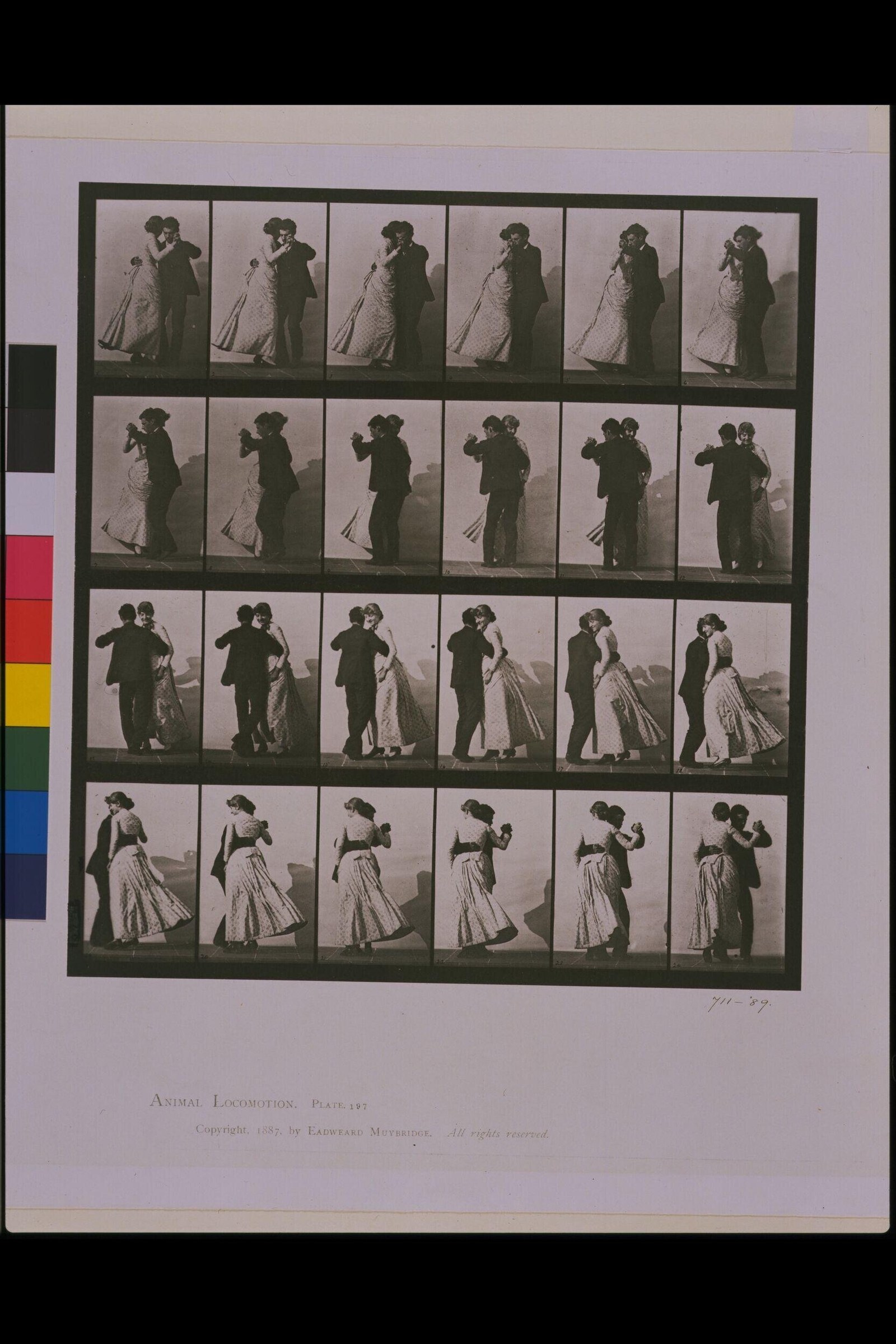
Dancing, waltz, two models
Muybridge, Eadweard
- Collection:
- Photograph
- Source:
- Victoria and Albert Museum
- Rights:
- Rights vary by item — check the source record before reusing this image. Source record ↗
- Recorded as:
- V&A — check rights per item
This work is a unique and invaluable visual record of how the waltz was actually performed in the 1880s, capturing details of frame, posture, and movement quality that cannot be recovered from written descriptions or notation alone. It also represents a turning point in dance documentation: the moment when photography began to replace illustration and choreographic notation as the primary method for capturing and transmitting dance knowledge. For historians and dancers, it provides direct evidence of performance practice, body mechanics, and the physical ideal of the period—showing us not what people wrote about the waltz, but what it actually looked like when danced.
What you are looking at
This is a contact sheet of sequential photographic frames arranged in four horizontal rows of six images each, documenting two figures—a man in dark formal dress and a woman in a light-colored, patterned dress—moving through the steps of a waltz. The photographs are printed on a single sheet with black borders separating each frame, a standard format for dance documentation of the era. The setting is plain and neutral, with minimal background detail; the focus is entirely on the dancers' bodies and their relative positions. Across the sequence, the couple progresses through recognizable waltz positions: initial distance, closed embrace, rotational movement, and changes of direction. The lighting is consistent throughout, suggesting a controlled studio environment. The woman's skirt, which appears to be made of patterned fabric, is captured mid-sway and mid-turn across the frames, revealing the dynamic motion of the movement. The man's posture remains upright and controlled, his frame stable across the sequence.
The dancing
The couple begins in open position and moves into closed ballroom hold, with the man's left hand placed on the woman's back and his right hand clasping her left. Their frames are aligned vertically, with the woman's body angled slightly away from the man's in the characteristic open frame of late-19th-century waltz. The man's weight shifts systematically through the frames, visible in his hip position and leg placement, while the woman follows with a mirrored action. The woman's arms are positioned with her right arm extended along his shoulder and back, and her left arm bent with hand meeting his. Across the sequence, their relative positioning rotates, indicating the characteristic rotational movement of the waltz.
The dance depicted
This is a waltz, the dominant ballroom dance of the late 19th century and a central social and theatrical form throughout the period. The sequence captures the essential mechanics of the waltz: the closed couple position, the three-beat meter implied by the stepping pattern, and the rotational movement around a central axis. The image shows two models—likely professionals hired to demonstrate the dance—performing the step combinations that would have been standard in both social dancing and theatrical performance of the era. The deliberate documentation in sequential frames suggests this was created for instructional or analytical purposes, typical of Muybridge's scientific approach to capturing human motion.
How it was made
This is a gelatin silver print from a series of sequential photographs, printed on a single sheet as a contact sheet or study plate. The printing process and the careful registration of multiple frames on one sheet indicate this was produced from glass plate negatives, a standard method in Muybridge's studio. The contact sheet format allowed viewers—whether dance teachers, performers, or students—to see the complete sequence of movement at a glance. Multiple prints could be made from the same negative, enabling wide distribution. The sequential framing technique was revolutionary for dance documentation, as it replaced static poses or narrative paintings with actual motion capture, though still limited by the photographic exposure times of the 1880s.
About this work
This work is one of a series of photographic studies of human and animal locomotion produced by Eadweard Muybridge in the 1880s, specifically documenting ballroom dance. The series represents a major turning point in how dance was studied and understood: rather than relying on notation systems or the interpretive skill of illustrators, Muybridge's camera provided direct visual evidence of how bodies actually moved through dance steps. This particular sheet captures the waltz, the defining social and theatrical dance of the 19th century, and shows two models executing the form with the precision and control expected of dancers of the period. The work sits at the intersection of scientific inquiry and dance practice—it was created partly as an anatomical study, but also as a practical resource for dancers, choreographers, and dance masters. The systematic documentation of multiple frames freezing different moments in a single phrase of movement anticipated the analytical methods that would become central to dance in the 20th century.
How to look at it
Look first at the sequence as a whole, not individual frames, to see the continuous rotation and rise-and-fall motion of the waltz. Notice how the man's frame remains stable throughout while his weight shifts in a clear pattern—this stability of frame relative to the partner is the defining characteristic of ballroom dance in this period. Observe the woman's skirt: the way it captures the swaying motion reveals how much of the waltz's aesthetic depended on the visual effect of the woman's gown moving through space. Finally, compare the early frames (where the couple is more open) with the later frames (where they are in full closed position): this progression shows how dancers entered and sustained the characteristic embrace of the waltz.
The artist
Eadweard Muybridge (1830–1904) was a pioneering photographer known for his systematic studies of human and animal locomotion. Based largely in California, he developed innovative techniques for capturing sequential motion using battery-operated cameras triggered in rapid succession. His work was driven by a combination of scientific curiosity, artistic ambition, and a belief that photography could reveal truths about motion invisible to the human eye. He published his findings in books, lectures, and exhibitions, and his work was influential in the development of cinematography. Muybridge was not primarily a dance photographer, but he approached the human body with the same analytical attention whether documenting an athlete, a horse, or a dancer. His dance studies were part of a broader project to create a comprehensive visual archive of human movement.
The period
The waltz emerged as a dominant ballroom dance in the early 19th century and remained the primary form of partnered social dancing throughout the Victorian era and beyond. By the 1880s, when Muybridge made this study, the waltz was performed in both social and theatrical contexts, and it was associated with elegance, respectability, and technical refinement. The period saw increasing interest in the scientific study of human motion, driven partly by developments in photography and partly by broader intellectual currents in anatomy and physiology. Dance was not excluded from this scientific gaze; there was growing interest in how dancers trained, how their bodies moved, and what made a performance technically proficient. Muybridge's work on human locomotion was published in several forms between 1887 and 1901, creating a comprehensive visual archive that influenced both scientific understanding and artistic practice.
Where it lives
This work is held by the V&A (Victoria and Albert Museum), suggesting it was recognized early as culturally and historically significant. It is one of a series of studies Muybridge created, likely produced initially for scientific purposes but quickly recognized as having artistic and educational value. The sheet itself is a print from glass plate negatives, one of many prints that circulated through museums, universities, and dance studios.
Dance in this work
Questions about this work
How did Muybridge capture these sequential images?
Muybridge used a series of cameras arranged in a line, each triggered by the dancer passing in front of it. In some cases he used a single camera with a rapidly rotating shutter. The exposure times were long enough that some motion blur is visible, but fast enough to freeze the basic positions of the body. The dancers had to repeat the movement several times to ensure the full sequence was captured.
Were these waltz steps standard for the 1880s?
Yes, the basic positions and the rotational movement shown here are consistent with waltz technique as described in dance manuals of the period. The closed frame, the man's lead, and the woman's follow are all characteristic of late-19th-century ballroom waltz. However, individual dancers and regions had variations, so this should be understood as one documented version rather than a universal standard.
Why would dancers or teachers have used these photographs?
Dance teachers could use the images to show students the correct body positions and the progression of movement through a phrase. The sequential format made it easier to see how weight transferred and how the frame changed subtly through the steps. For some teachers, these photographs may have been combined with written descriptions or notation to create a more complete instructional resource.
What does this tell us about how women danced the waltz?
The photographs show that the woman's role was to maintain her frame while responding to the man's lead. Her body follows his movement without initiating it. The swaying of her skirt—clearly visible in the frames—suggests that the visual presentation of the woman's body in motion was an important part of the dance's aesthetic appeal. Her posture is upright and controlled, not passive, but her agency lies in the quality and precision of her response.
More dance artwork





