49 works in this view — arrow keys or swipe to move between them.
Dance in Art
Theatre costume
Golovin, Aleksandr Yakovlevich
- Collection:
- Theatre costume
- Source:
- Victoria and Albert Museum
- Rights:
- Rights vary by item — check the source record before reusing this image. Source record ↗
- Recorded as:
- V&A — check rights per item
Golovin's costume designs are known primarily through photographs, theatre documentation, and the accounts of dancers and designers; surviving garments are uncommon. This piece offers direct evidence of his material practice, his understanding of how fabric, color, and silhouette would interact with stage light and a dancer's movement, and the technical skill available to the Imperial Theatres' workshops. For historians of early 20th-century ballet and theatrical design, and for designers and dancers interested in how abstract visual principles translate into costume, this is primary source material.
What you are looking at
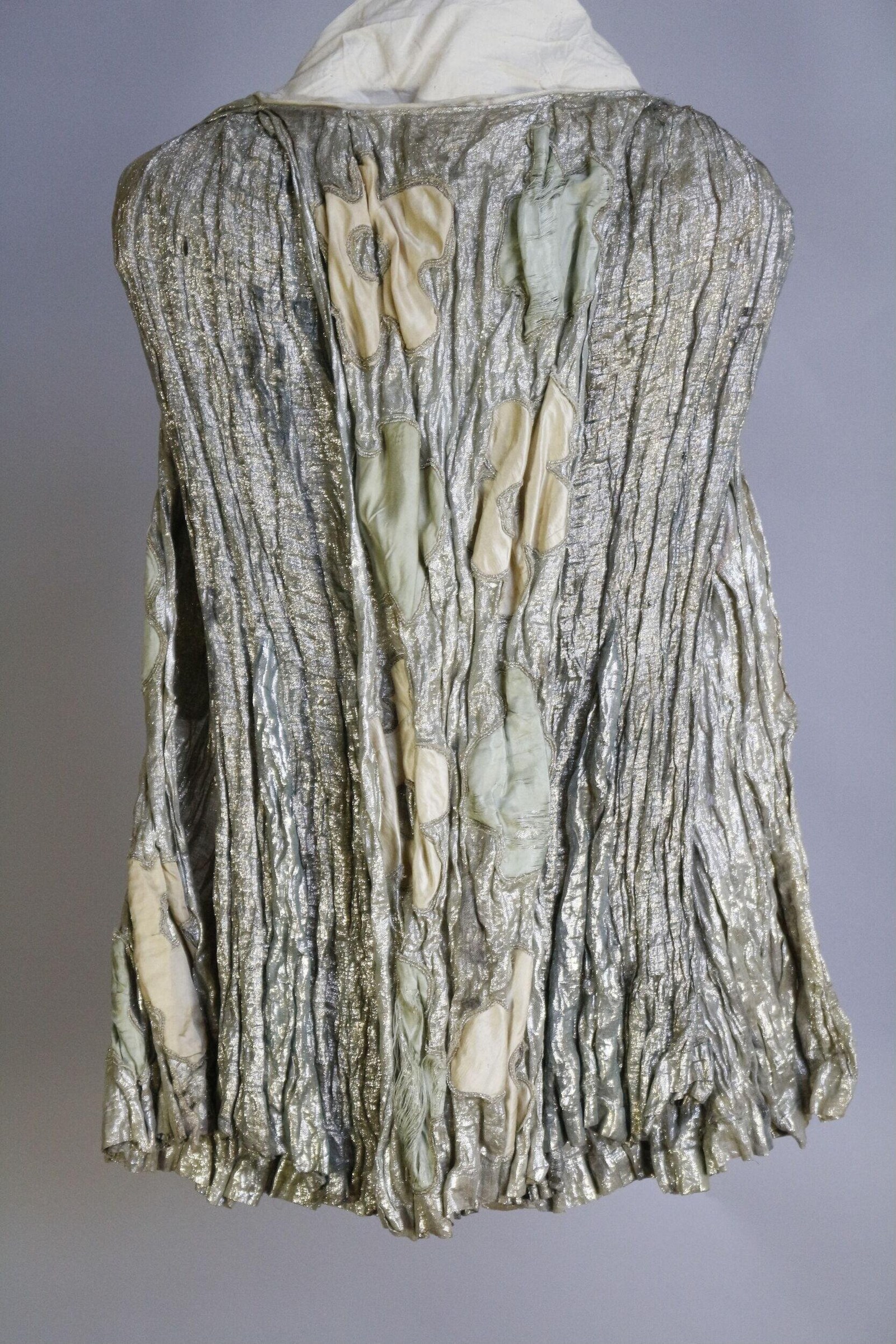
A theatrical costume displayed against a neutral background, shown from behind. The garment is a sleeveless vest or tunic of pleated silver-grey lame or metallic fabric, with pronounced vertical pleating throughout. Overlaid down the center back are appliquéd shapes in cream and pale green silk or satin—rounded, organic forms suggesting stylized drapery or possibly floral elements—arranged in a loose vertical sequence. The hem is dramatically flared and gathered, creating a voluminous silhouette that extends outward in deep folds. A white undershirt or chemise is visible at the neckline. The overall effect is one of controlled opulence: the rigid geometry of the pleats contrasts with the soft, painterly quality of the applied fabrics, and the weighty gathered hem suggests movement and grandeur appropriate to a major theatrical or ceremonial role.
The dancing
This is a costume rather than a depiction of a dancing body, so the figure is absent. However, the garment is constructed for an adult of substantial build, and the cut—sleeveless, with a relatively narrow shoulder line and a dramatically widened silhouette below—suggests a dancer of considerable presence. The gathered hem would create visual emphasis on leg movement and turn, and the light appliqués on the back plane indicate this role was designed to be seen in profile and from behind as well as face-on. The costume implies a formal, upright carriage and the kind of flowing, space-occupying movement associated with grand theatrical roles.
The dance depicted
This costume strongly suggests early 20th-century Romantic or Neo-Romantic ballet, or possibly a major role in theatrical spectacle of the Symbolist or Art Nouveau era. The style of the metallic pleating, the naturalistic appliqué motifs, and the silhouette are consistent with Russian Imperial ballet circa 1900–1910, a period when Diaghilev, Fokine, and Bakst were reshaping theatrical design. The fabric weight and construction indicate a leading role—a principal character or supernatural figure rather than a member of a corps de ballet. Without identifying marks or documentation, the specific ballet and character remain uncertain, though the costume suggests a figure of power or enchantment rather than a human heroine.
How it was made
This is a textile object—a constructed garment—not a representation of one. It is a three-dimensional artifact: pleated lame base fabric with hand-applied appliqués of silk or satin sewn in place, and gathered construction at the hem. Photography has captured it flat against a support, allowing inspection of material and seaming, but obscuring how it would drape and move on a dancer's body. The photographic record preserves evidence of hand craftsmanship that would otherwise be lost—the irregularity of the pleating, the variation in appliqué placement, the wear and aging of the materials—none of which would appear in a stage photograph or a designer's sketch.
About this work
This is a theatrical costume, attributed to the Russian designer Aleksandr Yakovlevich Golovin and dated 1901, held as a textile artifact in a theatre collection. Golovin was the principal scenic and costume designer for the Imperial Theatres in St. Petersburg and Moscow during the period when Russian theatrical design was at its most innovative and influential internationally. The costume displays hallmarks of the period's visual sophistication: the marriage of geometric form (the precise pleating) with organic, painterly ornament (the applied fabrics); the use of luxury materials for visual impact; and a silhouette engineered for theatrical presence. As a surviving artifact from the moment when Russian theatre design was becoming an international reference point—and before Diaghilev's Ballets Russes would make Russian designers household names in Paris and London—this garment is a rare witness to how these ideas were realized in three dimensions and worn by a professional dancer.
How to look at it
Examine the contrast between the precision of the pleating—mechanical, even, controlled—and the apparent spontaneity of the applied fabrics, which seem to float or drape across the surface. Notice how the appliqués are positioned mainly down the center and toward the hem, areas that would catch light and read clearly from the audience. The gathered hem is the most visually dramatic element; imagine how it would move as the wearer turned or moved through space, creating a shimmer of light on the metallic surface and a sense of volume and grandeur. The back view was deliberate: this costume was designed for a role whose power was visible from every angle, not merely from the front.
The artist
Aleksandr Yakovlevich Golovin (1863–1930) was the dominant scenic and costume designer of the Russian Imperial Theatres and one of the most influential theatre artists of the early 20th century. Based in St. Petersburg, he designed for opera, ballet, drama, and musical theatre from the 1890s onward, establishing a visual language that combined Symbolist aesthetics, Art Nouveau ornament, and a sophisticated understanding of color and light. His work for the Imperial Ballet—including roles in productions by Michel Fokine and the later Ballets Russes—helped establish the visual conventions of Romantic ballet revival and modern ballet spectacle. After the Russian Revolution, he continued designing in Soviet theatre.
The period
In 1901, Russian Imperial ballet was entering a period of artistic ferment. The reign of Marius Petipa as master of the ballet was ending; Michel Fokine's reforms were beginning to reshape choreographic practice. At the same time, the broader theatrical world was being transformed by the aesthetics of Symbolism, the decorative principles of Art Nouveau, and a new interest in color, light, and the total design of the stage. Golovin, working alongside the impresario Sergei Diaghilev (though the Ballets Russes did not premiere until 1909), was at the center of this transformation. Theatrical design was becoming recognized as an independent art form, worthy of the same attention as painting or sculpture. This costume belongs to that moment of ferment, before the international success of the Ballets Russes would make Russian design a global reference point.
Where it lives
The garment is held in a theatre collection (described in the record as 'Theatre costume'), suggesting it is part of an institutional archive of theatrical materials—possibly from one of the Imperial Theatres or a later Russian or Soviet theatre archive. The source attribution 'va' in the record is not immediately interpretable; the holding institution's name or acronym would clarify the specific provenance and any documentation associated with the piece.
Dance in this work
Questions about this work
Is this costume worn by a ballerina or a male dancer?
The record does not specify. The construction—sleeveless, with a fitted upper body and dramatically gathered hem—suits both. The narrow shoulder line and the visual emphasis on the legs suggests a principal dancer rather than a corps member. The character or role would determine the gender and type of dancer originally assigned to wear it; without additional documentation, this cannot be determined from the garment alone.
What role did this costume play in a specific ballet or theatrical work?
The record does not identify a specific work. The style, material, and construction are consistent with Russian Imperial ballet or grand theatrical spectacle circa 1900–1910, but without documentation, set designs, programmes, or other archival materials, the work and character are unknown. Theatre historians might be able to identify it through comparison with Golovin's documented designs or through records in the holding collection.
How would this costume have looked on a dancer in motion?
The gathered hem would create a dramatic silhouette and would move with the dancer, creating visual richness and an impression of volume and power. The metallic pleating would catch and reflect stage light, creating shimmer and visual interest. The appliqués, positioned for visibility from the back and sides, would read as ornamental or symbolic shapes—possibly representing nature, magic, or high social status depending on the character. On stage, the overall effect would be one of grandeur, opulence, and theatrical presence.
Why is this costume historically important?
Golovin was one of the most influential theatre designers of the early 20th century, helping to establish the visual language of modern ballet. Surviving original garments from his practice are rare; most evidence of his work comes from photographs or archival documentation. This piece is primary source material for understanding how his design principles were realized in fabric, how designers of the period understood the relationship between visual design and a dancer's body, and how Russian Imperial theatrical workshops constructed costumes at the highest level of craftsmanship.
More dance artwork





