49 works in this view — arrow keys or swipe to move between them.
Dance in Art
Ashley, Alfred
- Collection:
- Source:
- Victoria and Albert Museum
- Rights:
- Rights vary by item — check the source record before reusing this image. Source record ↗
- Recorded as:
- V&A — check rights per item
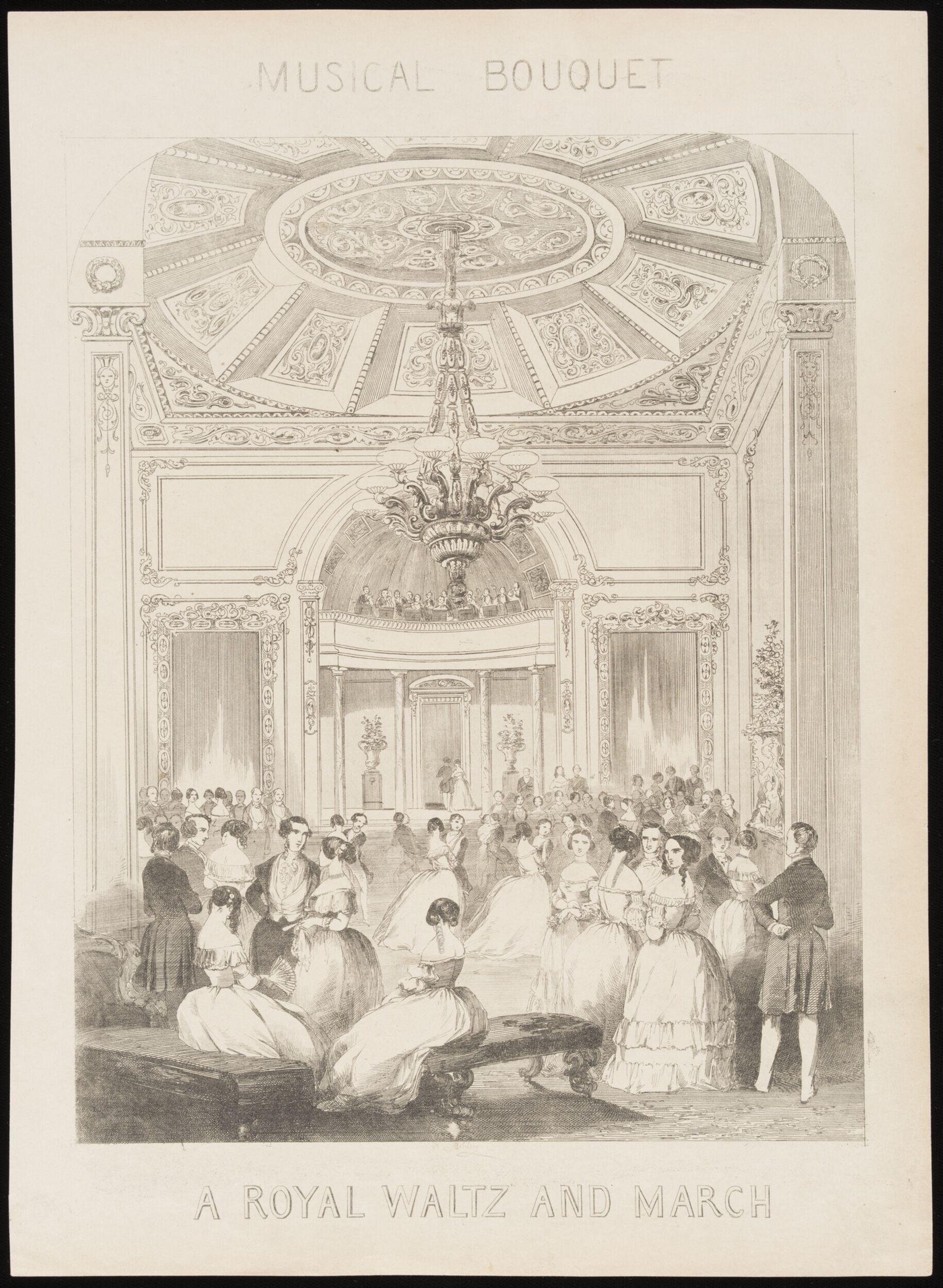
The engraving is evidence of how the waltz was taught, performed, and understood as a formal, structured dance in the nineteenth century—not the improvisational or competitive form of later eras. The architectural setting and the crowd of formally dressed spectators show that the waltz was a centerpiece of high society, and the careful postures of the couples visible in the print demonstrate the technical precision and decorum that ballroom dancing required. For historians of dance, fashion, and social custom, the work is a primary document of how bodies moved, how spaces were organized for dancing, and how the waltz signified wealth and respectability.
What you are looking at
This is an engraving depicting an elegant social dance in a grand neoclassical interior. The scene is set in a vast hall with a coffered and segmented ceiling, ornamental plasterwork, wall panels, and a monumental chandelier descending from the center. The architecture frames the composition with perfect symmetry. Numerous figures in period dress fill the hall: women in white gowns with fuller skirts, men in dark coats and breeches. Some couples are dancing while others stand in conversation or promenade. The foreground shows women in white with their skirts caught in graceful motion; the middle ground is crowded with spectators; the background opens to a raised dais or stage area where additional figures are visible. The engraving technique creates subtle gradation through fine parallel lines, giving the scene atmospheric depth and a sense of the gaslight era.
The dancing
The dancers nearest the viewer show couples in closed position, with upright frames typical of formal ball dancing. The women's arms are raised in the characteristic position of the waltz or similar formal dance, with partners maintaining proper distance and alignment. The full skirts of the women's gowns are evident in the swirl and drape as they move. Men stand tall in their formal tailcoats. The crowd includes both active dancers and stationary figures observing—a social arrangement in which dancing is the centerpiece of a public entertainment rather than universal participation.
The dance depicted
This is a ballroom scene from the nineteenth century, most likely depicting a waltz given the formal dress, the architectural grandeur, and the composition centered on couples in motion. The title 'A Royal Waltz and March' confirms the waltz as the primary dance. The setting suggests a palace or grand hotel ballroom, indicating that this was a dance of the aristocracy and wealthy middle class. The inclusion of a march (likely processional, as suggested by the title) indicates the formal opening of a ball, with the waltz as the principal social dance of the evening. The artist has captured the moment when the orchestra strikes up, with the hall filled with participants and onlookers.
How it was made
This is an engraving, likely a steel or copper engraving given the fineness of the line work and the capacity for fine detail in the architectural elements and figures. The technique allows for precise rendering of the interior space and the formal composition of the crowd. Engravings of this type were mass-produced and widely circulated in the nineteenth century as illustrations in books, periodicals, and as stand-alone prints for middle-class homes. The skill evident in the handling of perspective, the architectural detail, and the crowd of figures suggests a well-known engraver working for a major publisher. The print was accessible to a broad audience interested in fashionable society and contemporary manners.
About this work
This engraved print documents the formal waltz as it was danced in grand ballrooms of the nineteenth century. It is both a record of social practice and a celebration of architectural grandeur, framing the waltz as an elite entertainment. The work belongs in a dance history collection because it preserves the visual culture of ballroom dancing at its social height, showing not only the postures and dress of dancers but also the ceremonial and social context in which the waltz took place. The title's attribution to Alfred Ashley and the engraving technique place it squarely in the commercial print tradition of the Victorian era, when images of fashionable life were a major category of popular visual culture.
How to look at it
Observe the posture and frame of the nearest couple in the foreground: the closed position, the upright torso, the level of the partners' bodies. This is not theatrical ballet—there is no turnout, no elevation. This is ballroom dancing, constrained by fashion and decorum. Notice how the engraver has used the architecture to frame the action: the symmetry of the ceiling echoes the symmetry of the formal social order, and the chandelier draws the eye to the center of the composition, where couples waltz. Look at the crowd of onlookers: this dance is as much about being seen as about dancing.
The artist
Alfred Ashley was a commercial engraver working in the nineteenth century. Little is recorded of his biography, but his work appears in the context of major publishing houses producing fashionable prints for middle and upper-class audiences. Engravers of his era often worked from drawings or paintings by other artists, and may have specialized in architectural or social subjects. The quality and detail of this print suggests professional training and experience in rendering complex scenes with many figures.
The period
The waltz became the dominant ballroom dance of the nineteenth century, having spread from Austria and Germany across Europe and America in the early 1800s. Initially controversial for its close partner contact, by the Victorian era it had become the respectable center of elite social life. The grand ballroom setting depicted here—with its neoclassical architecture, gaslit chandelier, and formal crowd—reflects the aesthetic ideals of the mid-to-late nineteenth century, when such spaces were built for opera houses, hotels, and aristocratic palaces. The print itself belongs to the golden age of commercial engraving, when such images were a primary means of circulating images of fashionable life before photography and lithography became dominant.
Where it lives
The print is held in the VA (Victoria and Albert Museum) collection. It is a commercial engraving, likely from the mid-nineteenth century, produced for sale to the public as a fashionable print. The title suggests it may be part of a series or a larger illustrated publication documenting contemporary social life.
Dance in this work
Questions about this work
Is this actually depicting the waltz or just labeled that way?
The postures, the closed frame, the white gowns, and the formal ballroom setting all support that this is indeed a waltz. The title 'A Royal Waltz and March' confirms it, and the visual evidence—upright, formal couples in motion in a grand interior—is consistent with how the waltz was danced in this era. The artist understood the form.
Who were these people—was waltzing only for aristocrats?
By the time this print was made, the waltz was danced by the wealthy middle class as well as the aristocracy. The grand setting and formal dress indicate an elite event, but the circulation of such prints to middle-class homes suggests that aspiring dancers and their families wanted to learn and emulate these ballroom scenes.
Why does the title mention both a waltz and a march?
Formal balls of this era typically began with a march—a processional in which guests entered and were presented. The waltz then followed as the principal dance of the evening. The print may depict the moment of transition, or the title may simply acknowledge the two-part structure of the ball.
How do I know this is an engraving and not a painting?
The technique is evident in the fine parallel lines used to create shading and volume, the precision of the line work, and the overall aesthetic of black and white. Engravings were a highly refined medium in the nineteenth century, capable of great detail and nuance. Photography later displaced them, but for the period in which this was made, engraving was the primary means of reproducing images for mass circulation.
More dance artwork





