49 works in this view — arrow keys or swipe to move between them.
Dance in Art
Costume design
Stevenson, Hugh
- Collection:
- Costume design
- Source:
- Victoria and Albert Museum
- Rights:
- Rights vary by item — check the source record before reusing this image. Source record ↗
- Recorded as:
- V&A — check rights per item
Costume design drawings are essential primary sources for understanding how dance roles were conceived and presented to performers and audiences. They show the designer's priorities, the resources available during wartime production, and the visual language of character and rank used in theatrical dance. Stevenson's work here, with its confident handling of color and period detail, is a record of professional theatrical practice at a specific historical moment.
What you are looking at
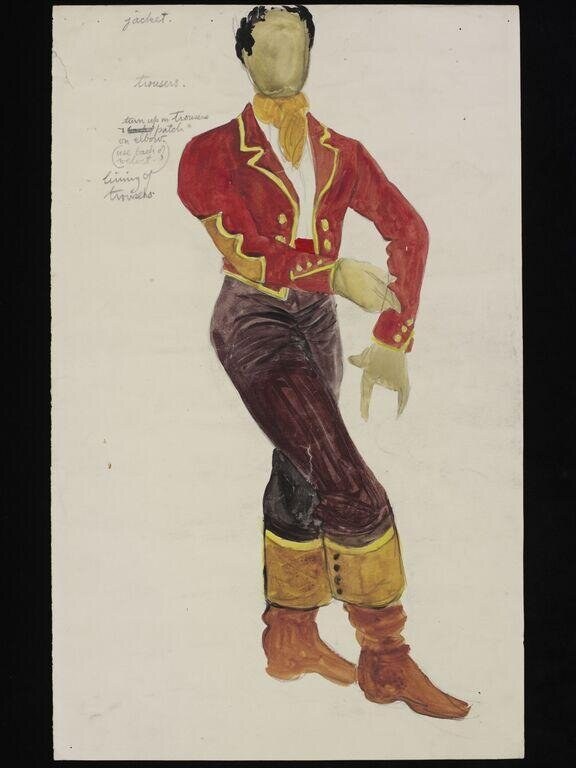
A single figure stands in a contrapposto pose against a neutral ground, displaying a theatrical costume in jewel tones. The dancer wears a brilliant red velvet jacket with gold frogging and trim, structured at the shoulders with what appears to be epaulettes or military-style detailing. A cream or pale yellow shirt front is visible at the neck. Below the jacket, dark burgundy or maroon velvet breeches or tights extend to the knee, where they meet gold-trimmed cuffs or boot tops. The legs are bare from knee to ankle, revealing the lower calf and foot. Rust or terracotta-colored stockings or boots cover the feet, which are positioned in a relaxed stance with slight weight shift. The figure's head is rendered as a simplified, featureless form in pale yellow ochre, without facial features or hair detail. The drawing technique combines watercolor or gouache with ink line work, executed with assured confidence in defining the fabric textures and the trim details. The work reads as a stage costume design rather than a finished portrait.
The dancing
The single figure occupies the full height of the sheet, standing in a neutral upright posture with one arm relaxed at the side and the other bent at the elbow. The weight distribution is even across both feet, and the stance conveys ease rather than dynamic movement. The costume dominates; the body is a vehicle for displaying the garment. The lack of facial features or anatomical detail in the head suggests the artist's primary interest was the cut, color, and decorative elements of the coat and breeches rather than portraiture or character study.
The dance depicted
This is a costume design rather than a representation of dance in motion. The style of dress—a military-cut jacket with gold frogging, breeches, and high boots—suggests either a theatrical role requiring formal or military dress, or a historical or national character part. The jacket's construction and the overall silhouette are consistent with European theatrical costume of the mid-20th century, possibly for ballet (particularly Russian imperial tradition), operetta, or character dance in a formal or military context. Without documentation or inscription visible in the image, the specific dance or theatrical tradition cannot be confirmed, though the elegance of the design and precision of the tailoring suggest a substantial or leading role.
How it was made
The work is executed in watercolor or gouache over pencil underdrawing, with ink or dark wash defining edges and details. The rendering of fabric—the sheen and weight of velvet, the stiffness of tailoring, the texture of trim—shows mastery of the medium and considerable technical skill. The simplified treatment of the head (left as a pale oval without feature work) is a deliberate choice common in costume design drawings of this era, where the garment was the primary subject and the figure merely a stand. The technique and presentation are consistent with professional theatrical design documentation of the 1940s.
About this work
This is a stage costume design by Hugh Stevenson, dated 1943, showing a formal military-style theatrical dress in rich colors and with careful attention to historical or stylized tailoring. It is a working design drawing, not a portrait or a representation of a dancer in motion, but evidence of how bodies were dressed for formal or character roles in theatrical dance during the Second World War era. The work documents both the aesthetic of 1940s theatrical design and the practical work of dressing major roles in ballet or theatrical dance.
How to look at it
Read the costume from top to bottom, noting how each element contributes to character: the military jacket announces authority or historical status; the gold trim signals formality and rank; the breeches and high boots suggest either a historical period or a stylized national or military character. The stillness of the pose is intentional—this is a sartorial display, not a choreographic moment. The artist chose to show the full garment in a neutral pose so the costume could be read clearly by the director, wardrobe master, and performer without distraction from movement or facial expression.
The artist
Hugh Stevenson (1910–1973) was a British stage designer and decorator who worked extensively in theatre and ballet. He was known for his work in costume and set design, contributing to major productions in London's West End and for British ballet companies. His practice spanned from the 1930s through the 1960s, and he was active during the early years of the Sadler's Wells Ballet (now The Royal Ballet). Stevenson's work is characterized by careful historical research, strong color sense, and an understanding of how costume functions on stage.
The period
In 1943, during the Second World War, British theatre and dance continued despite wartime constraints. Rationing and material shortages affected production, yet the ballet and theatrical dance maintained a strong presence as part of national morale and cultural continuity. Russian imperial ballet tradition remained influential in Britain, and roles in historical or military dress were common in the classical repertoire and in new character ballets. The formal elegance of this design reflects the aesthetic of British theatrical dance in the mid-war years, when classical lines and period authenticity were valued.
Where it lives
The work is held in a costume design collection designated 'va' in the catalogue system, indicating a British institutional archive or museum collection. The bare cataloguing suggests this is one of many such working drawings in institutional holdings, where costume designs are preserved as part of theatrical or dance history documentation.
Dance in this work
Questions about this work
Is this a ballet costume?
Likely yes, though the design itself does not specify. The style—military dress in a theatrical idiom—was common in classical ballet for roles such as princes, officers, or historical characters. However, the same costume type would appear in operetta, historical drama, or character dance. The drawing itself is a working design and does not document the specific dance or context.
Why is the head blank?
In costume design practice, the face is often left featureless because the purpose of the drawing is to display the garment, not to portray an individual. The actor or dancer would bring their own face and expression; the designer's job is to show how the costume should be cut and colored. This is a professional shorthand, not an oversight.
What can this tell us about wartime theatre?
Despite wartime material rationing, theatrical designers continued to create richly colored and finely detailed costumes. This design, with its multiple layers of fabric and extensive gold trim, suggests either that the production had significant resources or that the role was prestigious enough to justify the expense. It reflects the cultural priority placed on theatre and dance as part of maintaining morale and national identity during the war.
Who was Hugh Stevenson?
Stevenson (1910–73) was a major British stage designer active from the 1930s onward. He worked on major West End productions and for Sadler's Wells Ballet, the forerunner of The Royal Ballet. He was known for meticulous historical research, strong visual taste, and the practical understanding of how costume works on stage. His designs are held in institutional collections across Britain.
More dance artwork





