49 works in this view — arrow keys or swipe to move between them.
Dance in Art
Costume design
Stevenson, Hugh
- Collection:
- Costume design
- Source:
- Victoria and Albert Museum
- Rights:
- Rights vary by item — check the source record before reusing this image. Source record ↗
- Recorded as:
- V&A — check rights per item
This drawing preserves a crucial record of how mid-century theatrical designers approached the female silhouette on stage, prioritizing dramatic impact and the visual language of character over naturalism. For historians of dance and theatre, it documents both the specific aesthetic preferences of the 1940s and the working methods of professional costume design at that period, showing how designers communicated their ideas to construction teams.
What you are looking at
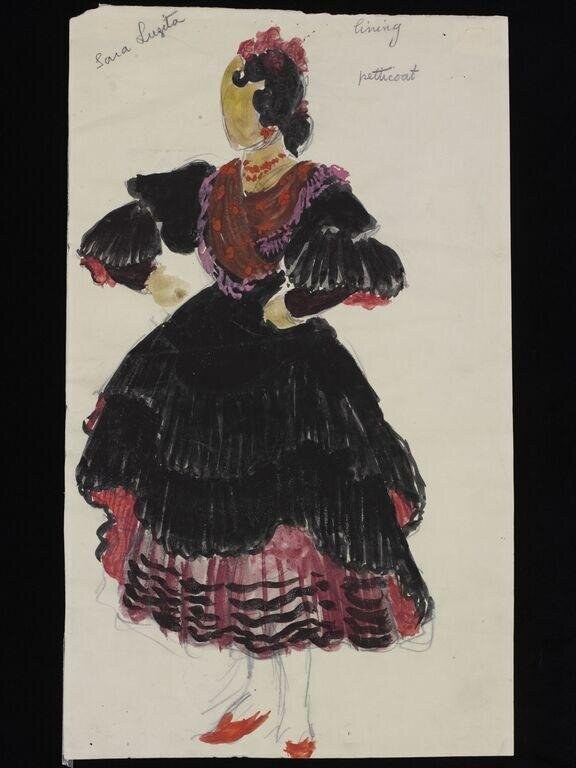
A figure in theatrical costume stands in a three-quarter pose against a plain background, drawn in what appears to be watercolor or gouache. The design presents a woman wearing an elaborate black skirt with deep pleating and a pink underskirt visible at the hem, topped with a fitted bodice in deep red or burgundy with pink accents at the shoulders. Most striking are the oversized black puffed sleeves, gathered dramatically at the shoulders and lined with pink silk visible on the underside, which extend to the elbow in a voluminous bell shape. The figure wears a yellow or pale gold collar or large circular ornament at the neck, and her dark hair is styled up with what may be a pink or red feathered headpiece. Her posture is upright and slightly tilted, with the weight forward, the left arm extended and the right at her side. The annotation at the top of the sheet, in period handwriting, reads "Sara Laserre" and what appears to be "liveing" or "living," with the word "petticoat" visible lower on the page—indicating this is a costume design for a named performer.
The dancing
A single figure is shown in an exaggerated contrapposto stance, weight shifted forward on the legs in a pose that suggests readiness and forward momentum. The oversized puffed sleeves dominate the silhouette; they are constructed to sit high on the shoulders and balloon outward to the elbows, creating a pronounced frame that draws the eye upward. The arms are held away from the body—the left extended forward at roughly mid-torso height, the right hanging more naturally—in a position that reads as confident and performative rather than naturalistic. The upright carriage and lifted chest suggest theatrical presence.
The dance depicted
This appears to be a costume design for a theatrical performance, most likely from a ballet or theatrical production of the 1940s. The style of dress—particularly the exaggerated silhouette, the voluminous pleated skirt, and the oversized puffed sleeves—suggests a romantic or fantastical character role. The annotation identifying the wearer as "Sara Laserre" suggests this was designed for a specific named performer. Without additional context, the exact role and work cannot be determined, but the construction of the costume implies a character requiring theatrical presence and probably stylized, formal movement rather than contemporary naturalism. The extreme proportions of the sleeves suggest the designer prioritized visual impact and silhouette over ease of movement.
How it was made
This is a costume design drawing executed in watercolor or gouache over pencil on paper, a standard medium for theatrical costume documentation in the mid-twentieth century. The artist—identified in the catalogue as Hugh Stevenson—has used transparent washes to indicate the translucency and layering of fabrics, with darker pigment applied to define the pleating of the skirt and the volume of the sleeves. The technique allows for both the overall silhouette and color detail to be read quickly by a dressmaker or costumier preparing the piece for construction. The style of annotation and presentation is consistent with working designs intended for practical theatrical use rather than fine art display.
About this work
This is a costume design by Hugh Stevenson created in 1943 for the performer Sara Laserre, likely for a theatrical or ballet production. The drawing shows a woman's theatrical costume featuring an exaggerated silhouette built on a foundation of a black pleated skirt with pink underskirt, a fitted burgundy bodice, and most notably, enormous puffed sleeves in black silk with pink lining. The costume exemplifies mid-twentieth-century theatrical design practice, when costumiers understood that stage silhouette and visual impact often took precedence over everyday wearability or comfort. The work documents both the designer's vision for a specific character and the practical process of costume-making in wartime British theatre.
How to look at it
Focus on the relationship between the body and the costume: the puffed sleeves are so extreme that they seem to reshape and enlarge the figure itself, drawing attention away from actual arm position and toward the designed silhouette. Note how the artist has used transparency in the fabric to suggest the layering of the skirt and the lining of the sleeves—practical information for a costumier, but also a way of suggesting how the garment will move and catch light on stage. The color notation (the yellow collar, the pink undertones, the deep black and red) indicates a theatrical lighting design: these colors are chosen not for realism but for visibility and visual harmony under stage lights. The upright posture and forward weight suggest that despite the costume's volume, the performer was expected to carry it with confidence and forward momentum.
The artist
Hugh Stevenson (1910–1973) was a prominent British theatre designer, known for his work in ballet, opera, and drama. He designed costumes and scenery for the Ballet Rambert, the Royal Ballet, and the British theatre establishment over several decades. His work is characterized by bold silhouettes, sophisticated color sense, and an understanding of how costume functions within the choreography and staging. Stevenson's designs from the 1940s reflect the aesthetic priorities of British ballet and theatrical design during the Second World War and immediate postwar period—a time of constraints on materials but continued investment in theatrical spectacle as a form of morale and cultural continuity.
The period
This design was created in 1943, during the Second World War, when British theatre and ballet companies continued to produce work despite wartime restrictions on materials and labor. The silhouette and aesthetic—particularly the exaggerated proportions and romantic styling—reflect the continued influence of classical ballet design and the continued interest in fairy-tale and fantastical subjects on the British stage. The 1940s were a period of transition in costume design; wartime shortages forced ingenuity, but the theatrical tradition of the previous decades remained strong. This was also the period when the Ballet Rambert and other British companies were establishing a distinctive national approach to ballet design, drawing on but distinct from European models.
Where it lives
This design is held in the V&A Museum's costume and design collection. It is a working design document from a professional theatrical practice, not a finished artwork; such drawings were created for immediate practical use in costume construction and would typically be filed away after the production closed.
Dance in this work
Questions about this work
Who was Sara Laserre?
The annotation identifies her as the performer for whom this costume was designed in 1943. Without additional archival research, little more can be established from the drawing itself, but she was a named theatrical performer in the British theatre or ballet world of that period, significant enough to have a costume designed by a major designer like Stevenson.
What production was this costume for?
The catalogue record does not specify the production. The style and period suggest it was likely for a ballet or theatrical work, and the fantastical character of the costume (the exaggerated proportions, the romantic color palette) suggests a fairy-tale or romantic subject, but the specific work cannot be identified from the image alone.
Why are the sleeves so enormous?
On stage, exaggerated proportions read much larger and clearer to an audience than realistic garments would. The oversized sleeves frame the figure, create a distinctive silhouette readable from a distance, and suggest a theatrical or fantastical character type. They also create a strong visual line that can enhance certain kinds of movement or stillness depending on the choreography.
How would an actual performer move in this costume?
The voluminous skirt would restrict leg movement but create a dramatic sweep when turning or moving laterally. The puffed sleeves, while visually enormous, would allow reasonable arm movement; the silk lining visible in the design suggests the inner fabric is relatively lightweight. The costume seems designed for theatrical presence and formal, controlled movement rather than rapid or naturalistic action.
More dance artwork





