49 works in this view — arrow keys or swipe to move between them.
Dance in Art
Poster
A. E. King & Jackson Ltd.
- Collection:
- Poster
- Source:
- Victoria and Albert Museum
- Rights:
- Rights vary by item — check the source record before reusing this image. Source record ↗
- Recorded as:
- V&A — check rights per item
For dance historians, this poster is evidence of how flamenco circulated internationally in the mid-20th century and how male flamenco dancers were promoted and perceived in British performance contexts. The photograph captures the visual language and costume conventions of professional mid-century flamenco and suggests the repertoire and performance style that audiences would have expected to see.
What you are looking at
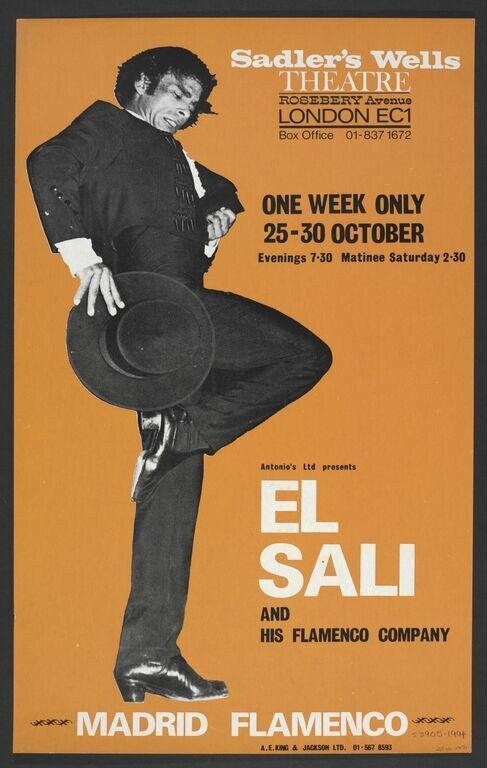
A theatrical poster in orange and black announces a week-long engagement of flamenco dance at Sadler's Wells Theatre in London, October 25-30 (the year appears to be 1971 based on the box office number). The central image shows a single male dancer captured mid-movement against the orange ground, photographed in stark black and white. He wears a dark (likely black) fitted jacket and light-coloured shirt, his posture dynamic and theatrical. His weight is thrown dramatically to one side, one leg extended or raised, and he holds a wide-brimmed hat in his hand at waist level—a classic element of flamenco costume and iconography. His facial expression reads intensity and engagement. The composition is vertically oriented, with the dancer's figure dominating the frame. Text identifies him as "El Sali" with "His Flamenco Company," and credits the presentation to Antonio's Ltd. The production title "Madrid Flamenco" appears at bottom. The poster's layout and typography are typical of mid-century theatrical advertising, with clear hierarchy and bold sans-serif fonts.
The dancing
A single male figure occupies the composition, his body weight shifted dramatically onto one leg while the other appears lifted or extended, creating an asymmetrical, dynamic silhouette. His torso is upright but angled; his right arm is bent and held close to his body, while his left arm extends downward holding the hat. His shoulders are slightly raised and his head tilted, suggesting effort and expression. The posture conveys the characteristic weight shifts and dramatic contrasts of flamenco—the sudden changes between stillness and explosive movement, between gathered tension and release.
The dance depicted
This is unquestionably a flamenco poster, and the photograph captures El Sali, a professional flamenco dancer of the period, in a moment of performance or rehearsal. The hat (likely a cordobés or similar flamenco-associated style) is a traditional prop in male flamenco dress and performance. The dramatic body weight shift, the angle of the torso, and the intensity of the pose are consistent with the male flamenco vocabulary of the mid-20th century—a style that emphasizes footwork (though the feet are not clearly visible here), sharp movements, and theatrical presence. The fact that the poster emphasizes a solo male dancer, with the company listed secondarily, suggests El Sali was the principal attraction and likely performed both solo pieces and ensemble work.
How it was made
This is a printed theatrical poster, almost certainly a lithograph or screenprint based on the flat color application, the bold black photographic image, and the characteristic registration visible between the orange background and the black figure. The photograph of El Sali has been reproduced and integrated into the design. The printing technique allowed for rapid, economical production suitable for mass posting around London's West End, and the high contrast between figure and background ensures visibility from a distance. The format and materials are typical of mid-century British theatre advertising.
About this work
This is a promotional poster for a flamenco dance company's one-week engagement at a major London venue in 1971, featuring the performer El Sali. It is a document of both theatrical practice and visual culture in post-war Britain—evidence of how flamenco was marketed to English audiences, how male flamenco dancers were represented, and how mid-century theatre used photography and graphic design to advertise live performance. The poster preserves a moment from a specific production and reveals professional flamenco's presence and commercial viability in 1970s London.
How to look at it
Look at the angle of the dancer's weight and the position of his feet: this frozen moment captures the characteristic flamenco contrast between gathered tension and explosive movement. The hat, held rather than worn, is a prop that signals genre and tradition. The stark black-and-white photography against the warm orange background creates visual drama that mimics the intensity of live flamenco performance—the high contrast, the emphasis on the solitary figure, and the sense of explosive physicality. Notice also the date and venue: this is a specific historical moment, and the design choices (typeface, color, photograph) are legible as 1970s.
The artist
A. E. King & Jackson Ltd. was a British printing company specializing in theatrical and commercial printing, particularly poster production. The company's name appears in the printer's mark at the bottom of the poster ("A.E.P.M. JACKSON LTD, BELL ROAD"). This was standard commercial printing practice; the artist who designed the poster layout is not identified, nor is the photographer who made the original image of El Sali. Theatrical poster design of this period typically employed house designers and was produced at speed for short-term promotion.
The period
In the 1960s and early 1970s, flamenco experienced a period of international expansion and theatrical legitimacy in Europe and North America. Spanish flamenco companies regularly toured major cities, and London's West End theatres hosted international dance companies. The presentation at Sadler's Wells—a venue with significant prestige in British dance and theatre—indicates that flamenco had secured a place in the mainstream theatrical repertoire. This was also a period when male flamenco performers were increasingly prominent in international touring companies, moving beyond the gender associations that had dominated earlier decades.
Where it lives
This poster is held in the V&A collection as a piece of theatrical and graphic design ephemera. It documents a specific production and is catalogued as a poster (the medium and production technique are not specified in the holdings record).
Dance in this work
Questions about this work
Who was El Sali?
The poster identifies him as a flamenco dancer and company principal who performed at Sadler's Wells in October 1971 under the "Madrid Flamenco" banner. Beyond what the poster tells us, his biographical details are not recorded in the image. He was part of the wave of Spanish flamenco artists touring major European theatres in this period.
Why is the hat important in this image?
The hat (likely a cordobés or similar style) is a traditional element of male flamenco costume and is often used as a prop in performance and theatrical presentations of flamenco. Its prominence in this poster signals the dance style and helps communicate the visual language of flamenco to potential audiences.
What does the body position tell us about flamenco technique?
The dramatic weight shift and upright torso are characteristic of flamenco's aesthetic: the sudden, dramatic contrasts between stillness and explosive movement, between gathered power and release. Male flamenco emphasizes these sharp transitions and a theatrical, presentational quality.
Why was this poster printed this way?
The lithographic or screenprinted technique allowed for fast, economical production of multiple copies for posting throughout London's theatres and streets. The high-contrast design ensures visibility and legibility from a distance, and the bold colors and dramatic photography draw attention in a crowded visual environment.
More dance artwork





