49 works in this view — arrow keys or swipe to move between them.
Dance in Art
Poster
Hart-Talbot Printers
- Collection:
- Poster
- Source:
- Victoria and Albert Museum
- Rights:
- Rights vary by item — check the source record before reusing this image. Source record ↗
- Recorded as:
- V&A — check rights per item
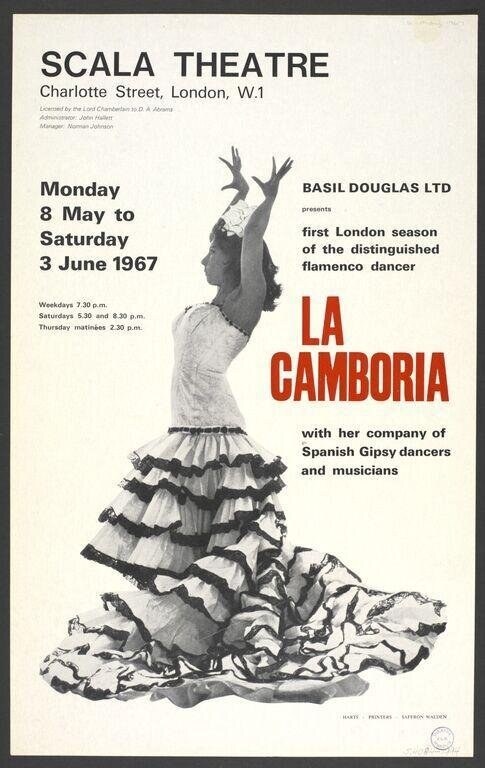
The poster preserves visual evidence of how flamenco was marketed and experienced in 1960s Britain, and shows the centrality of the female dancer's arched torso and expressive upper body to the visual identity of the form. For scholars of dance photography and theatre publicity, it demonstrates how the dynamic three-dimensionality of performance was translated into static graphic form to attract audiences.
What you are looking at
This is a theatre poster for a flamenco dance performance at London's Scala Theatre in May–June 1967. The image shows a female flamenco dancer captured mid-performance, her body arched backward in a dramatic pose with arms raised expressively above her head. She wears a traditional flamenco dress (vestido de cola) with multiple deep ruffles or flounces in black and white, the voluminous skirt spread across the ground in a pool of fabric. The photograph is cropped to show the dancer from roughly waist up, emphasizing the sculptural quality of the ruffled skirt and the intensity of her upper-body extension. The composition is a black-and-white photograph printed as a poster, with bold red typography spelling "LA CAMBORIA" positioned to the right of the figure. The poster announces this as "first London season of the distinguished flamenco dancer" and notes her performance "with her company of Spanish Gipsy dancers and musicians."
The dancing
The dancer's body demonstrates the extreme flexibility and dramatic extension characteristic of flamenco performance. Her torso is deeply arched backward, with her head thrown back and her arms lifted high and outward in an expressive frame. The pose suggests a moment of peak intensity within a performance sequence—neither a static position nor a step-based moment, but rather an expression of duende, the emotional and spiritual depth central to flamenco. The photograph captures the three-dimensionality of the body in space, with particular attention to how the heavily ruffled skirt responds to movement, forming architectural folds and layers that read as almost sculptural.
The dance depicted
This is flamenco (baile flamenco), the Andalusian Spanish dance form that fuses Romani (Gitano) tradition with broader Spanish and Moorish influences. The poster identifies the performer as "La Camboria," a flamenco dancer of sufficient international reputation to headline a London season. The image shows neither a specific named palos (form) nor recognizable footwork patterns, but rather captures a moment of emotional expression and upper-body articulation that is fundamental to flamenco performance. The presence of "Spanish Gipsy dancers and musicians" in the company indicates a theatrical presentation of flamenco as a concert art form, likely including cante (singing), guitarra (guitar), and palmas (hand-clapping) alongside the dance.
How it was made
This is a lithographic poster, printed by Hart-Talbot Printers (as credited at the bottom). The image is based on a black-and-white photograph that has been reproduced for mass printing. Lithography allowed for high-quality reproduction of photographic tonality and detail, making it ideal for theatre publicity in 1967; the dramatic contrast between the dancer's body and the ruffled skirt is preserved with clarity. The red typography is overprinted on the photograph, a common technique for theatre posters of the period. As a poster, this was produced in multiple copies for public display in London, making it a document of touring performance culture and the marketing of Spanish dance to British audiences.
About this work
This is a promotional poster for a 1967 London season by the flamenco dancer La Camboria and her ensemble. It is a lithographic reproduction of a photograph, printed with overprinted text and imagery typical of mid-twentieth-century theatre publicity. The poster preserves a moment of high drama in flamenco performance—a deeply arched torso, raised arms, and the explosive volume of the traditional ruffled skirt—capturing the emotional and physical intensity that defines the form. As a theatrical advertisement, it documents both the technical and expressive vocabulary of flamenco dance as it was presented to London audiences in the 1960s, at a moment when Spanish flamenco was gaining international recognition as a concert art form distinct from its roots in working-class Andalusian culture.
How to look at it
Attend to the moment captured: not a footwork pattern or recognizable step, but a moment of upper-body expression and emotional intensity. The photographer has chosen to emphasize the arched spine, raised arms, and the sculptural volume of the skirt, which together communicate the physical and emotional demands of flamenco performance. Note how the ruffles of the dress read almost as a separate element, responding to movement and creating spatial depth. The composition makes the dancer's body the sole subject; there is no stage setting, no other performers visible, no distraction—a choice that emphasizes the individual performer and the intensity of the moment.
The artist
Hart-Talbot Printers was a commercial lithographic printing firm active in mid-twentieth-century Britain. No individual artist or photographer is named on the poster; the photograph was likely commissioned or provided by the dance company's management for promotional purposes. The designer of the poster layout and typography is also uncredited, which was standard practice for commercial theatre publicity of the period.
The period
In the 1960s, flamenco was undergoing significant internationalization and professionalization. Spanish flamenco dancers and companies were touring major European cities with increasing frequency, presenting the form as a concert art rather than a vernacular social practice. Simultaneously, photography and lithography were the primary media for theatre publicity; television advertising for theatre was still limited, and posters remained the dominant way to reach potential audiences. The design and aesthetic of this poster—dramatic, high-contrast, photograph-based—reflects the visual conventions of mid-century European theatre promotion.
Where it lives
This is a theatre poster produced by Hart-Talbot Printers, London, for the Scala Theatre's programme in May–June 1967. Posters were created in quantity for public display to advertise the performance. The holding collection (VA) indicates this is part of a broader archive of theatre and performance ephemera.
Dance in this work
Questions about this work
What is flamenco, and how does it differ from Spanish dance generally?
Flamenco is a dance, music, and vocal form originating in Andalusia that synthesizes Romani (Gitano), Arabic, and Spanish traditions. It is characterized by intense emotional expression (duende), percussive footwork, hand-clapping (palmas), and guitar accompaniment. Unlike Spanish regional folk dances such as sevillanas, flamenco is typically a solo or small-group art form performed in concert or social settings, emphasizing individual expression and improvisation within formal structures called palos.
Who was La Camboria?
The poster identifies her only as "the distinguished flamenco dancer," with no further biographical information provided. She was prominent enough to command a London season with her own company in 1967, suggesting an established international career, but detailed records of her life and career would require additional research beyond what the poster supplies.
Why is the ruffled skirt so important to flamenco costume?
The vestido de cola (trained dress) with multiple voluminous ruffles is central to flamenco performance aesthetics. The ruffles respond dynamically to the dancer's movements—spinning, swaying, stomping—creating visual spectacle and amplifying the spatial impact of footwork and body movement. The dress is both a practical element that shapes the choreography and a statement of theatrical presence.
What does it mean that this is a lithographic poster?
Lithography was the dominant technology for colour and high-quality black-and-white theatrical posters in the mid-twentieth century. It allowed faithful reproduction of photographic tonality and detail, and the ability to overprint text and colour for eye-catching effect. Unlike screen-printing or digital printing, lithography produced a softer, more photographic quality that was ideal for promoting dance and theatre performances to mass audiences.
More dance artwork





