49 works in this view — arrow keys or swipe to move between them.
Dance in Art
Evening dress
Unknown artist
- Collection:
- Evening dress
- Source:
- Victoria and Albert Museum
- Rights:
- Rights vary by item — check the source record before reusing this image. Source record ↗
- Recorded as:
- V&A — check rights per item
Evening dress is a primary document of dance history: it shows us what dancers wore, how garments were engineered to move, and what aesthetic values shaped dance presentation at a particular moment. This dress, with its carefully constructed tiered skirt, reveals mid-century thinking about how women's ballroom costumes should look in motion and how fabric architecture could enhance performance.
What you are looking at
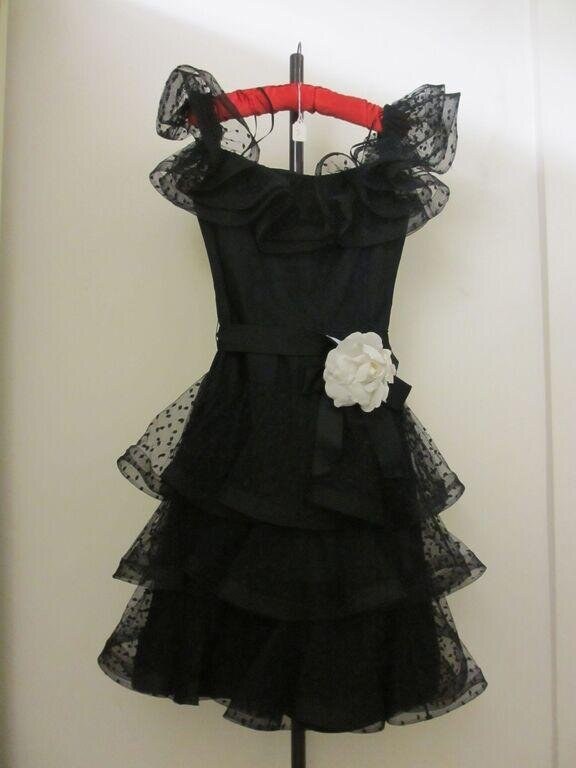
A black evening dress is displayed on a dress form against a neutral wall. The dress is sleeveless with prominent black lace cap sleeves and a black lace overlay on the bodice. The skirt consists of three tiered layers of black lace that graduate in fullness, creating a dramatic silhouette. A white fabric flower is pinned at the waist on the left side. A red ribbon or sash is threaded through the neckline at the shoulders, creating bold color contrast. The dress form is mounted on a dark pole with a finial tip, and the photograph is taken straight-on in what appears to be a museum or gallery setting with controlled lighting.
The dancing
This is a dress on a form, not a dancer. The presentation emphasizes the garment's structure: the tiered, graduated skirt layers suggest movement and motion even when static, while the fitted bodice would define the dancer's frame. The cap sleeves frame the shoulders, and the overall silhouette suggests a garment designed to accommodate ballroom or theatrical movement.
The dance depicted
The dress is a formal evening wear, likely from the mid-20th century, designed for ballroom or theatrical dance. The tiered skirt construction would create dramatic movement and flow during rotation or swinging motions characteristic of ballroom styles such as Waltz, Foxtrot, or similar formal partner dances. The lace overlay and fitted bodice suggest a dress intended for a female ballroom or theatrical performer of the 1940s–1950s era. Without additional documentation, the specific dance style cannot be definitively identified, but the construction supports formal partner dancing.
How it was made
This is a three-dimensional textile object: a constructed evening dress in black fabric with hand-applied lace overlay and decoration. The photograph documents the dress as a museum artifact, captured in studio lighting that emphasizes the geometric construction of the tiered skirt and the texture of the lace. The image is a documentary photograph, likely a museum catalogue or collection image, serving to preserve and communicate the garment's visual properties to researchers and viewers.
About this work
This is a black evening dress, likely from the 1940s–1950s, designed for formal ballroom or theatrical performance. The tiered skirt and fitted bodice represent a particular moment in dance costume design when women's ballroom wear emphasized silhouette and movement potential through constructed layers rather than simple drape. The dress demonstrates how costume engineering enabled specific movement qualities in social and competitive dance.
The garment belongs in a dance history collection because costume and dress are fundamental to understanding how dancers moved, what movements were possible and desirable, and how dance was presented and valued in mid-century popular culture. The construction of the skirt—its graduated tiers and lace overlay—directly shaped the visual and kinetic experience of movement.
How to look at it
Attend to the graduated tiers of the skirt: each layer is slightly wider than the one above, creating a cascading effect that would amplify movement during turns and spins. The lace overlay adds visual texture and lightness while maintaining the structural lines. The white flower detail and red ribbon accent the garment's intended formality and suggest this was costume for a showcase or competition rather than casual social dancing.
The period
This dress dates to approximately 1940–1960, a period when ballroom dancing was a major social and competitive activity in North America and Europe. Women's evening wear for dance emphasized fitted bodices, full skirts, and dramatic silhouettes that would photograph well and create visual impact on the dance floor. The use of lace and layered construction reflects post-war fashion aesthetic and the increasing professionalization of competitive ballroom dancing.
Where it lives
The dress is held in the Victoria & Albert Museum collection (indicated by source 'va' in the record). It is catalogued as "Evening dress" with no date, maker, or donor information recorded. The photograph appears to be a standard museum documentation image.
Dance in this work
Questions about this work
What dance would this dress have been worn for?
Based on the construction, this is an evening dress for formal ballroom dancing, likely Waltz, Foxtrot, or similar partner dances popular in the 1940s–1950s. The tiered, graduated skirt would create dramatic movement during turns and rotations. The fitted bodice would allow close partnering while the full skirt would sweep and flow visibly.
Why is the skirt made in layers like that?
The graduated tiers serve both aesthetic and kinetic purposes. Visually, they create volume and silhouette. Functionally, they allow the skirt to move independently of the body, creating momentum and flow during spinning movements. The layers also reduce bulk at the waist while maintaining fullness at the hem.
What do the red ribbon and white flower mean?
The red ribbon threaded through the neckline is a decorative accent that frames the face and provides color contrast. The white flower is a traditional ornament for formal evening wear, commonly pinned at the waist. Both suggest this dress was designed for an important performance or competition rather than casual social dancing.
More dance artwork





