49 works in this view — arrow keys or swipe to move between them.
Dance in Art
Evening dress
Balenciaga, Cristóbal
- Collection:
- Evening dress
- Source:
- Victoria and Albert Museum
- Rights:
- Rights vary by item — check the source record before reusing this image. Source record ↗
- Recorded as:
- V&A — check rights per item
Balenciaga's work is studied in fashion history, but this dress matters equally to dance historians because it reveals how costume and dance technique are inseparable. The dress's construction—the fitted bodice that enforces upright carriage, the flared skirt that becomes visible only in motion—was engineered for the Waltz and Foxtrot. To understand how these dances looked and felt in their formal, competitive context, you must understand the garments that shaped the body and made the steps visible.
What you are looking at
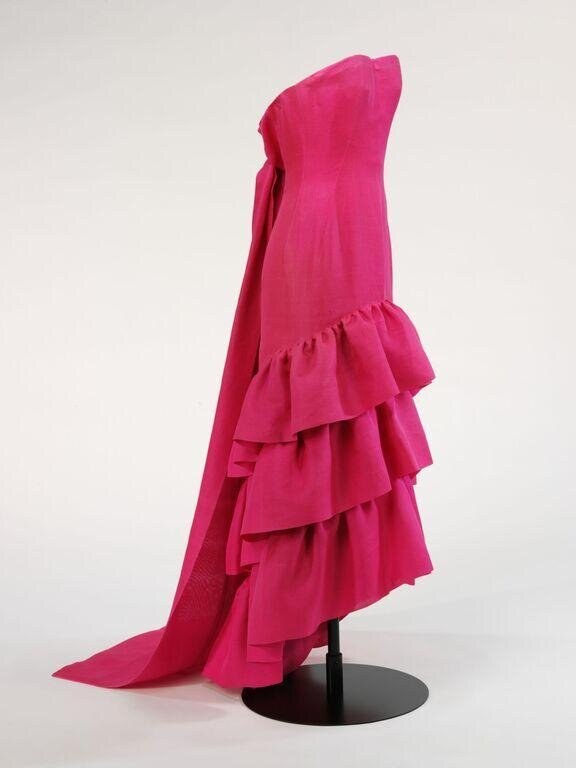
A striking strapless evening gown in vivid fuchsia silk dominates the composition, displayed on a dress form against a neutral background. The garment is photographed in three-quarter view, revealing its architectural construction: a fitted bodice with a sweetheart neckline curves sharply inward at the waist, then releases into a dramatic series of tiered ruffles that cascade asymmetrically down the skirt. The ruffles, each precisely pleated and fluted, build in depth and volume toward the hemline, creating a sculptural silhouette that seems to defy gravity. A long train extends from the side, pooling on the black base of the dress form with elegant ease. The photograph's stark studio lighting emphasizes the fabric's luminous quality and the geometric precision of the pleating, rendering the garment almost like a fashion architecture study.
The dancing
This is a costume garment rather than a dancing figure, so the body is absent and only the dress's relationship to an imagined female form is suggested. The sweetheart neckline and fitted bodice would position the shoulders back and down; the extreme waist definition suggests a corsetted or heavily constructed silhouette that demands upright posture and restricted movement. The ruffled skirt, beginning at mid-thigh and expanding outward and downward, would allow dramatic motion through the lower body while the fitted waist enforces stillness in the torso—a tension central to 1960s formal dress.
The dance depicted
This is an evening dress, not a dance costume in the working sense, and the image does not depict dance. However, it belongs in a dance archive because mid-century formal wear shaped how the body moved and how movement was read in social spaces—ballrooms, galas, social dances, and theatrical occasions. The construction of this garment, with its fitted control at the center and voluminous release below, was designed to frame and amplify the movements possible in Waltz, Foxtrot, and other ballroom forms, where the torso turns within a narrow frame and the skirt becomes a visual extension of the step. The asymmetrical ruffles and train suggest a dress intended for statement moments—the turn, the promenade—rather than constant motion.
How it was made
This is a photograph of a museum object (the dress itself). The medium of the dress is silk (likely silk faille or silk taffeta, given the crisp pleating and light-holding quality visible in the image). The photograph is a studio museum documentation shot, likely taken using professional museum lighting to render the garment's surface, construction detail, and three-dimensional form with precision. The stark background and controlled lighting position the dress as an artifact rather than as it would appear worn, emphasizing its design and technique—the hand-finishing of the ruffles, the precision of the pleating, the engineering of the silhouette.
About this work
This is a haute couture evening gown by Cristóbal Balenciaga, the Spanish designer whose work between the 1940s and his retirement in 1968 defined the silhouette of formal European fashion. Balenciaga's architectural approach to dressmaking—his mastery of seaming, proportion, and the interplay of fabric and void—is evident in this gown's structure: a corseted waist from which a series of ruffled tiers unfold in a studied progression. The dress belongs in a dance archive because it is a direct dialogue with ballroom and social dance. The 1960s were a moment when formal evening wear remained tied to ballroom dancing even as popular culture moved toward pop and rock; this garment was made for a specific kind of moving body, one trained in the closed holds and frame of Standard and Smooth ballroom dances. The dress's design both constrains and amplifies movement, turning the dancer's body into a sculptural form.
How to look at it
Attend to the waistline first: the extreme definition and control at the center of the body tells you that this dress demands a specific postural frame—the upright carriage, squared shoulders, and immobile torso of ballroom technique. Then follow the ruffles downward and outward: each tier is separate, allowing the skirt to move independently of the body above, which means the dress was designed to make the footwork and hip rotation of the Waltz or Foxtrot visible without the skirt's motion being continuous or fluid. The asymmetrical placement of the ruffles and the train suggest it was meant to be seen in motion, turning; stand on one side and imagine the dress being worn in a promenade or a full rotation, and you will see why Balenciaga constructed it this way.
The artist
Cristóbal Balenciaga (1895–1972) was a Spanish couturier who opened his first salon in San Sebastián in 1917 and became known for architectural precision and structural innovation. After the Spanish Civil War, he relocated to Paris and established his maison in 1937. By the 1950s and 1960s, Balenciaga was recognized as the most technically accomplished dressmaker of his generation—a maker who understood seaming, proportion, and the sculpting of fabric as a form of engineering. He refused to franchise his name or show his work widely, maintaining control of production and aesthetic vision until his retirement in 1968. His evening wear was the standard of formal dress for the European and American elite; his designs for ballroom-era gowns were uncompromising in their demands on the wearer's posture and movement.
The period
In 1962, the year this dress was made, ballroom dancing was undergoing a transformation. Competitive ballroom dancing—the International Standard and Latin categories—was becoming increasingly professionalized and codified through organizations like the World Dance Council (founded 1959). Simultaneously, popular culture was shifting rapidly toward rock and roll, the twist, and informal club dancing. The evening dress as a category was thus in a moment of tension: formal wear still implied ballroom competence, but ballroom itself was becoming a specialized practice rather than a social norm for the educated classes. Balenciaga's designs of this period represent the final apotheosis of formal evening wear as a dance-centered technology. By the 1970s, such garments would be read as historical costume rather than as living clothes for social movement.
Where it lives
The dress is held in the Victoria & Albert Museum collection (noted in the source field as 'va'). The V&A holds one of the world's most significant collections of European couture, including major holdings in Balenciaga's work, making this dress part of an institutional archive dedicated to understanding fashion design as both artistic and technical practice.
Dance in this work
Questions about this work
Why is a fashion object in a dance archive?
Dance and dress are inseparable. This gown was made to be worn by a moving body in a ballroom context; its construction—the fitted waist, the tiered ruffles, the asymmetrical train—was engineered to work with the posture, frame, and footwork of Standard ballroom dances like the Waltz and Foxtrot. To understand how these dances looked and felt, you must understand the costumes that shaped the dancer's body and made the movement visible.
What dances would have been performed in this dress?
Most likely the Waltz, Foxtrot, Tango, or Quickstep—the Standard (Smooth) ballroom categories. The construction allows for the closed hold and frame these dances require, and the tiered skirt would be designed to show the footwork and hip rotation of these forms in motion, particularly in the full rotation of the Waltz or the long, gliding lines of the Foxtrot.
How do you know this dress is for ballroom dancing rather than, say, evening wear worn while listening to music?
The engineering of the silhouette is the evidence. The extreme waist control and upright bodice enforce the posture required by ballroom technique—a neutral spine and upper body frame that contrasts with the mobile lower body. The tiered ruffles are constructed to move independently and to make footwork visible, not to flow continuously. These are deliberate design choices for a moving body trained in a specific technique, not just a garment for standing or sitting elegantly.
More dance artwork





