49 works in this view — arrow keys or swipe to move between them.
Dance in Art
Figure
Eberlein, Johann Friedrich
- Collection:
- Figure
- Source:
- Victoria and Albert Museum
- Rights:
- Rights vary by item — check the source record before reusing this image. Source record ↗
- Recorded as:
- V&A — check rights per item
Most images of 18th-century dance come from prints and paintings that flatten movement into static formality. This porcelain group, by virtue of its three-dimensionality and the sculptor's need to solve real engineering problems of balance and support, shows us how couples actually held each other and how much physical vigor the dance involved. It also documents the taste of the aristocratic collectors who treasured such pieces—revealing what they wanted to see when they looked at dance.
What you are looking at
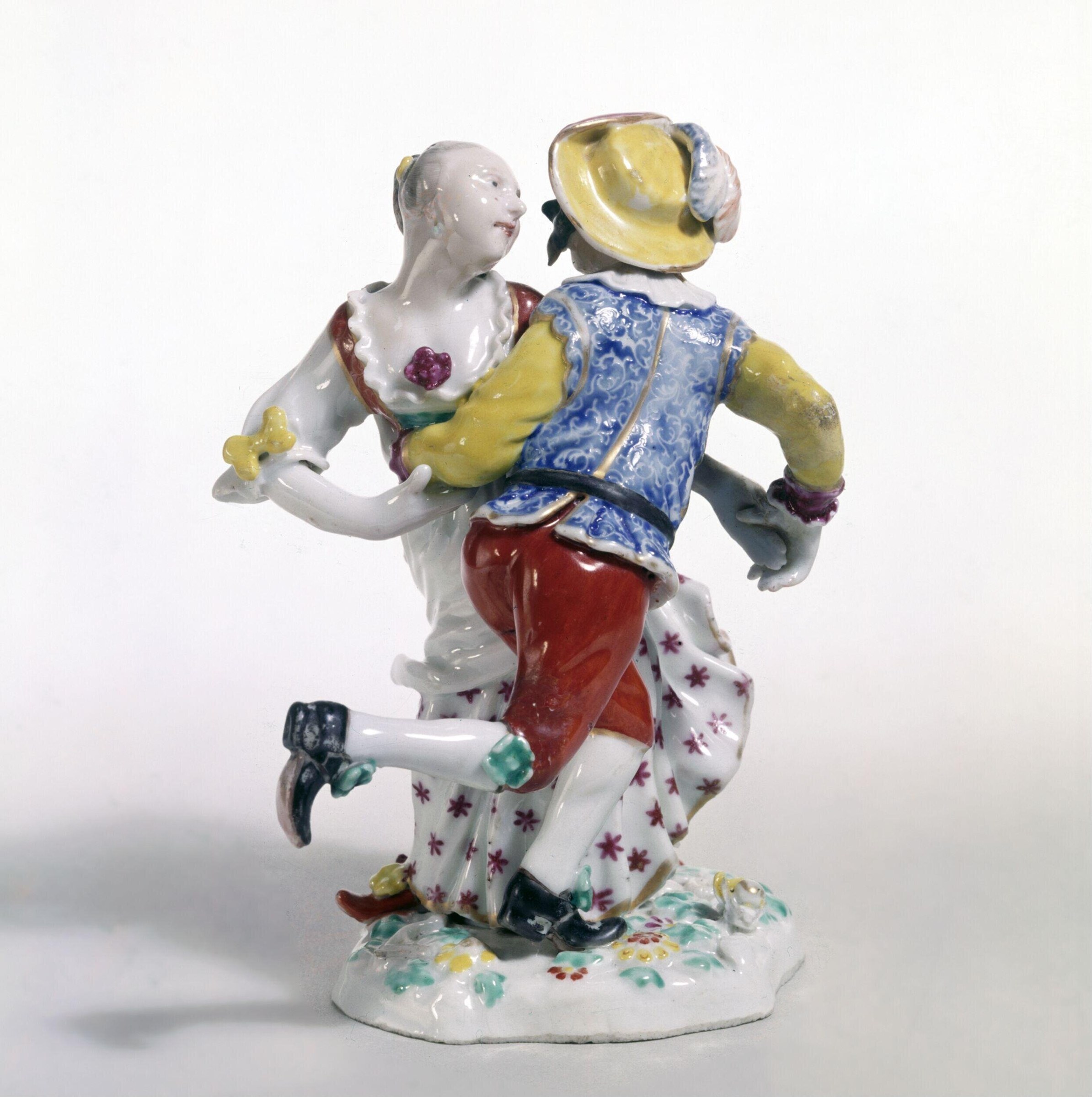
This is a porcelain figural group depicting two dancers in an energetic embrace, likely from the mid-18th century German manufacture. The figure on the right, seen from behind, wears a vibrant yellow coat over red breeches and a yellow hat with a black bow, and carries the other dancer aloft. The left figure, a pale female dancer, wears a white bodice with red detail at the chest and a white skirt with small purple flower sprigs, her blonde hair styled up. Both figures are captured mid-movement in an exuberant pose suggesting rapid rotation or a lifting movement. The base is white porcelain with scattered small painted flowers and foliage in green, red, and yellow. The modeling is precise and delicate, with fine attention to the textures of fabric and the musculature of the dancing bodies.
The dancing
The male dancer carries his partner in a high, dynamic lift with her body extended horizontally across his body and arms. Her left arm reaches toward his shoulder, her head thrown back in pleasure or abandon. His stance is wide and braced, his body angled to counterbalance her weight. Both figures are rendered with naturalistic anatomical detail: their limbs are slender but articulated, their postures show the strain and vigor of the movement. This is a moment of maximum exertion and intimacy, frozen at the apex of the lift.
The dance depicted
This depicts a ballroom or court dance, most likely a Minuet or similar galant-era partner dance, though the energy and lifting motion suggest moments from livelier forms like a Gavotte or Cotillion. The lift itself—a sustained elevation of the female partner—was not a standard feature of formal 18th-century court dance, so this may represent either a moment of theatrical exaggeration for dramatic effect, or a dance from a popular or lower-class context where such lifts were permissible. The dress and setting place it firmly in the European aristocratic milieu of the 1740s–1760s.
How it was made
This is a hard-paste porcelain figure group, likely from a German factory such as Meissen (the pre-eminent maker of such pieces) or one of its competitors. The technique involved modeling separate limbs and bodies in clay, allowing for complex dynamic poses, then assembling them with slip (liquid clay) before the first firing. The fine detailing—facial features, textile patterns, color gradations in the garments—would have been applied by hand after glazing. Such pieces were expensive luxury objects for aristocratic collections and required skilled sculptors and painters. The fragility of the medium and the complexity of the composition made each piece a technical achievement.
About this work
This porcelain figure group is a rare sculptural record of how elite 18th-century dancers moved in their private entertainments and ballrooms. Created during the height of the Rococo period when German porcelain factories competed fiercely for aristocratic patronage, it captures a moment of physical exuberance that formal dance manuals do not quite document. The work sits between high art sculpture and decorative functional porcelain—a showpiece designed to be displayed on a mantelpiece or in a cabinet, yet one that communicates real knowledge of how bodies move together. It belongs in a history of dance because it is one of very few three-dimensional records of dancing bodies from this era, and because its dynamic poses reveal what artists understood about the physicality of galant dancing.
How to look at it
Notice how the sculptor has solved the problem of making a standing figure support a suspended one without visible internal armature—this required precise calculation of weight distribution and a deep understanding of anatomy. The female dancer's body is not passive; her left arm is active and gripping, her torso has weight and musculature. The male dancer's wide stance and tense posture show the real effort of the lift. The artist chose the moment of maximum drama and exertion, not a moment of rest. Look also at the faces: both are animated, showing pleasure or concentration, not the serene formality of much contemporary portraiture. This tells us that even in elite circles, dance was understood as a physical, even passionate activity.
The artist
Johann Friedrich Eberlein was a master modeler at the Meissen porcelain factory in Saxony, one of the most prestigious sculptors of the mid-18th century. He specialized in figural groups—elaborate compositions of multiple human and animal figures—that showcased both the technical capabilities of hard-paste porcelain and the artistic ambitions of the factory. Eberlein's work defined the Rococo style in porcelain: his figures are graceful, dynamic, often engaged in narrative moments drawn from mythology, theater, or contemporary social life. He worked at Meissen from the 1730s until the 1750s and trained many other sculptors.
The period
In the 1750s, porcelain had become the supreme luxury material of European courts, and Meissen dominated the market. This was also the height of the galant style in dance—a period when the formal minuet ruled aristocratic ballrooms, but when theatrical dance and popular entertainment were becoming more athletic and ostentatious. The figure group tradition itself was borrowing from court spectacle and the theater; these pieces were designed to remind their owners of the entertainment and luxury they could afford. Rococo taste prized movement, playfulness, and erotic suggestiveness, all evident here in the intimacy of the pose and the energy of the lift.
Where it lives
The work is held in a collection identified in the catalogue record as "Figure," suggesting it may be part of a larger decorative arts collection or museum of applied arts. The source is marked "va," which may indicate a regional or institutional archive. Further information about the holding institution and accession history would clarify the object's provenance.
Dance in this work
Questions about this work
Was this kind of lift actually done in 18th-century court dance?
Formal ballroom dances like the Minuet did not include lifts. However, theatrical dances, country dances, and popular entertainments often did. The porcelain maker may have been depicting a moment from a theatrical dance or carnival celebration, or exaggerating for dramatic effect. Either way, the piece shows that contemporary observers associated dancing with physical vigor and intimate contact between partners.
Why was porcelain so valuable in this period?
Hard-paste porcelain was extraordinarily difficult to manufacture; the formula had been guarded as a Chinese and Japanese secret for centuries. Meissen's discovery of the secret in the early 1700s made the factory immensely wealthy and gave European aristocrats access to a material previously available only through trade. A large figural group like this required months of skilled labor and represented a significant portion of a nobleman's art budget.
How do we know this is by Eberlein?
The catalogue record attributes it to him. This may be based on a signature, a mark, documentary evidence, or scholarly attribution based on style. Meissen pieces were sometimes marked with the factory's crossed-swords symbol but not always signed by the modeler, so attribution histories vary.
More dance artwork





