49 works in this view — arrow keys or swipe to move between them.
Dance in Art
Spanish Dancer No.2
Knight, Laura
- Collection:
- Source:
- Victoria and Albert Museum
- Rights:
- Rights vary by item — check the source record before reusing this image. Source record ↗
- Recorded as:
- V&A — check rights per item
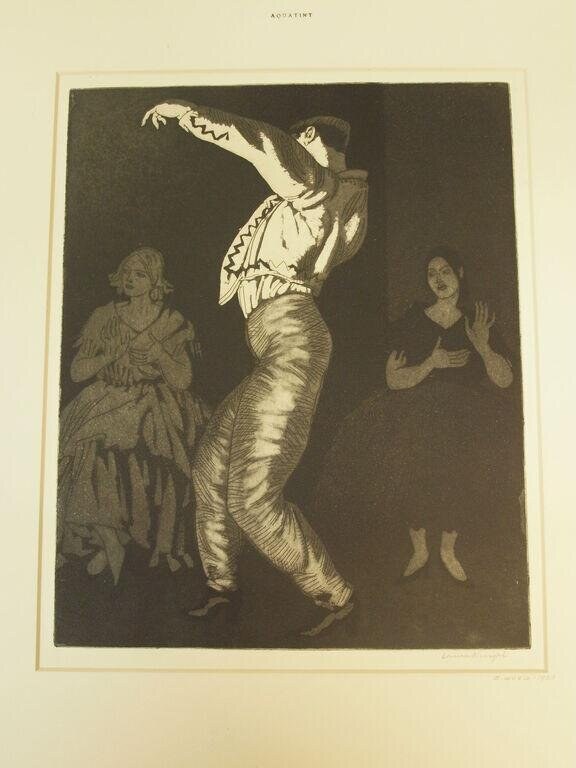
Laura Knight was one of the very few major painters of the early 20th century to centre dance as a serious artistic subject; this print documents her engagement with flamenco at a moment when Spanish culture was gaining international fascination in Europe. The image records how Spanish dance was understood and aestheticized by British artists of the period—as explosive, exuberant, and fundamentally about the individual body's emotional expression.
What you are looking at
A woman in a white blouse and wrapped striped skirt executes an exuberant leap with one arm raised overhead and the other extended outward, her body arched dynamically mid-movement. Two figures flank her—one on the left in a long dress facing inward, one on the right in dark clothing with raised hands, both appearing to respond to or accompany the central dancer. The background is rendered in deep shadow with minimal detail, focusing all attention on the leaping figure and her explosive energy. The composition captures a moment of intense, elevated movement, with the dancer's wrapped lower body and the sharp contrast of her white blouse and arms creating strong visual rhythm.
The dancing
The central dancer launches into the air with a pronounced backward arch, her torso extended and weight committed to the jump. Her raised arm reaches above her head while the other extends to the side at shoulder height, creating an expansive, open frame. The two flanking figures are much less animated: the left figure stands more passively in profile, while the right figure has both hands raised in a gesture that might signal encouragement, amazement, or participation. The central dancer's isolation in mid-air and heightened physicality contrasts sharply with the grounded, supporting postures of the other two.
The dance depicted
This work most likely depicts Spanish flamenco or a stylized theatrical interpretation of Spanish dance, suggested by the wrapped skirt construction, the setting with accompanying figures, and the explosive, emotive quality of the leap. The wrapped or wound skirt visible on the central dancer is characteristic of flamenco costume. The spontaneous, joyful energy and the arch-backed, expansive arm positions are consistent with flamenco's characteristic expressiveness, though the rendering is somewhat stylized. The work captures the theatrical elevation and drama rather than a strictly codified movement vocabulary, placing it closer to theatrical flamenco or interpretive Spanish dance than to folkloric or competitive forms.
How it was made
This is a relief print—likely a woodcut or linocut—executed in bold contrasts of black and cream. The artist has used strong areas of shadow to eliminate all background detail, creating a stark spotlight effect that emphasizes the dancer's movement and costume. The technique's reliance on simple light and dark masses gives the work graphic power and makes it highly suitable for reproduction and circulation as a print. The decorative title 'AQUALINT' (or 'A.QUALINT') appears at top, suggesting this may be an artist's proof or signed edition. The print medium allowed this image to reach a broad audience and was commonly used for theatrical and dance imagery in the early 20th century.
About this work
Spanish Dancer No. 2 is a striking early 20th-century relief print capturing a moment of explosive Spanish dance movement. Laura Knight was one of the most accomplished painters of dance of her era, and this print demonstrates her ability to freeze dynamic motion in a single expressive gesture—the arched leap of a woman in traditional Spanish dress, flanked by two accompanying figures. The work is one of at least two known prints on this subject from Knight's hand, suggesting she found in Spanish flamenco a subject worthy of sustained artistic attention. The stark graphic style and compositional focus on the central figure's athleticism and emotional intensity exemplify how modernist printmaking could capture dance's essential energy without literal documentation.
How to look at it
Look first at the frozen moment of the leap and what it tells you about the dancer's physical commitment—the backward arch and extended arms signal abandon and joy rather than control. Note how Knight has positioned the flanking figures not as active participants but as witnesses or accompanists, drawing the eye back to the central figure. The stark black background is not realism but a deliberate graphic choice that isolates the white-clad torso and the wrapped skirt, making the costume and the body equally legible. The print's lack of naturalistic shading or atmosphere asks you to read the movement through silhouette and the rhythm of light and dark shapes rather than through modeling or perspective.
The artist
Laura Knight (1877–1970) was a British painter celebrated for her energetic depictions of performance, particularly dance, theatre, and circus. She was a founding member of the Newlyn School and later a Royal Academician—rare honours for a woman of her generation. Knight worked extensively from live observation, attending performances and making rapid studies, and she brought to painting a sense of movement and spontaneity that departed from academic convention. Her dance subjects ranged from Russian ballet to music-hall performance to Spanish flamenco; she was drawn to the physicality and the cultural encounter that dance represented. She also worked in printmaking, where her bold line and confident use of light and shadow are evident.
The period
The 1920s saw a flourishing of interest in Spanish and Mediterranean culture among European modernists, partly catalysed by the success of the Ballets Russes and by growing tourism. Spanish flamenco in particular was becoming fashionable in elite European circles as both folk tradition and exotic spectacle. At the same time, printmaking (particularly woodcut and linocut) was experiencing a renaissance among modernist and socially engaged artists, associated with German Expressionism and with the Arts and Crafts legacy. Knight's work sits at the intersection of these currents: a print-based engagement with living performance, rendered in a style that is both graphically modern and deeply observational.
Where it lives
This work is held as a print in an institutional collection designated 'va' (likely the Victoria and Albert Museum, London, a major repository of British theatrical prints and design). It is a print edition rather than a unique work, part of how Knight's dance subjects reached audiences beyond the painting market.
Dance in this work
Questions about this work
Who are the two figures flanking the dancer?
The artist does not identify them. They may represent musicians, other dancers, or audience members; their role is to anchor the central leap and suggest the social or theatrical context of the dance. Their relative passivity emphasizes the soloist's command of the moment.
How do you know this is Spanish dance and not something else?
The wrapped or wound skirt is a strong indicator of Spanish or flamenco costume. The arch-backed, expansive arm gesture is characteristic of flamenco expression. The title 'Spanish Dancer' in the catalogue record confirms this reading. However, the rendering is stylized rather than documentary, so this should be read as a theatrical or artistic interpretation rather than a strict ethnographic record.
Why is the background completely black?
In relief printing (woodcut or linocut), the artist removes material to create white areas against a dark ground. Knight has used this limitation as a strength, creating a stark spotlight effect that isolates the dancer and eliminates all competing visual information. This focuses the viewer's entire attention on the movement and the costume.
Is this the only print Laura Knight made of Spanish dancers?
No; the title 'No. 2' indicates there is at least one other. Knight clearly returned to this subject, suggesting a sustained interest in Spanish dance as a vehicle for exploring performance and physicality.
More dance artwork





