49 works in this view — arrow keys or swipe to move between them.
Dance in Art
Indian Dancers
Passano, Roy
- Collection:
- Furnishing fabric
- Source:
- Victoria and Albert Museum
- Rights:
- Rights vary by item — check the source record before reusing this image. Source record ↗
- Recorded as:
- V&A — check rights per item
This fabric shows how dance imagery—specifically South Asian classical dance—was absorbed into Western design culture in the mid-20th century, often drained of cultural context and reduced to exotic surface decoration. For historians of textile design and for those tracking the visual representation of Indian dance in the West, it is evidence of a particular moment and practice.
What you are looking at
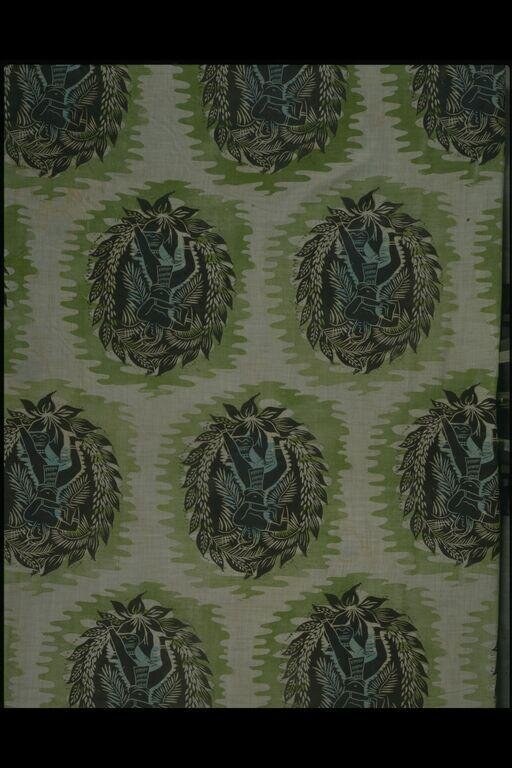
This is a furnishing fabric with a repeating pattern of stylized oval medallions arranged in a grid. Each medallion frames a dense, intricately detailed composition of exotic foliage and intertwined figures in motion. Within the dark ovals, which are rendered in black and deep teal, dancers and ornamental vegetation create a complex visual texture. The ovals are separated by a lighter ground in pale gray-green, with vertical striping that provides rhythm to the composition. The repeating unit suggests a fabric intended for upholstery or drapery, with the pattern scaled to allow visibility of the narrative scenes within each medal while maintaining overall decorative coherence. The artist has rendered the dancers and foliage at a small scale, requiring close viewing to discern the actual movement and gesture.
The dancing
The dancers are small and densely composed within each oval, making precise gestural analysis difficult at standard viewing distance. What is visible suggests multiple figures intertwined with flowering vines and leafy forms. The composition is tightly packed rather than linear, suggesting movement that is curvilinear and decorative rather than balletic or formal. The bodies appear to be rendered in profile and three-quarter view, overlapping with the botanical elements in a way that prioritizes pattern and surface rhythm over anatomical clarity.
The dance depicted
The title 'Indian Dancers' indicates the subject is South Asian dance, most likely Kathak, Bharatanatyam, or another classical Indian form given the mid-20th-century date and Western decorative arts context. However, the scale and density of the pattern, and the integration of dancers with ornamental vegetation, makes it impossible to identify specific mudras, postures, or style markers from the fabric alone. The work appears to be a Western designer's interpretation of 'Indian' dance as an exotic decorative motif rather than a documentary representation. The format—repeated framed scenes—suggests influence from textile design traditions that exoticized non-Western performance.
How it was made
This is a printed furnishing fabric, likely produced by engraving, lithography, or screen-printing based on the crisp pattern registration and the date (1947). The technique creates a repeating pattern suitable for mass production, implying circulation as a commercial domestic textile. The medium allowed the designer to compress narrative detail into a repeating unit and to combine representation with ornamental structure in ways that would not be feasible in a single artwork. The dense patterning and small scale of the figures suggest the artist prioritized decorative surface effect over readable narrative.
About this work
This is a mid-20th-century furnishing fabric by Roy Passano featuring a repeating pattern of framed scenes of Indian dancers interwoven with tropical foliage. The work sits at the intersection of fine art, textile design, and the Western appetite for exoticized representations of non-Western performance. As a commercial textile, it would have brought images of Indian dance into middle-class domestic interiors across North America and Europe, though in a heavily stylized and ornamentalized form that flattened cultural specificity into decorative pattern. The fabric is a document of postwar design practice and of how dance imagery circulated as commodity and ornament rather than as representation of living practice.
How to look at it
Approach this as a pattern rather than a narrative illustration. Notice how Passano has subordinated the dancers to the overall repeating structure and integrated them visually with the botanical forms. The ovals act as frames that both contain and compress the action. At close range, try to trace individual figures within the density; the interweaving of bodies and leaves is intentional and reflects a design priority of visual complexity and surface richness over clarity of movement or gesture.
The artist
Roy Passano was a textile and furnishing designer active in mid-20th-century North America. Limited biographical information is readily available, but the work is consistent with a broader cohort of American and Canadian designers who drew on global sources—often superficially—for pattern and ornament. His practice reflects the commercial design world's embrace of cultural exoticism as marketable aesthetic.
The period
In 1947, as India moved toward independence and Western interest in 'exotic' non-Western cultures peaked, Indian dance and aesthetics became fashionable design sources in Europe and North America. This was simultaneously a moment of high modernism and a moment of mass production and consumer culture. Textiles were a primary vehicle for bringing avant-garde and 'ethnic' visual language into domestic space. Passano's fabric belongs to this context: a commercial product that packaged Indian dance as ornamental luxury for Western homes.
Where it lives
This fabric is held in the Victoria & Albert Museum collection (source: va) as a furnishing fabric, indicating it was acquired as a significant example of mid-20th-century commercial textile design.
Dance in this work
Questions about this work
Can you identify the specific Indian dance form shown?
Not with certainty from this pattern. The scale, density, and integration with ornamental foliage make it impossible to read specific poses or mudras. The title indicates South Asian dance generally, but the work is a Western designer's interpretation rendered as decorative motif rather than a representation grounded in specific dance vocabulary.
Was this fabric actually produced and sold?
It appears to be a documented design held by a major museum, suggesting it was part of a commercial or semi-commercial production. Repeating patterns of this kind were typically produced as furnishing fabrics for upholstery, curtains, or wall coverings.
Why were Indian dancers popular in Western design in the 1940s?
The 1940s saw growing Western fascination with non-Western cultures, fueled by travel, colonialism's aftermath, and modernism's hunger for 'primitive' or 'exotic' formal languages. Indian classical dance, with its visual richness and unfamiliar aesthetic, was particularly appealing to designers seeking ornamental and decorative inspiration.
More dance artwork





